
Advanced Palladium-Catalyzed Synthesis of Aryl Acetamides for Commercial Scale-Up
The pharmaceutical and fine chemical industries continuously seek robust methodologies for constructing amide bonds, a ubiquitous motif in bioactive molecules and functional materials. Patent CN111978194B discloses a groundbreaking preparation method for aryl acetamide compounds that addresses long-standing challenges in transition metal-catalyzed carbonylation. This technology leverages a sophisticated palladium-catalyzed system where benzyl formate functions dually as a carbon monoxide source and a reactant, paired with tertiary amines as the nitrogen source. By operating under relatively mild thermal conditions without the necessity for explosive gas mixtures or harsh oxidants, this invention represents a significant leap forward in synthetic efficiency. For R&D directors and process chemists, this approach offers a streamlined pathway to complex scaffolds, ensuring high purity and structural integrity essential for downstream drug development applications.
The Limitations of Conventional Methods vs. The Novel Approach
The Limitations of Conventional Methods
Traditionally, the synthesis of aryl acetamides has relied heavily on the direct amidation of phenylacetic acid derivatives or classical carbonylation reactions involving primary and secondary amines. These conventional routes often suffer from severe limitations, particularly when attempting to utilize tertiary amines as substrates. The activation of the C-N bond in tertiary amines is notoriously difficult and typically requires aggressive reaction conditions, including the use of excessive oxidants or dangerous mixtures of carbon monoxide and oxygen which pose significant safety hazards in a manufacturing environment. Furthermore, traditional methods frequently exhibit poor functional group tolerance, leading to side reactions that complicate purification and reduce overall yield. The reliance on high-pressure equipment for gaseous CO also introduces substantial capital expenditure and operational complexity, making scale-up economically challenging for many fine chemical manufacturers seeking cost-effective solutions.
The Novel Approach
In stark contrast, the methodology outlined in CN111978194B utilizes a clever design where benzyl formate acts as a liquid, easy-to-handle surrogate for carbon monoxide. This eliminates the safety risks associated with high-pressure gas cylinders and allows for precise stoichiometric control within a standard sealed tube reactor. The reaction employs a palladium catalyst system, specifically palladium acetate paired with the bidentate ligand DPEphos, which facilitates the efficient cleavage of the tertiary amine C-N bond without requiring additional oxidants. This oxidative-neutral pathway not only simplifies the reaction mixture but also drastically reduces the generation of toxic byproducts. The process operates effectively in polar aprotic solvents like acetonitrile at 130°C, providing a practical balance between reaction rate and energy consumption that is highly attractive for industrial adoption.
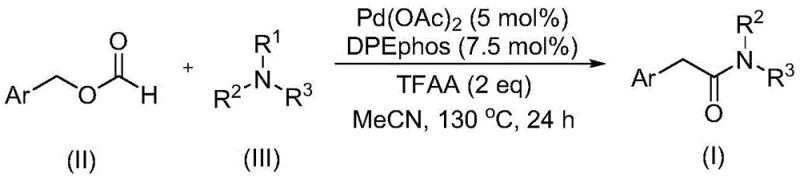
The mechanistic elegance of this transformation lies in the synergistic interaction between the palladium center and the specialized ligand environment. The use of DPEphos (bis(2-diphenylphosphinophenyl) ether) is critical, as its wide bite angle stabilizes the active palladium species and promotes the reductive elimination step necessary for amide bond formation. Trifluoroacetic anhydride (TFAA) plays a pivotal role as an activator, likely facilitating the formation of a reactive acyl-palladium intermediate from the benzyl formate. This activation allows for the subsequent insertion of the amine component and the cleavage of the C-N bond in the tertiary amine. Crucially, the system avoids the need for external oxidants, which are often sources of impurity and safety concerns in large-scale synthesis. The result is a clean catalytic cycle that tolerates a diverse array of electronic environments on the aryl ring, from electron-donating methoxy groups to electron-withdrawing trifluoromethyl and cyano substituents.
Impurity control is inherently superior in this protocol due to the specificity of the catalytic cycle and the absence of radical-generating oxidants. In conventional oxidative carbonylations, over-oxidation of sensitive functional groups is a common failure mode that leads to complex impurity profiles difficult to separate. Here, the mild conditions preserve delicate moieties such as halogens and heterocycles, as evidenced by the successful synthesis of furan and thiophene derivatives. The post-treatment process is equally streamlined, involving simple filtration followed by silica gel chromatography, which is a standard and scalable unit operation in pharmaceutical manufacturing. This ensures that the final aryl acetamide products meet stringent purity specifications required for regulatory compliance in API intermediate production.
How to Synthesize Aryl Acetamide Efficiently
To implement this synthesis effectively, one must adhere to the optimized parameters defined in the patent to maximize yield and reproducibility. The process involves charging a reactor with precise molar ratios of palladium acetate, DPEphos ligand, benzyl formate, the chosen tertiary amine, and trifluoroacetic anhydride in acetonitrile. The detailed standardized synthesis steps for this high-efficiency route are provided in the guide below.
- Combine palladium acetate catalyst, DPEphos ligand, benzyl formate, tertiary amine, and trifluoroacetic anhydride in an organic solvent such as acetonitrile.
- Heat the reaction mixture to 130°C and maintain stirring for approximately 24 hours to ensure complete conversion.
- Upon completion, filter the mixture, mix with silica gel, and purify via column chromatography to isolate the target aryl acetamide compound.
Commercial Advantages for Procurement and Supply Chain Teams
For procurement managers and supply chain heads, the economic implications of this technology are profound. By replacing hazardous gaseous carbon monoxide with stable, liquid benzyl formate, the process eliminates the need for specialized high-pressure reactors and the associated safety infrastructure. This translates directly into reduced capital expenditure and lower operational overheads for manufacturing facilities. Furthermore, the starting materials, including benzyl formate and common tertiary amines like triethylamine, are commodity chemicals available from multiple global suppliers, ensuring a resilient supply chain that is not dependent on single-source specialty reagents. The ability to run the reaction in standard glass-lined or stainless steel reactors at atmospheric pressure significantly enhances the ease of technology transfer from lab to plant.
- Cost Reduction in Manufacturing: The elimination of high-pressure equipment and hazardous gas handling systems results in substantial cost savings regarding both equipment maintenance and safety compliance protocols. Additionally, the use of inexpensive benzyl formate as a dual-purpose reagent reduces the overall raw material cost per kilogram of product compared to traditional carbonylation methods that require expensive ligands or high-pressure CO infrastructure. The high conversion rates observed, often exceeding 80% yield across various substrates, minimize waste disposal costs and improve the overall atom economy of the process.
- Enhanced Supply Chain Reliability: Since the key reagents are widely available bulk chemicals, the risk of supply disruption is significantly mitigated. Unlike processes relying on proprietary or unstable intermediates, this method utilizes robust starting materials that can be sourced globally with short lead times. The simplified reaction setup also means that production can be easily scaled or shifted between different manufacturing sites without requiring extensive requalification of specialized equipment, thereby ensuring continuous supply continuity for downstream customers.
- Scalability and Environmental Compliance: The absence of external oxidants and the use of a closed-loop system for the solvent and reagents align perfectly with modern green chemistry principles. This reduces the burden on waste treatment facilities and lowers the environmental footprint of the manufacturing process. The straightforward workup procedure involving filtration and chromatography is easily adaptable to large-scale continuous processing or batch operations, facilitating the commercial scale-up of complex pharmaceutical intermediates without encountering the bottlenecks typical of more exotic synthetic methodologies.
Frequently Asked Questions (FAQ)
The following questions address common technical inquiries regarding the implementation and scope of this patented synthesis method. These insights are derived directly from the experimental data and claims within the patent documentation to assist technical teams in evaluating feasibility.
Q: What is the primary advantage of using benzyl formate in this synthesis?
A: Benzyl formate serves as a safe and effective carbon monoxide surrogate, eliminating the need for handling hazardous high-pressure CO gas while simultaneously acting as a reactant in the carbonylation process.
Q: Does this method require additional oxidants for tertiary amine activation?
A: No, a key innovation of this patent is that the cleavage of the C-N bond in tertiary amines occurs without the need for additional external oxidants, simplifying the reaction system and reducing waste.
Q: What types of substrates are compatible with this catalytic system?
A: The system demonstrates broad functional group tolerance, successfully accommodating aryl groups substituted with alkyl, alkoxy, trifluoromethyl, cyano, and halogen groups, as well as heterocycles like furan and thiophene.
Partnering with NINGBO INNO PHARMCHEM: Your Reliable Aryl Acetamide Supplier
At NINGBO INNO PHARMCHEM, we recognize the transformative potential of this palladium-catalyzed carbonylation technology for the production of high-value pharmaceutical intermediates. As a dedicated CDMO partner, we possess extensive experience scaling diverse pathways from 100 kgs to 100 MT/annual commercial production, ensuring that your project transitions smoothly from gram-scale optimization to full industrial output. Our rigorous QC labs and commitment to stringent purity specifications guarantee that every batch of aryl acetamide delivered meets the exacting standards required for global regulatory submissions.
We invite you to collaborate with our technical procurement team to explore how this innovative synthesis route can optimize your supply chain. Contact us today to request a Customized Cost-Saving Analysis tailored to your specific volume requirements. Our experts are ready to provide specific COA data and comprehensive route feasibility assessments to demonstrate how we can become your trusted partner in delivering high-purity aryl acetamides efficiently and reliably.