
Advanced Heterogeneous Oxidation Strategy for Commercial Prothioconazole Production
Advanced Heterogeneous Oxidation Strategy for Commercial Prothioconazole Production
The global demand for high-efficacy fungicides continues to drive innovation in agrochemical intermediate synthesis, with Prothioconazole standing out as a critical active ingredient for cereal disease control. Patent CN108689952B introduces a transformative preparation method that addresses long-standing inefficiencies in the oxidation of triazolidine precursors. This technology leverages a heterogeneous oxidation system utilizing ferric chloride in aromatic hydrocarbon solvents, fundamentally altering the downstream processing landscape. By shifting away from traditional homogeneous mixtures, this approach enables the direct isolation of the target molecule through simple filtration, bypassing energy-intensive distillation and extraction protocols. For technical directors and supply chain managers, this represents a pivotal shift towards greener, more cost-effective manufacturing paradigms that align with modern sustainability goals while maintaining rigorous purity standards above 98.0%.
The Limitations of Conventional Methods vs. The Novel Approach
The Limitations of Conventional Methods
Historically, the synthesis of Prothioconazole has relied heavily on methods described in prior art such as CN1411450A, which typically employ mixed solvent systems comprising alcohols, esters, and water. These conventional routes suffer from significant operational drawbacks, primarily due to the formation of stable emulsions and the necessity for complex phase separations post-reaction. The use of ethyl acetate or ethanol often leads to solvent decomposition under the strong acidic conditions generated by ferric chloride, introducing difficult-to-remove impurities that compromise the final quality of the agrochemical intermediate. Furthermore, these homogeneous systems generate vast quantities of aqueous waste containing ferrous chloride, necessitating expensive neutralization and disposal procedures that inflate the overall production cost and environmental footprint. The inability to easily recover and reuse solvents in these mixed systems further exacerbates the economic inefficiency, making large-scale production less viable.

The Novel Approach
In stark contrast, the methodology disclosed in CN108689952B utilizes a singular aromatic hydrocarbon solvent, such as toluene or xylene, to create a controlled heterogeneous reaction environment. This strategic solvent selection ensures that the starting material reacts efficiently at the interface without requiring complete dissolution, while the resulting Prothioconazole product precipitates out of the solution as a high-purity solid. This physical behavior allows manufacturers to bypass traditional liquid-liquid extraction and solvent stripping steps entirely, as the product can be harvested directly via filtration and drying. The reduction in solvent volume to merely 1-6 times the mass of the raw material significantly enhances equipment utilization rates and reduces the thermal load required for solvent recovery. Consequently, this novel approach not only streamlines the workflow but also drastically minimizes the generation of hazardous waste, offering a robust solution for cost reduction in fungicide manufacturing.
Mechanistic Insights into FeCl3-Catalyzed Heterogeneous Oxidation
The core chemical transformation involves the oxidative dehydrogenation of the 4,5-dihydro-1,2,4-triazole-5-thione ring to the corresponding triazole-5-thione structure, mediated by ferric chloride. In this specific aromatic solvent system, the reaction kinetics are governed by the interfacial area between the solid or partially dissolved substrate and the oxidant species. The aromatic solvent plays a dual role: it acts as a medium that stabilizes the transition state while simultaneously limiting the solubility of the oxidized product, driving the equilibrium forward through precipitation. This phenomenon, known as reactive crystallization, effectively suppresses the formation of over-oxidized byproducts or polymeric impurities that often plague homogeneous oxidations. The precise control of temperature between 10-50°C further optimizes the selectivity, ensuring that the sensitive cyclopropyl and chlorophenyl moieties remain intact throughout the process.
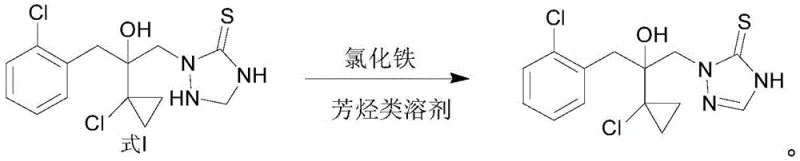
Impurity control in this system is inherently managed by the phase behavior of the reaction components. Since the product precipitates immediately upon formation, it is physically removed from the reactive aqueous-organic interface, preventing further degradation or side reactions. The aqueous phase, containing the reduced ferrous species, remains separated from the organic product cake, facilitating a clean isolation. Additionally, the patent highlights that the organic phase can be recycled directly into subsequent batches with minimal makeup of fresh solvent, demonstrating exceptional process stability. This mechanism ensures that the high-purity prothioconazole obtained meets stringent specifications without the need for recrystallization, thereby preserving yield and reducing cycle time. The ability to regenerate the ferric chloride oxidant from the aqueous waste stream using common oxidants like hydrogen peroxide closes the material loop, enhancing the overall atom economy of the synthesis.
How to Synthesize Prothioconazole Efficiently
The implementation of this heterogeneous oxidation protocol requires careful attention to solvent ratios and phase management to maximize the benefits of the reactive precipitation effect. The process is designed to be scalable, moving seamlessly from laboratory verification to industrial reactor operations without significant re-engineering. Operators must ensure that the mixing efficiency is sufficient to maintain the suspension of solids while avoiding excessive shear that might alter particle size distribution. Detailed standard operating procedures regarding the regeneration of the aqueous oxidant stream are critical for maintaining consistent batch-to-batch quality.
- Charge Formula I compound and ferric chloride aqueous solution into an aromatic hydrocarbon solvent such as toluene or xylene to form a heterogeneous mixture.
- Heat the reaction mixture to 30-40°C and maintain stirring for 5-12 hours to allow the oxidation to proceed without requiring complete dissolution of the starting material.
- Cool the reaction to 10-20°C to induce precipitation, then filter and dry the solid directly to obtain prothioconazole with over 98% purity, while regenerating the aqueous phase for reuse.
Commercial Advantages for Procurement and Supply Chain Teams
For procurement specialists and supply chain leaders, the adoption of this patented technology offers tangible strategic advantages beyond mere technical feasibility. The elimination of complex solvent mixtures and the ability to recycle the organic phase directly translate into a simplified logistics framework, reducing the dependency on multiple solvent suppliers and minimizing inventory complexity. The process inherently lowers the consumption of fresh raw materials per kilogram of output, which serves as a powerful lever for cost reduction in agrochemical intermediate manufacturing. Moreover, the simplified workup procedure significantly shortens the production cycle time, allowing facilities to increase throughput without capital expenditure on new equipment. This efficiency gain is crucial for meeting fluctuating market demands and ensuring a steady supply of critical crop protection ingredients.
- Cost Reduction in Manufacturing: The primary economic driver of this technology is the drastic reduction in solvent usage and the elimination of energy-intensive distillation steps. By operating with a solvent-to-feed ratio as low as 1:1 by mass and reusing the organic phase indefinitely, the variable cost associated with solvent purchase and recovery is minimized. Furthermore, the avoidance of ester solvents prevents costly losses due to acid-catalyzed hydrolysis, ensuring that every dollar spent on materials contributes directly to product yield. The regeneration of ferric chloride from the waste stream further offsets the cost of oxidants, creating a circular economy within the production plant that substantially lowers the cost of goods sold.
- Enhanced Supply Chain Reliability: Relying on a single class of aromatic solvents rather than complex blends simplifies the supply chain and reduces the risk of shortages affecting production schedules. The robustness of the heterogeneous system means that minor variations in raw material quality have less impact on the final outcome, ensuring consistent delivery performance to downstream formulators. This reliability is essential for maintaining the trust of global agrochemical partners who require uninterrupted supply chains to support seasonal planting cycles. The ability to scale this process from pilot plants to multi-ton reactors without losing efficiency makes it an ideal candidate for securing long-term supply contracts.
- Scalability and Environmental Compliance: From an environmental perspective, this method significantly reduces the volume of hazardous waste requiring treatment, aligning with increasingly strict global regulations on industrial effluent. The absence of aqueous-organic emulsions simplifies wastewater treatment, lowering the operational costs associated with environmental compliance. The process is inherently safer due to the lower inventory of volatile solvents and the moderate reaction temperatures, reducing the risk profile of the manufacturing site. These factors combined make the commercial scale-up of complex agrochemical intermediates more feasible and sustainable, positioning manufacturers as responsible leaders in the industry.
Frequently Asked Questions (FAQ)
Understanding the technical nuances of this synthesis route is vital for stakeholders evaluating its integration into existing production lines. The following questions address common concerns regarding process safety, purity profiles, and scalability potential. Addressing these points early helps in forming a comprehensive risk assessment and implementation strategy.
Q: How does the heterogeneous system improve purification efficiency?
A: The process utilizes a specific aromatic solvent system where the product precipitates directly upon completion, eliminating the need for complex extraction, washing, and distillation steps required in homogeneous systems.
Q: Can the ferric chloride byproduct be recycled?
A: Yes, the aqueous phase containing ferrous chloride can be acidified and treated with oxidants like hydrogen peroxide to regenerate ferric chloride, allowing for closed-loop reagent usage and reduced waste.
Q: What are the advantages of using single aromatic solvents over mixed solvents?
A: Using single aromatic solvents like toluene simplifies the recovery process significantly compared to mixed alcohol-ester systems, reduces solvent volume requirements, and prevents ester decomposition caused by acidic conditions.
Partnering with NINGBO INNO PHARMCHEM: Your Reliable Prothioconazole Supplier
At NINGBO INNO PHARMCHEM, we recognize the critical importance of adopting advanced synthetic methodologies to maintain competitiveness in the global agrochemical market. Our technical team possesses extensive experience scaling diverse pathways from 100 kgs to 100 MT/annual commercial production, ensuring that innovations like the FeCl3-mediated heterogeneous oxidation are translated into reliable industrial reality. We are committed to delivering stringent purity specifications through our rigorous QC labs, guaranteeing that every batch of Prothioconazole meets the exacting standards required for formulation into final crop protection products. Our infrastructure is designed to handle complex chemistries safely and efficiently, providing a secure foundation for your supply chain.
We invite you to collaborate with us to leverage this cutting-edge technology for your specific business needs. Our technical procurement team is ready to provide a Customized Cost-Saving Analysis that quantifies the potential efficiencies of switching to this novel route. Please contact us to request specific COA data and route feasibility assessments tailored to your volume requirements. By partnering with NINGBO INNO PHARMCHEM, you gain access to not just a product, but a strategic alliance focused on reducing lead time for high-purity fungicides and optimizing your overall manufacturing economics.