
Advanced Metal-Free Synthesis of 3,4,5-Trisubstituted 1,2,4-Triazoles for Pharmaceutical Applications
Advanced Metal-Free Synthesis of 3,4,5-Trisubstituted 1,2,4-Triazoles for Pharmaceutical Applications
The pharmaceutical industry continuously seeks robust and scalable synthetic routes for heterocyclic scaffolds that serve as critical building blocks for active pharmaceutical ingredients (APIs). A significant breakthrough in this domain is detailed in patent CN113105402B, which discloses a highly efficient preparation method for 3,4,5-trisubstituted 1,2,4-triazole compounds. These nitrogen-containing five-membered heterocycles are ubiquitous in medicinal chemistry, forming the core structure of renowned drugs such as Maraviroc, Sitagliptin, and Deferasirox, as illustrated in the structural diversity of bioactive molecules below. The introduction of a trifluoromethyl group into these heterocyclic systems is particularly valuable, as it markedly enhances physicochemical properties including electronegativity, metabolic stability, and lipophilicity, thereby improving the overall bioavailability of the final drug candidate.
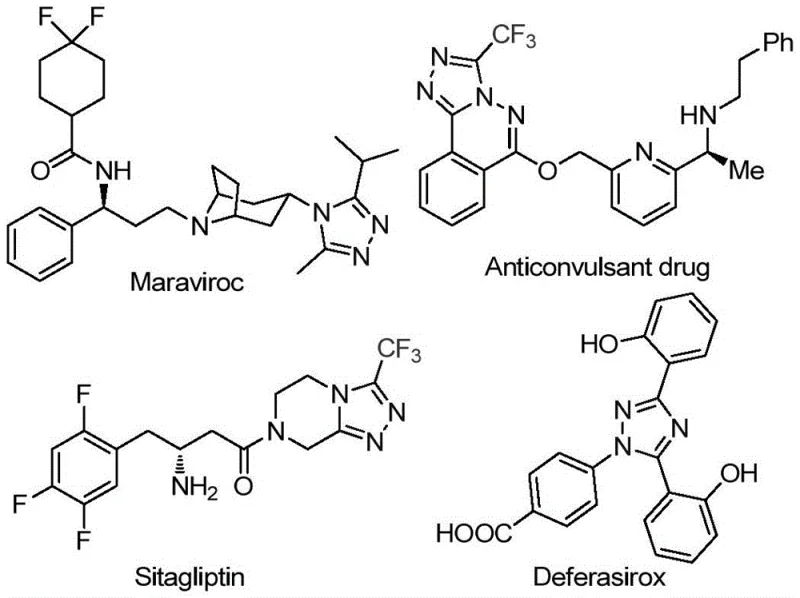
This novel methodology addresses the growing demand for reliable pharmaceutical intermediate suppliers who can deliver high-purity compounds without the environmental and cost burdens associated with traditional heavy metal catalysis. By leveraging a non-metallic iodine-promoted system, the process eliminates the need for complex anhydrous or oxygen-free environments, streamlining the manufacturing workflow. For R&D directors and procurement managers alike, this represents a strategic opportunity to optimize supply chains for complex pharmaceutical intermediates. The ability to access these structurally intricate molecules through a simplified, cost-effective route ensures greater supply continuity and reduces the risk of production bottlenecks often caused by scarce catalytic materials or stringent operational requirements.
The Limitations of Conventional Methods vs. The Novel Approach
The Limitations of Conventional Methods
Historically, the synthesis of polysubstituted 1,2,4-triazoles, particularly those bearing both trifluoromethyl and acyl groups, has been fraught with challenges that hinder industrial scalability. Conventional routes often rely on transition metal catalysts which are not only expensive but also introduce significant complications regarding residual metal removal, a critical quality attribute for API manufacturing. Furthermore, many existing protocols necessitate rigorous anhydrous and anaerobic conditions, requiring specialized equipment and increasing energy consumption. The substrate scope in traditional methods is frequently limited, struggling to tolerate diverse functional groups on the aromatic rings, which restricts the chemical space available for drug discovery teams. These factors collectively contribute to higher production costs, longer lead times, and a larger environmental footprint, making them less attractive for the cost reduction in API manufacturing that modern generic and innovator companies strive to achieve.
The Novel Approach
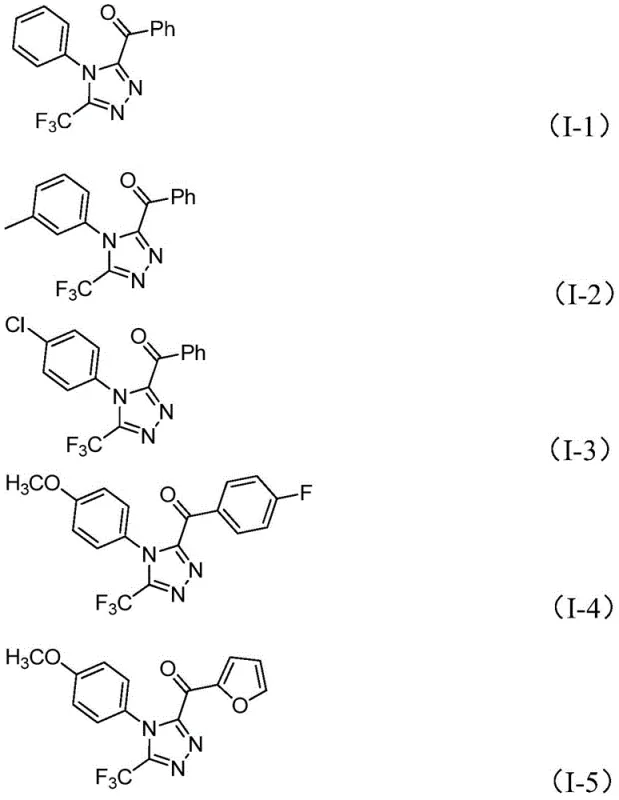
In stark contrast, the method described in patent CN113105402B utilizes a tandem reaction sequence promoted by elemental iodine in dimethyl sulfoxide (DMSO), offering a transformative alternative for producing these valuable heterocycles. This approach capitalizes on the Kornblum oxidation of aryl ethyl ketones to generate aryl diketones in situ, which subsequently undergo condensation and cyclization with trifluoroethylimide hydrazide. The versatility of this method is demonstrated by its broad substrate tolerance, successfully accommodating various substituents such as methyl, methoxy, chloro, and trifluoromethyl groups on both the N-aryl and C-acyl moieties, as seen in the diverse product library below. By avoiding toxic heavy metals and operating under relatively mild conditions without the need for inert atmospheres, this process significantly lowers the barrier to entry for commercial scale-up of complex pharmaceutical intermediates.
Mechanistic Insights into Iodine-Promoted Tandem Cyclization
The mechanistic pathway of this synthesis is a sophisticated yet elegant example of cascade reactivity driven by iodine and DMSO. The reaction initiates with the iodination of the aryl ethyl ketone, followed by a Kornblum oxidation where DMSO acts as the oxidant to convert the methyl ketone into an alpha-dicarbonyl species. This reactive intermediate then condenses with the trifluoroethylimide hydrazide to form a hydrazone intermediate. Under the continued influence of iodine and the basic environment provided by pyridine and sodium dihydrogen phosphate, an intramolecular cyclization occurs. This final step constructs the 1,2,4-triazole ring while simultaneously installing the trifluoromethyl group at the 3-position and the acyl group at the 5-position. The precise control over this sequence ensures high regioselectivity and minimizes the formation of isomeric impurities, a crucial factor for maintaining stringent purity specifications in pharmaceutical production.
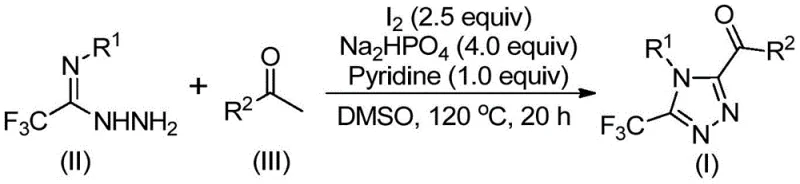
From an impurity control perspective, the use of stoichiometric iodine and phosphate buffers helps regulate the oxidation potential, preventing over-oxidation or degradation of sensitive functional groups on the aromatic rings. The reaction conditions, specifically heating to 110-130°C for 12-20 hours, provide sufficient thermal energy to drive the cyclization to completion while maintaining a profile that favors the desired triazole product over potential side reactions. Understanding this mechanism allows process chemists to fine-tune parameters such as reagent ratios—typically maintaining a molar ratio of hydrazide to ketone to iodine around 1:2:2.5—to maximize yield and minimize waste. This level of mechanistic clarity provides confidence to technical teams that the process is robust and reproducible across different batches and scales.
How to Synthesize 3,4,5-Trisubstituted 1,2,4-Triazoles Efficiently
Implementing this synthesis route requires careful attention to the sequential addition of reagents and temperature control to ensure optimal conversion. The process begins by dissolving the aryl ethyl ketone and a portion of elemental iodine in DMSO, followed by an initial heating phase to generate the oxidative intermediate. Subsequently, the remaining reagents, including the hydrazide source, base, and additional iodine, are introduced to facilitate the ring closure. The detailed standardized synthesis steps, including specific molar equivalents and workup procedures like silica gel filtration and column chromatography, are outlined in the guide below to assist laboratory and pilot plant teams in replicating these results effectively.
- Combine aryl ethyl ketone and elemental iodine in dimethyl sulfoxide (DMSO) and heat to 90-110°C for 4-6 hours to initiate Kornblum oxidation.
- Add additional iodine, sodium dihydrogen phosphate, pyridine, and trifluoroethylimide hydrazide to the reaction mixture.
- Heat the mixture to 110-130°C for 12-20 hours to complete the cyclization, then filter and purify via column chromatography.
Commercial Advantages for Procurement and Supply Chain Teams
For procurement managers and supply chain heads, the adoption of this iodine-promoted synthesis offers tangible benefits that extend beyond mere chemical efficiency. The primary advantage lies in the drastic simplification of the raw material portfolio; aryl ethyl ketones and elemental iodine are commodity chemicals available globally at low cost, unlike specialized organometallic catalysts that may suffer from supply volatility. This shift to abundant feedstocks directly translates to enhanced supply chain reliability, reducing the risk of production delays caused by material shortages. Furthermore, the elimination of heavy metals simplifies the downstream purification process, removing the need for expensive scavenging resins or complex extraction protocols designed to meet strict residual metal limits. This streamlined workflow not only accelerates the manufacturing timeline but also substantially reduces the operational expenditure associated with quality control and waste disposal.
- Cost Reduction in Manufacturing: The economic impact of replacing precious metal catalysts with elemental iodine cannot be overstated. Iodine is significantly cheaper than palladium, copper, or rhodium complexes, and its usage here does not require ligand systems that further inflate costs. Additionally, the reaction tolerates technical grade solvents and does not demand high-purity anhydrous conditions, lowering the utility costs for solvent drying and nitrogen blanketing. The high atom economy of the tandem reaction means less raw material is wasted in side products, leading to a more efficient use of resources. Consequently, the overall cost of goods sold (COGS) for these triazole intermediates is significantly reduced, providing a competitive edge in pricing for final API contracts.
- Enhanced Supply Chain Reliability: Supply security is paramount in the pharmaceutical industry, and this method bolsters resilience by relying on a decentralized supply base for its key inputs. Since aryl ketones and iodine are produced by numerous chemical manufacturers worldwide, reliance on a single vendor is minimized. The robustness of the reaction conditions also means that the process can be transferred between different manufacturing sites with minimal re-validation effort, ensuring business continuity even if one facility faces disruptions. This flexibility allows for a more agile supply chain strategy, capable of responding quickly to fluctuations in market demand for trifluoromethyl-containing drugs without compromising on delivery schedules or product quality.
- Scalability and Environmental Compliance: Scaling chemical processes often introduces new safety and environmental challenges, but this protocol is inherently designed for expansion. The absence of pyrophoric reagents or high-pressure hydrogenation steps reduces the safety risks associated with large-scale operations. From an environmental standpoint, the avoidance of toxic heavy metals aligns with green chemistry principles and simplifies regulatory compliance regarding effluent discharge. The waste stream primarily consists of organic byproducts and iodine salts, which are easier to treat and dispose of compared to heavy metal sludge. This environmental compatibility facilitates smoother permitting processes for new production lines and supports corporate sustainability goals by reducing the ecological footprint of pharmaceutical manufacturing.
Frequently Asked Questions (FAQ)
The following questions address common technical and commercial inquiries regarding the implementation of this triazole synthesis technology. These insights are derived directly from the experimental data and beneficial effects reported in the patent documentation, providing a clear understanding of the method's capabilities and limitations. By clarifying these points, we aim to assist decision-makers in evaluating the feasibility of integrating this route into their existing manufacturing portfolios for high-purity pharmaceutical intermediates.
Q: Does this synthesis method require expensive heavy metal catalysts?
A: No, the patented method utilizes elemental iodine as a promoter instead of toxic or expensive transition metal catalysts, significantly reducing raw material costs and simplifying waste treatment.
Q: What are the typical reaction conditions for this triazole synthesis?
A: The reaction proceeds in dimethyl sulfoxide (DMSO) at temperatures between 90°C and 130°C. It does not require strict anhydrous or oxygen-free conditions, making it operationally simple.
Q: Is this process suitable for large-scale industrial production?
A: Yes, the method uses cheap and readily available starting materials like aryl ethyl ketones and avoids sensitive conditions, allowing for easy scale-up from gram to kilogram levels.
Partnering with NINGBO INNO PHARMCHEM: Your Reliable 3,4,5-Trisubstituted 1,2,4-Triazole Supplier
At NINGBO INNO PHARMCHEM, we recognize the critical role that advanced synthetic methodologies play in accelerating drug development and commercialization. Our team possesses extensive experience scaling diverse pathways from 100 kgs to 100 MT/annual commercial production, ensuring that promising laboratory discoveries like this iodine-promoted triazole synthesis can be seamlessly transitioned to industrial reality. We are committed to delivering high-purity intermediates that meet stringent purity specifications, supported by our rigorous QC labs equipped with state-of-the-art analytical instrumentation. Our expertise in handling fluorine chemistry and heterocyclic synthesis positions us as a strategic partner for companies seeking to optimize their supply chains for next-generation therapeutics.
We invite you to collaborate with us to leverage this cost-effective and scalable technology for your specific project needs. Our technical procurement team is ready to provide a Customized Cost-Saving Analysis tailored to your volume requirements, demonstrating how this metal-free route can improve your margins. Please contact us to request specific COA data for our triazole inventory or to discuss route feasibility assessments for your custom synthesis projects. Together, we can drive innovation and efficiency in the production of vital pharmaceutical building blocks.