
Advanced Pd-Catalyzed Synthesis of Carbonyl-Bridged Biheterocyclic Compounds for Commercial Pharmaceutical Applications
Advanced Pd-Catalyzed Synthesis of Carbonyl-Bridged Biheterocyclic Compounds for Commercial Pharmaceutical Applications
The pharmaceutical and fine chemical industries are constantly seeking robust methodologies to construct complex heterocyclic scaffolds, which serve as the core backbone for numerous bioactive molecules. Patent CN115353511A introduces a groundbreaking multi-component synthesis strategy for preparing carbonyl-bridged biheterocyclic compounds, specifically targeting the efficient assembly of indolinone and imidazole fused systems. This technology represents a significant leap forward in organic synthesis, addressing critical pain points related to safety, cost, and operational complexity that have historically plagued carbonylation reactions. By leveraging a transition metal palladium-catalyzed cascade reaction, this method enables the one-pot construction of multiple chemical bonds, including carbon-carbon and carbon-nitrogen bonds, alongside the crucial carbonyl insertion step. For R&D directors and process chemists, this patent offers a viable pathway to access diversified substituted double heterocyclic compounds containing trifluoromethyl and carbonyl groups, which are highly valued motifs in modern drug discovery programs.
The Limitations of Conventional Methods vs. The Novel Approach
The Limitations of Conventional Methods
Historically, the synthesis of biheterocyclic compounds has relied on several distinct strategies, each carrying inherent drawbacks that hinder efficient commercial manufacturing. Traditional approaches often involve the direct coupling of two pre-formed heterocycle substrates, a method that frequently suffers from low atom economy and requires harsh reaction conditions to drive the coupling to completion. Alternatively, oxidative cyclization reactions involving substrates with dual nucleophiles and activated methyl-substituted heterocycles are employed, but these pathways often necessitate stoichiometric amounts of oxidants, generating substantial chemical waste and complicating downstream purification processes. Furthermore, conventional carbonylation reactions typically mandate the use of toxic carbon monoxide gas, which poses severe safety risks and requires specialized high-pressure equipment, thereby inflating capital expenditure and operational overheads for manufacturing facilities. These limitations collectively result in prolonged development timelines and reduced overall process reliability for producing complex biheterocyclic intermediates.
The Novel Approach
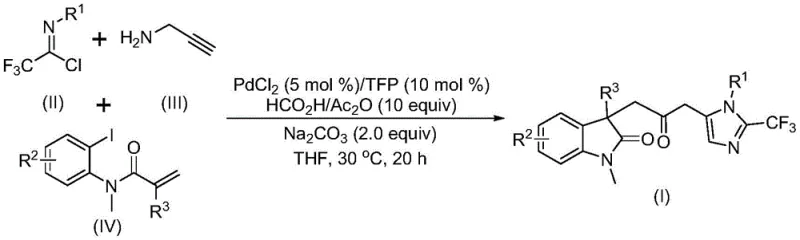
In stark contrast to these legacy methods, the novel approach disclosed in the patent utilizes a sophisticated yet operationally simple multi-component reaction system that elegantly bypasses the need for hazardous gaseous reagents. The core innovation lies in the use of a formic acid and acetic anhydride mixture as a safe, liquid carbon monoxide surrogate, which releases CO in situ under mild thermal conditions. This allows the reaction to proceed at a remarkably low temperature of 30°C, significantly reducing energy consumption compared to high-temperature alternatives. The reaction integrates three readily available starting materials—trifluoroethylimidoyl chloride, propargylamine, and acrylamide derivatives—into a single pot, facilitated by a palladium catalyst system comprising PdCl2 and a TFP ligand. This telescoped process not only streamlines the synthetic route by eliminating isolation steps for intermediates but also enhances the overall yield and purity profile of the final carbonyl-bridged biheterocyclic products.
Mechanistic Insights into Pd-Catalyzed Carbonylation Cascade
Understanding the mechanistic underpinnings of this transformation is crucial for R&D teams aiming to optimize the process for specific target molecules. The reaction is believed to initiate with the oxidative addition of a zero-valent palladium species into the carbon-iodine bond of the acrylamide substrate, generating a reactive organopalladium intermediate. This is immediately followed by an intramolecular Heck-type reaction, which constructs the indolinone core and forms a divalent alkyl palladium species. Subsequently, the carbon monoxide generated from the decomposition of the formic acid and acetic anhydride mixture inserts into the palladium-carbon bond, yielding an acyl palladium intermediate. This acyl species is pivotal, as it serves as the electrophilic partner for the subsequent cyclization event. Concurrently, the base-promoted reaction between trifluoroethylimidoyl chloride and propargylamine generates a trifluoroacetamidine compound, which undergoes isomerization to become nucleophilic enough to attack the activated acyl palladium center. This final intramolecular cyclization step closes the imidazole ring, releasing the final carbonyl-bridged biheterocyclic product and regenerating the active palladium catalyst to continue the cycle.
From an impurity control perspective, this mechanism offers distinct advantages due to the high chemoselectivity of the palladium catalyst and the mild reaction environment. The use of sodium carbonate as a base ensures that the deprotonation steps occur smoothly without promoting unwanted side reactions such as hydrolysis of the sensitive imidoyl chloride or polymerization of the acrylamide double bond. The specific choice of the TFP (tris(2-furyl)phosphine) ligand is critical, as it stabilizes the palladium center against aggregation while maintaining sufficient electron density to facilitate the oxidative addition and CO insertion steps efficiently. This precise tuning of the catalytic cycle minimizes the formation of homocoupling byproducts or incomplete cyclization intermediates, resulting in a cleaner crude reaction mixture that simplifies the final purification via column chromatography, ultimately delivering high-purity pharmaceutical intermediates suitable for stringent regulatory standards.
How to Synthesize Carbonyl-Bridged Biheterocyclic Compounds Efficiently
To implement this synthesis effectively, operators must adhere to strict stoichiometric ratios and environmental controls as outlined in the patent embodiments. The standard protocol involves dissolving the palladium catalyst, ligand, and base in an aprotic organic solvent such as tetrahydrofuran (THF), which has been identified as the optimal medium for solubilizing all reactants while maximizing conversion rates. The sequential or simultaneous addition of the three primary substrates must be managed to ensure homogeneous mixing before the exothermic generation of carbon monoxide begins. Maintaining the reaction temperature precisely at 30°C is vital; deviations could either slow down the kinetics excessively or promote decomposition of the sensitive intermediates. Detailed standardized synthesis steps follow below.
- Combine palladium chloride catalyst, TFP ligand, sodium carbonate base, and the formic acid/acetic anhydride CO source mixture in an organic solvent such as THF.
- Add the three key substrates: trifluoroethylimidoyl chloride, propargylamine, and the specific acrylamide derivative into the reaction vessel under stirring.
- Maintain the reaction mixture at 30°C for 12 to 20 hours, followed by filtration, silica gel treatment, and column chromatography purification to isolate the final biheterocyclic product.
Commercial Advantages for Procurement and Supply Chain Teams
For procurement managers and supply chain heads, the adoption of this patented methodology translates into tangible strategic benefits that extend beyond mere chemical novelty. The shift away from hazardous gaseous reagents fundamentally alters the risk profile of the manufacturing process, allowing for production in standard glass-lined reactors rather than specialized high-pressure autoclaves. This reduction in infrastructure complexity directly correlates to lower capital investment requirements and decreased maintenance costs over the lifecycle of the production line. Furthermore, the reliance on commercially available, commodity-grade starting materials such as propargylamine and acrylamide derivatives ensures a stable and resilient supply chain, mitigating the risks associated with sourcing exotic or custom-synthesized precursors that often suffer from long lead times and price volatility.
- Cost Reduction in Manufacturing: The elimination of toxic carbon monoxide gas removes the need for expensive gas handling systems, scrubbers, and rigorous safety monitoring protocols, leading to substantial operational cost savings. Additionally, the one-pot nature of the reaction reduces solvent consumption and labor hours associated with multiple isolation and purification steps, thereby driving down the overall cost of goods sold (COGS) for these complex intermediates. The use of inexpensive palladium chloride as the catalyst source, combined with the ability to recover and recycle the catalyst in optimized iterations, further enhances the economic viability of the process for large-scale applications.
- Enhanced Supply Chain Reliability: By utilizing a synthetic route that tolerates a broad spectrum of functional groups, manufacturers can source a wider variety of raw material grades without compromising final product quality. The robustness of the reaction conditions means that minor fluctuations in raw material specifications are less likely to cause batch failures, ensuring consistent output and reliable delivery schedules to downstream clients. This stability is crucial for maintaining continuous production lines in the fast-paced pharmaceutical sector, where delays in intermediate supply can bottleneck entire drug development pipelines.
- Scalability and Environmental Compliance: The patent explicitly demonstrates the successful expansion of this chemistry to gram-scale reactions, providing a clear proof-of-concept for kilogram and tonne-scale manufacturing. The mild reaction temperature of 30°C significantly lowers the energy footprint of the process compared to traditional high-temperature cyclizations, aligning with modern green chemistry principles and corporate sustainability goals. Moreover, the simplified workup procedure involving filtration and standard chromatography reduces the volume of chemical waste generated, facilitating easier compliance with increasingly stringent environmental regulations regarding effluent discharge and hazardous waste disposal.
Frequently Asked Questions (FAQ)
The following questions address common technical inquiries regarding the implementation and scope of this synthesis technology, derived directly from the patent's experimental data and background analysis. These insights are intended to clarify the practical applicability of the method for potential licensees or contract manufacturing partners looking to integrate this chemistry into their portfolios.
Q: What are the safety advantages of this carbonylation method compared to traditional techniques?
A: Unlike conventional carbonylation reactions that require toxic and hazardous carbon monoxide gas under high pressure, this patented method utilizes a safe formic acid and acetic anhydride mixture to generate carbon monoxide in situ, significantly enhancing operational safety and reducing infrastructure requirements.
Q: Does this synthesis method support a wide range of substrate functional groups?
A: Yes, the process demonstrates excellent substrate compatibility, tolerating various substituents such as halogens, alkyl groups, alkoxy groups, nitro groups, and trifluoromethyl groups on the aromatic rings, allowing for the diverse design of biheterocyclic libraries.
Q: Is this synthetic route suitable for large-scale industrial production?
A: The patent explicitly confirms that the method has been successfully expanded to gram-scale reactions with high efficiency, indicating strong potential for commercial scale-up due to the use of cheap, readily available starting materials and mild reaction conditions.
Partnering with NINGBO INNO PHARMCHEM: Your Reliable Carbonyl-Bridged Biheterocyclic Compounds Supplier
At NINGBO INNO PHARMCHEM, we recognize the transformative potential of this palladium-catalyzed multi-component synthesis in accelerating the development of next-generation therapeutic agents. As a premier CDMO partner, we possess extensive experience scaling diverse pathways from 100 kgs to 100 MT/annual commercial production, ensuring that your transition from laboratory bench to industrial reactor is seamless and efficient. Our state-of-the-art facilities are equipped to handle the specific requirements of this chemistry, including precise temperature control and advanced purification capabilities, guaranteeing that every batch meets stringent purity specifications and rigorous QC labs standards required by global regulatory bodies.
We invite you to collaborate with our technical team to explore how this innovative route can optimize your specific project needs. By engaging with us, you gain access to a Customized Cost-Saving Analysis tailored to your target molecule, helping you identify the most economically efficient production strategy. We encourage you to contact our technical procurement team today to request specific COA data for similar biheterocyclic intermediates and comprehensive route feasibility assessments, ensuring your supply chain is built on a foundation of scientific excellence and commercial reliability.