
Advanced Palladium-Catalyzed Synthesis of Fluorine-Containing Alkylthio Olefin Derivatives for Commercial Scale-Up
The pharmaceutical and fine chemical industries are constantly seeking robust methodologies to introduce fluorine atoms into organic scaffolds, given the profound impact of fluorination on metabolic stability and bioavailability. Patent CN114369045B, filed in October 2022, presents a significant technological breakthrough in this domain by disclosing a novel synthesis method for fluorine-containing alkylthio substituted olefin derivatives. This innovation leverages the unique reactivity of alkenyl sulfonium salts as versatile synthetic building blocks, enabling the efficient construction of complex organofluorine architectures that are pivotal in modern drug discovery. The disclosed methodology addresses the longstanding challenge of selectively introducing fluorine-containing alkylthio groups onto olefinic backbones, a transformation that is notoriously difficult to achieve with high regio- and stereoselectivity using traditional approaches. By utilizing readily available starting materials and a palladium-catalyzed system, this technology offers a streamlined pathway to access a diverse library of fluorinated intermediates, positioning it as a critical asset for the development of next-generation active pharmaceutical ingredients (APIs) and advanced functional materials.
The Limitations of Conventional Methods vs. The Novel Approach
The Limitations of Conventional Methods
Historically, the synthesis of fluorine-containing olefin derivatives has been plagued by significant technical hurdles that impede large-scale manufacturing and cost-effective production. Conventional strategies often rely on direct fluorination techniques which typically require harsh reaction conditions, such as cryogenic temperatures or the use of highly reactive and hazardous fluorinating agents like elemental fluorine or specialized electrophilic fluorine sources. These methods frequently suffer from poor functional group tolerance, leading to extensive side reactions and the formation of complex impurity profiles that are difficult to purify. Furthermore, the natural scarcity of fluorine-containing organic compounds necessitates multi-step synthetic routes that are not only time-consuming but also result in low overall atom economy. The reliance on expensive reagents and the generation of substantial chemical waste render many traditional processes economically unviable for commercial scale-up, creating a bottleneck for supply chain reliability in the production of high-purity fluorinated intermediates required by the global pharmaceutical market.
The Novel Approach
In stark contrast to these legacy methods, the technology described in CN114369045B introduces a paradigm shift by employing alkenyl sulfonium salts as key electrophilic precursors in a palladium-catalyzed nucleophilic substitution reaction. This innovative approach utilizes simple fluoride salts, such as cesium fluoride (CsF), as the fluorine source, which are commercially abundant and significantly more cost-effective than specialized fluorinating reagents. The reaction proceeds under remarkably mild conditions, typically requiring temperatures between 60-120°C, with an optimal range of 80-100°C, thereby eliminating the need for energy-intensive cryogenic setups. As illustrated in the general reaction scheme below, the process efficiently converts the sulfonium salt intermediate into the desired fluorine-containing alkylthio substituted olefin derivative with high reaction efficiency and excellent stereoselectivity.
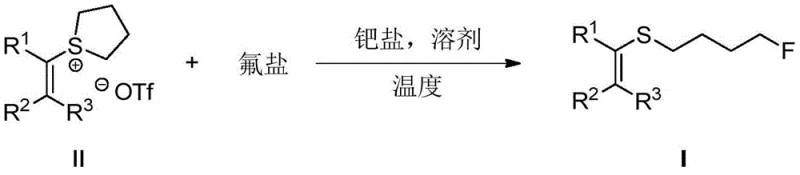
This novel pathway not only simplifies the operational procedure but also dramatically enhances the safety profile of the manufacturing process, making it an ideal candidate for reliable pharmaceutical intermediates supplier networks aiming to reduce lead time for high-purity fluorinated compounds while maintaining rigorous quality standards.
Mechanistic Insights into Palladium-Catalyzed Nucleophilic Substitution
The core of this technological advancement lies in the sophisticated mechanistic interplay between the palladium catalyst and the alkenyl sulfonium salt substrate. The reaction initiates with the activation of the carbon-sulfur bond in the sulfonium salt by the palladium species, facilitating a nucleophilic attack by the fluoride ion. This mechanism is particularly advantageous because the sulfonium moiety acts as an excellent leaving group, driving the reaction forward without the need for excessive thermal energy or aggressive promoters. The use of palladium acetate (Pd(OAc)2) as the preferred catalyst ensures a balanced catalytic cycle that minimizes metal leaching and maximizes turnover frequency. From a process chemistry perspective, this mechanism allows for precise control over the reaction kinetics, ensuring that the formation of the carbon-fluorine bond occurs with high fidelity. The structural diversity of the alkenyl sulfonium salt, where substituents R1, R2, and R3 can vary widely from hydrogen and alkyl groups to complex aryl and heteroaryl systems, means that this catalytic system is highly adaptable. This adaptability is crucial for cost reduction in fine chemical manufacturing, as it allows a single platform technology to produce a vast array of distinct molecular entities without requiring complete process redevelopment for each new target molecule.
Furthermore, the impurity control mechanism inherent in this design is robust. The high stereoselectivity observed in the products, as evidenced by the specific examples in the patent data, suggests that the transition state of the catalytic cycle is well-defined, preventing the formation of unwanted geometric isomers. This level of control is vital for regulatory compliance in the pharmaceutical sector, where impurity profiles must be strictly managed. The ability to tune the electronic properties of the olefin backbone through the selection of R groups allows chemists to optimize the reactivity for specific substrates, ensuring consistent yields ranging from 45% to 90% across different structural classes. Such predictability in reaction outcomes reduces the risk of batch failures and ensures a steady supply of critical intermediates, reinforcing the commercial viability of this synthesis route for the production of complex organofluorine compounds.
How to Synthesize Fluorine-Containing Alkylthio Olefin Derivatives Efficiently
The practical implementation of this synthesis route is designed for scalability and ease of operation, making it accessible for both laboratory research and industrial production. The process begins with the preparation of the alkenyl sulfonium salt precursor, which can be synthesized from readily available olefins and sulfolane derivatives under controlled low-temperature conditions. Once the precursor is secured, the key fluorination step involves mixing the sulfonium salt with a fluoride source and the palladium catalyst in a suitable solvent system. The choice of solvent plays a critical role, with 1,4-dioxane identified as the optimal medium due to its ability to solubilize both organic and inorganic components effectively while maintaining thermal stability at the required reaction temperatures. Detailed standardized synthesis steps for this high-efficiency route are provided in the guide below.
- Prepare the alkenyl sulfonium salt II by reacting olefin A with sulfolane B and trifluoromethanesulfonic anhydride in DCM at -78°C.
- Combine the alkenyl sulfonium salt II with a fluoride salt (preferably CsF) and a palladium catalyst (preferably Pd(OAc)2) in 1,4-dioxane.
- Heat the reaction mixture to 80-100°C for 5-12 hours under nitrogen atmosphere to achieve nucleophilic substitution and form the target fluorinated olefin derivative I.
Commercial Advantages for Procurement and Supply Chain Teams
For procurement managers and supply chain directors, the adoption of this patented synthesis method offers tangible strategic benefits that extend beyond mere technical feasibility. The primary advantage lies in the substantial cost savings achieved through the utilization of commodity chemicals. Unlike proprietary fluorinating agents that command premium prices and are subject to volatile supply chains, the fluoride salts and palladium catalysts used in this process are standard industrial chemicals with stable global availability. This shift in raw material sourcing significantly de-risks the supply chain, ensuring continuity of supply even during periods of market fluctuation. Moreover, the simplified operational protocol, which avoids extreme temperatures and pressures, translates directly into reduced capital expenditure for reactor infrastructure and lower energy consumption per kilogram of product produced. These factors collectively contribute to a more resilient and cost-efficient manufacturing ecosystem.
- Cost Reduction in Manufacturing: The elimination of expensive and hazardous specialized fluorinating reagents in favor of inexpensive fluoride salts like CsF drastically lowers the raw material cost base. Additionally, the high reaction efficiency and yields up to 90% minimize waste generation and reduce the burden on downstream purification processes, leading to significant operational expenditure savings. The use of relatively non-toxic palladium salts further reduces the costs associated with hazardous waste disposal and environmental compliance, enhancing the overall economic attractiveness of the process for large-scale production.
- Enhanced Supply Chain Reliability: By relying on widely available starting materials such as olefins and sulfolane derivatives, manufacturers can secure multiple sourcing options, thereby mitigating the risk of single-supplier dependency. The robustness of the reaction conditions means that production can be maintained consistently without frequent interruptions due to sensitive process parameters. This reliability is essential for meeting the strict delivery schedules demanded by downstream pharmaceutical clients, ensuring that the pipeline for high-purity fluorinated intermediates remains uninterrupted and responsive to market demand.
- Scalability and Environmental Compliance: The mild reaction temperatures and atmospheric pressure conditions facilitate straightforward scale-up from gram-scale laboratory experiments to multi-ton commercial production without the need for specialized high-pressure equipment. The process generates fewer by-products and utilizes solvents that can be easily recovered and recycled, aligning with green chemistry principles and stringent environmental regulations. This environmental compatibility not only simplifies permitting processes but also enhances the corporate sustainability profile, which is increasingly important for partnerships with major multinational corporations committed to reducing their carbon footprint.
Frequently Asked Questions (FAQ)
The following questions address common technical and commercial inquiries regarding the implementation of this fluorination technology. These insights are derived directly from the experimental data and claims presented in the patent documentation, providing a clear understanding of the process capabilities and limitations. Understanding these details is crucial for technical teams evaluating the feasibility of integrating this method into existing production lines or for R&D departments planning new synthetic routes for fluorinated drug candidates.
Q: What are the optimal reaction conditions for synthesizing fluorine-containing olefin derivatives?
A: According to patent CN114369045B, the optimal conditions involve using Cesium Fluoride (CsF) as the fluoride source and Palladium Acetate (Pd(OAc)2) as the catalyst in 1,4-dioxane solvent at a temperature range of 80-100°C for 5-12 hours.
Q: What is the structural diversity of the resulting olefin derivatives?
A: The method allows for significant structural diversity where R1 can be hydrogen, methyl, aryl, acetyl, or benzoyl, and R2/R3 can be hydrogen, alkyl, aryl, or heteroaryl groups, enabling the synthesis of various pharmaceutical intermediates.
Q: Can these fluorinated olefins be used for further heterocyclic synthesis?
A: Yes, the patent demonstrates that the synthesized fluorine-containing alkylthio substituted olefin derivatives can serve as key intermediates for constructing nitrogen-containing heterocycles such as pyrazoles and pyrimidines with high yields.
Partnering with NINGBO INNO PHARMCHEM: Your Reliable Fluorine-Containing Olefin Derivative Supplier
At NINGBO INNO PHARMCHEM, we recognize the transformative potential of the synthesis technology described in CN114369045B for the future of fluorinated pharmaceutical intermediates. As a leading CDMO partner, we possess the technical expertise and infrastructure necessary to translate this innovative laboratory method into a robust commercial reality. Our facilities are equipped to handle the specific requirements of palladium-catalyzed reactions, including precise temperature control and efficient metal scavenging systems to ensure product purity. We have extensive experience scaling diverse pathways from 100 kgs to 100 MT/annual commercial production, ensuring that your supply needs are met with consistency and quality. Our rigorous QC labs and stringent purity specifications guarantee that every batch of fluorine-containing alkylthio substituted olefin derivatives meets the highest international standards, ready for immediate use in complex drug synthesis.
We invite you to collaborate with us to leverage this cutting-edge chemistry for your next project. Our team is prepared to provide a Customized Cost-Saving Analysis tailored to your specific volume requirements, demonstrating exactly how this method can optimize your budget. Please contact our technical procurement team today to request specific COA data for our available intermediates and to discuss detailed route feasibility assessments. Let us help you secure a competitive advantage in the market with our reliable supply of high-performance fluorinated building blocks.