
Advanced Stereospecific Synthesis of Oseltamivir Chiral Impurity for Global Pharma Compliance
Introduction to Patent CN108047077B and Strategic Importance
The pharmaceutical industry faces relentless pressure to maintain the highest standards of purity and safety, particularly for strategic antiviral medications like Oseltamivir phosphate. Patent CN108047077B, published in late 2020, introduces a sophisticated preparation method for specific oseltamivir chiral impurities, addressing a critical gap in quality control infrastructure. As a global leader in fine chemical manufacturing, understanding the nuances of this patent is essential for procurement and R&D teams aiming to secure reliable supply chains for reference standards. The invention details a robust synthetic route to generate specific chiral isomers (Compound 7) that serve as vital markers for detecting trace impurities in active pharmaceutical ingredient (API) production. By establishing a reliable pharmaceutical intermediates supplier network capable of executing this complex chemistry, manufacturers can ensure their final products meet stringent FDA and international pharmacopoeia requirements. This technology not only supports the registration of generic oseltamivir phosphate but also enhances the overall safety profile of influenza treatments distributed worldwide.
The Limitations of Conventional Methods vs. The Novel Approach
The Limitations of Conventional Methods
Traditionally, the synthesis of specific chiral impurities for oseltamivir has been fraught with challenges related to stereochemical control and purification efficiency. Conventional routes often rely on non-stereospecific reactions that generate a complex mixture of all possible isomers, necessitating laborious and costly chromatographic separations to isolate the single target impurity. Furthermore, older methodologies may utilize harsh reaction conditions or unstable intermediates that degrade yield and introduce secondary impurities, complicating the analytical validation process. The lack of a direct, convergent synthesis means that procurement teams often face long lead times and exorbitant costs when sourcing these critical reference materials. Additionally, the reliance on resolution techniques rather than asymmetric synthesis results in significant material waste, which contradicts modern green chemistry principles and increases the environmental burden of pharmaceutical manufacturing. These inefficiencies create bottlenecks in the quality assurance workflow, delaying the release of batch records and potentially hindering regulatory approval timelines for new drug applications.
The Novel Approach
The methodology outlined in patent CN108047077B represents a paradigm shift by employing a rational, stereospecific design that minimizes waste and maximizes structural precision. Instead of attempting to separate a racemic mixture, this novel approach constructs the target molecule through a sequence of predictable inversion steps, ensuring the correct spatial arrangement of atoms from the outset. The process begins with a highly selective epoxide opening, setting the initial stereochemistry with high fidelity before proceeding through protected intermediates that prevent side reactions. This strategic use of protecting groups, such as the Boc group, allows for orthogonal reactivity, enabling chemists to modify specific functional groups without disturbing the sensitive chiral centers. By focusing on chemical inversion rather than physical separation, the method drastically simplifies the downstream processing requirements. This streamlined workflow translates directly into cost reduction in API manufacturing support services, as fewer resources are consumed in purification and waste disposal. The result is a scalable, reproducible process that delivers high-purity chiral impurities suitable for rigorous analytical benchmarking.
Mechanistic Insights into Stereospecific Nucleophilic Substitution
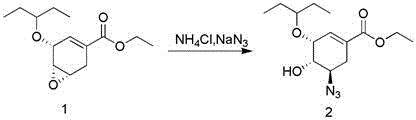
The core brilliance of this synthesis lies in its masterful application of SN2 nucleophilic substitution mechanisms to dictate stereochemistry. The first critical transformation involves the attack of the azide ion on the epoxy ring of the starting material (Compound 1). Under the influence of ammonium chloride, the azide ion acts as a potent nucleophile, attacking the less hindered carbon of the epoxide from the backside. This backside attack forces the inversion of configuration at that specific chiral center, a phenomenon known as Walden inversion, which is meticulously preserved throughout the subsequent steps. The reaction conditions, typically maintained between 40-75°C in an alcohol solvent, are optimized to balance reaction kinetics with the stability of the sensitive epoxy substrate. Following this, the azide group is reduced to an amine via a Staudinger reaction using triphenylphosphine, a mild and selective reducing agent that avoids over-reduction of other functional groups like the ester moiety. The resulting amine is immediately protected with a Boc group to prevent unwanted nucleophilic interference in later stages, demonstrating a high level of synthetic foresight.
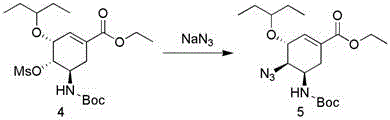
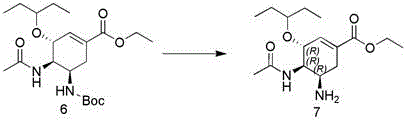
The second pivotal stereochemical event occurs during the conversion of Compound 4 to Compound 5. Here, the hydroxyl group is first activated by conversion into a mesylate (methanesulfonate) ester using methanesulfonyl chloride and a base like triethylamine at low temperatures (-5°C to 10°C). This activation transforms a poor leaving group (hydroxyl) into an excellent leaving group (mesylate), priming the molecule for the second inversion. Subsequent treatment with sodium azide at elevated temperatures (70-100°C) triggers another SN2 displacement. The azide ion attacks the carbon bearing the mesylate from the side opposite to the leaving group, effectively flipping the configuration back or to a specific desired state depending on the starting geometry. This double-inversion strategy allows for precise tuning of the three chiral centers present in the cyclohexene ring system. Finally, the azide is reduced and acetylated, and the Boc group is removed under acidic conditions to reveal the free amine, yielding the target chiral impurity (Compound 7) with the exact stereochemical definition required for analytical standards.
How to Synthesize Oseltamivir Chiral Impurity Efficiently
Implementing this synthesis requires strict adherence to the reaction parameters defined in the patent to ensure the integrity of the chiral centers. The process is designed to be operationally simple, utilizing common laboratory reagents and standard equipment, which facilitates easy technology transfer from R&D to pilot plant scales. The initial epoxide opening sets the foundation for the entire sequence, making temperature control and reagent stoichiometry critical at this stage. As the synthesis progresses through protection and activation steps, maintaining anhydrous conditions where necessary prevents hydrolysis of the ester or premature deprotection. The final deprotection step using hydrogen chloride solutions must be carefully monitored to avoid degradation of the acetamide group while ensuring complete removal of the Boc moiety. For detailed operational protocols, safety data, and specific workup procedures, please refer to the standardized guide below.
- Perform nucleophilic attack on the epoxy group of compound 1 using sodium azide and ammonium chloride to obtain compound 2 with inverted configuration.
- Execute Staudinger reduction on compound 2 followed by Boc protection to yield compound 3, then convert the hydroxyl group to a mesylate to form compound 4.
- Conduct a second nucleophilic substitution with sodium azide on compound 4 to invert configuration again, followed by reduction, acetylation, and final deprotection to yield compound 7.
Commercial Advantages for Procurement and Supply Chain Teams
For procurement managers and supply chain directors, the adoption of this patented synthesis route offers tangible benefits that extend beyond mere technical feasibility. The primary advantage lies in the significant simplification of the supply chain for raw materials. The process relies on commodity chemicals such as sodium azide, methanesulfonyl chloride, and triphenylphosphine, which are readily available from multiple global vendors, thereby mitigating the risk of single-source dependency. This abundance of starting materials ensures enhanced supply chain reliability, allowing manufacturers to maintain consistent production schedules even during periods of market volatility. Furthermore, the elimination of expensive chiral catalysts or enzymatic resolutions, which are often required in alternative asymmetric syntheses, leads to substantial cost savings. The avoidance of precious metals also removes the need for complex and costly metal scavenging steps, further reducing the overall cost of goods sold (COGS). From a logistical perspective, the robustness of the reaction conditions—many of which proceed at moderate temperatures and pressures—means that the process can be scaled up in standard stainless steel reactors without requiring specialized high-pressure or cryogenic equipment.
- Cost Reduction in Manufacturing: The economic viability of this method is driven by the high atom economy of the substitution reactions and the use of inexpensive, bulk-scale reagents. By avoiding the need for preparative chiral HPLC to separate isomers, the process eliminates one of the most expensive unit operations in fine chemical manufacturing. The high yields reported in the patent examples indicate efficient conversion of starting materials, minimizing waste disposal costs associated with unreacted feedstock. Additionally, the simplified purification protocol, which primarily involves extraction and washing rather than complex chromatography, reduces solvent consumption and energy usage. These factors combine to create a lean manufacturing process that significantly lowers the barrier to entry for producing high-quality reference standards, ultimately passing savings down to the pharmaceutical customers who require these materials for regulatory compliance.
- Enhanced Supply Chain Reliability: In the context of global pharmaceutical logistics, the stability and shelf-life of intermediates are paramount. The intermediates generated in this route, particularly the Boc-protected species, are generally stable and can be stored for extended periods, allowing for the creation of strategic inventory buffers. This capability is crucial for mitigating supply disruptions caused by geopolitical issues or raw material shortages. The modular nature of the synthesis also allows for flexible production planning; if demand for a specific intermediate spikes, the process can be paused at the stable Compound 3 or 4 stage. Moreover, the use of non-hazardous solvents like ethanol and ethyl acetate in key steps simplifies transportation and storage regulations compared to processes relying on highly toxic or flammable solvents. This operational flexibility ensures that partners can respond rapidly to urgent requests for high-purity oseltamivir impurity standards without compromising on quality or safety.
- Scalability and Environmental Compliance: As regulatory scrutiny on environmental impact intensifies, the green chemistry attributes of this synthesis become a major competitive advantage. The process generates minimal heavy metal waste, as it avoids transition metal catalysts entirely. The aqueous workups described in the patent facilitate the separation of organic and inorganic byproducts, allowing for easier treatment of effluent streams. The ability to run reactions at concentrations that maximize throughput while maintaining safety margins supports the commercial scale-up of complex pharmaceutical intermediates. Scaling from gram to kilogram quantities does not introduce new kinetic hazards, as the exotherms associated with the azide additions are manageable with standard cooling systems. This scalability ensures that suppliers can meet the growing global demand for antiviral quality control materials without the need for massive capital expenditure on new reactor infrastructure, aligning with sustainable manufacturing goals.
Frequently Asked Questions (FAQ)
The following questions address common technical and commercial inquiries regarding the production and application of oseltamivir chiral impurities. These insights are derived directly from the technical specifications and experimental data provided in the patent documentation, ensuring accuracy and relevance for industry professionals. Understanding these details helps stakeholders make informed decisions about integrating this technology into their quality control frameworks. For further clarification on specific batch capabilities or customization options, our technical team is available to provide deeper consultation.
Q: Why is the preparation of specific chiral impurities critical for Oseltamivir Phosphate?
A: Oseltamivir phosphate contains three chiral centers, leading to seven possible opposite chiral isomers. These isomers can affect the safety and efficacy profile of the final drug. Regulatory bodies require rigorous qualitative and quantitative analysis of these impurities to ensure product quality and patient safety during registration.
Q: How does this novel synthesis method improve upon conventional impurity preparation?
A: This method utilizes a controlled double-inversion strategy starting from a defined epoxy precursor. Unlike non-specific synthesis routes that produce complex mixtures requiring difficult separation, this approach leverages stereospecific SN2 reactions to directly access the target isomer with high structural fidelity, simplifying purification.
Q: What are the key reagents used in the stereoinversion steps?
A: The process relies on sodium azide as the primary nucleophile for ring-opening and displacement reactions. Key auxiliary reagents include ammonium chloride for catalysis, methanesulfonyl chloride for activating the hydroxyl leaving group, and triphenylphosphine for the Staudinger reduction of azides to amines.
Partnering with NINGBO INNO PHARMCHEM: Your Reliable Oseltamivir Chiral Impurity Supplier
At NINGBO INNO PHARMCHEM, we recognize that the integrity of your final pharmaceutical product depends on the quality of every component, including the reference standards used for testing. Our facility is equipped to execute the sophisticated synthetic pathways described in patent CN108047077B with precision and consistency. We possess extensive experience scaling diverse pathways from 100 kgs to 100 MT/annual commercial production, ensuring that we can support your needs whether you are in the early stages of method development or full-scale GMP manufacturing. Our commitment to quality is underpinned by stringent purity specifications and rigorous QC labs that utilize state-of-the-art analytical instrumentation to verify the stereochemical identity of every batch. We understand that in the antiviral sector, time is of the essence, and our optimized workflows are designed to reduce lead time for high-purity pharmaceutical intermediates without sacrificing the meticulous attention to detail required for chiral synthesis.
We invite you to collaborate with us to secure a stable and cost-effective supply of oseltamivir chiral impurities. By leveraging our technical expertise, you can streamline your regulatory filing processes and ensure robust quality control for your oseltamivir phosphate products. Please contact our technical procurement team today to request a Customized Cost-Saving Analysis tailored to your specific volume requirements. We are ready to provide specific COA data and route feasibility assessments to demonstrate how our manufacturing capabilities align with your strategic goals. Let us be your partner in advancing pharmaceutical quality and safety through superior chemical innovation.