
Scalable Production of High-Purity p-Acetoxystyrene for Advanced Photoresist Applications
Scalable Production of High-Purity p-Acetoxystyrene for Advanced Photoresist Applications
The rapid evolution of the semiconductor industry demands increasingly sophisticated materials for integrated circuit etching and chip manufacturing, with poly-p-hydroxystyrene serving as a critical component in chemical amplification type photoresists. At the heart of this supply chain lies p-acetoxystyrene, a vital monomer whose purity and structural integrity directly influence the performance of the final photoresist material. Patent CN110655462A introduces a transformative preparation method that addresses long-standing challenges in synthesizing this key electronic chemical. By shifting from traditional acid-catalyzed dehydration to a novel alkaline elimination strategy, this technology offers a robust pathway for producing high-purity p-acetoxystyrene with exceptional stability and yield. For R&D directors and procurement specialists seeking a reliable electronic chemical supplier, understanding the mechanistic advantages of this route is essential for securing a competitive edge in semiconductor material manufacturing.
The Limitations of Conventional Methods vs. The Novel Approach
The Limitations of Conventional Methods
Historically, the synthesis of p-acetoxystyrene has relied heavily on routes starting from p-hydroxybenzaldehyde or p-hydroxyacetophenone, often involving complex multi-step sequences that introduce significant inefficiencies. Traditional methods frequently employ acid-catalyzed thermal elimination to generate the vinyl group, a process fraught with inherent chemical instability. Under acidic conditions, the newly formed double bond is highly susceptible to electrophilic attack, leading to uncontrolled side reactions such as acid-catalyzed flash polymerization and double-bond coupling. These side reactions not only drastically reduce the overall yield but also generate difficult-to-remove impurities that compromise the electronic grade purity required for lithography applications. Furthermore, the harsh conditions often necessitate high vacuum and elevated temperatures, increasing energy consumption and placing severe stress on reactor equipment, thereby complicating the commercial scale-up of complex electronic chemicals.
The Novel Approach
In stark contrast, the methodology disclosed in CN110655462A pioneers a three-step sequence that fundamentally alters the reaction landscape by introducing a base-mediated elimination in the final step. The process begins with the acetylation of p-hydroxyacetophenone, followed by a selective hydrogenation to form the alcohol intermediate, and culminates in an alkaline elimination reaction. 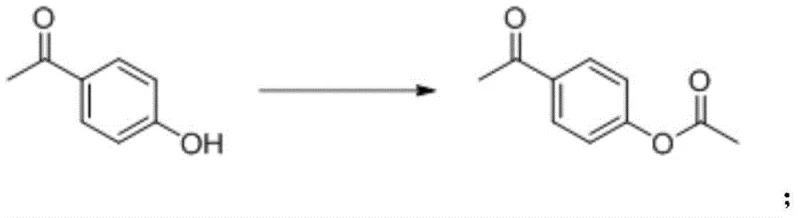 This strategic shift to alkaline conditions effectively suppresses the formation of carbocation intermediates that typically drive polymerization side reactions. By maintaining a basic environment, the generated double bonds remain stable for extended periods within the reaction system, allowing for more flexible processing windows and significantly higher isolated yields. This approach not only simplifies the purification workflow but also ensures that the final monomer meets the stringent quality specifications demanded by advanced photoresist formulations.
Mechanistic Insights into Alkaline Elimination Dynamics
The core innovation of this synthesis lies in the third step, where 1-(4-acetoxyphenyl)ethanol undergoes elimination to form the styrene derivative. Unlike acid-catalyzed E1 mechanisms that proceed through unstable carbocations prone to rearrangement and polymerization, this process likely follows an E2-type elimination pathway facilitated by strong inorganic bases such as sodium hydroxide or potassium hydroxide. In this mechanism, the base abstracts a beta-proton from the ethyl group while the leaving group departs simultaneously, forming the carbon-carbon double bond in a concerted manner. This pathway avoids the generation of free cationic species that would otherwise initiate chain growth of the styrene monomer, thereby preserving the monomeric state of the product. The use of polar aprotic solvents like DMAC or DMF further enhances the nucleophilicity of the base and stabilizes the transition state, ensuring a clean conversion even at elevated temperatures ranging from 100 to 130°C.
Furthermore, the stability of the product under these alkaline conditions is a critical factor for industrial viability. Experimental data indicates that p-acetoxystyrene exhibits remarkable thermal stability in the reaction mixture, maintaining its concentration over extended heating periods without significant degradation. 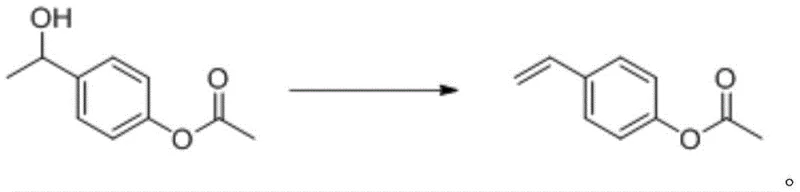 This stability is paramount for large-scale operations where heat transfer limitations might cause localized hot spots; the resistance to acid-catalyzed flash side reactions means the process is far more forgiving and controllable than its acidic counterparts. For quality control teams, this translates to a much narrower impurity profile, reducing the burden on downstream distillation columns and ensuring that the final API intermediate or electronic material consistently meets high-purity standards required for sub-micron lithography processes.
How to Synthesize p-Acetoxystyrene Efficiently
The synthesis protocol outlined in the patent provides a clear, reproducible framework for generating p-acetoxystyrene suitable for immediate industrial adoption. The procedure leverages common organic synthesis techniques—acetylation, catalytic hydrogenation, and base-mediated elimination—making it accessible for facilities equipped with standard reactors and hydrogenation units. The detailed standardized synthesis steps below outline the precise stoichiometric ratios, solvent choices, and thermal profiles necessary to maximize yield and purity while minimizing waste generation.
- Acetylate p-hydroxyacetophenone using acetyl chloride or anhydride with a base scavenger to form p-acetoxyacetophenone.
- Hydrogenate p-acetoxyacetophenone using Pd/C or Raney Nickel catalyst under moderate pressure to obtain 1-(4-acetoxyphenyl)ethanol.
- Perform alkaline elimination on the alcohol intermediate using inorganic bases in polar aprotic solvents to yield p-acetoxystyrene.
Commercial Advantages for Procurement and Supply Chain Teams
For procurement managers and supply chain heads, the transition to this alkaline elimination process represents a significant opportunity for cost reduction in semiconductor material manufacturing. By eliminating the need for harsh acidic catalysts and the associated corrosion-resistant equipment, capital expenditure for reactor maintenance and replacement can be substantially reduced. The process utilizes readily available commodity chemicals such as p-hydroxyacetophenone, acetic anhydride, and common inorganic bases, ensuring a stable and diversified supply chain that is less vulnerable to the volatility of specialized reagent markets. Moreover, the improved yield and selectivity directly correlate to lower raw material consumption per kilogram of finished product, driving down the variable cost of goods sold without compromising on the quality of the high-purity photoresist monomer.
- Cost Reduction in Manufacturing: The avoidance of expensive and hazardous acid catalysts, combined with the elimination of complex purification steps required to remove polymerization byproducts, leads to substantial cost savings. The higher single-pass yield means less feedstock is wasted, and the energy intensity of the process is optimized by operating at moderate pressures and temperatures compared to high-vacuum thermal elimination methods. This efficiency gain allows manufacturers to offer more competitive pricing structures while maintaining healthy margins in the volatile electronic chemicals sector.
- Enhanced Supply Chain Reliability: The robustness of the reaction conditions ensures consistent batch-to-batch reproducibility, a critical factor for long-term supply contracts with major semiconductor fabs. Since the raw materials are bulk commodities rather than niche specialty chemicals, the risk of supply disruption is minimized. Additionally, the stability of the intermediate and final product allows for greater flexibility in logistics and storage, reducing the lead time for high-purity electronic chemicals and enabling just-in-time delivery models that are essential for modern manufacturing workflows.
- Scalability and Environmental Compliance: The process is inherently scalable, moving seamlessly from laboratory benchtop to multi-ton production without the exponential increase in safety risks associated with high-pressure acid catalysis. The use of aqueous workups and standard organic solvents simplifies waste treatment protocols, aligning with increasingly strict environmental regulations regarding hazardous waste disposal. This environmental compatibility not only reduces compliance costs but also enhances the corporate sustainability profile, a growing priority for global technology partners.
Frequently Asked Questions (FAQ)
The following questions address common technical and operational inquiries regarding the implementation of this synthesis route. These insights are derived directly from the experimental data and comparative analysis provided in the patent documentation, offering clarity on process safety, yield optimization, and product stability.
Q: Why is alkaline elimination preferred over acid catalysis for p-acetoxystyrene synthesis?
A: Acid-catalyzed elimination often leads to uncontrolled side reactions such as double-bond polymerization and coupling, resulting in low yields and difficult purification. Alkaline elimination avoids carbocation intermediates, ensuring the double bond remains stable and the reaction proceeds with higher selectivity.
Q: What are the critical parameters for the hydrogenation step?
A: The hydrogenation of p-acetoxyacetophenone requires precise control of temperature (20-50°C) and hydrogen pressure (5-10 bar). Using catalysts like Pd/C or Raney Nickel ensures efficient reduction to the alcohol intermediate without affecting the acetate group.
Q: How does this method improve scalability for industrial production?
A: The process utilizes readily available raw materials and avoids harsh acidic conditions that corrode equipment. The stability of the product in the reaction mixture allows for flexible post-treatment times, facilitating large-scale batch processing and consistent quality control.
Partnering with NINGBO INNO PHARMCHEM: Your Reliable p-Acetoxystyrene Supplier
As the demand for advanced photoresists continues to surge, partnering with a manufacturer who understands the nuances of electronic chemical synthesis is crucial. NINGBO INNO PHARMCHEM possesses extensive experience scaling diverse pathways from 100 kgs to 100 MT/annual commercial production, ensuring that your supply needs are met with precision and reliability. Our state-of-the-art facilities are equipped with rigorous QC labs capable of verifying stringent purity specifications, guaranteeing that every batch of p-acetoxystyrene meets the exacting standards required for integrated circuit manufacturing. We are committed to delivering high-purity photoresist monomers that empower the next generation of semiconductor devices.
We invite you to engage with our technical procurement team to discuss how this innovative synthesis route can be tailored to your specific volume requirements. By requesting a Customized Cost-Saving Analysis, you can gain deeper insights into how our optimized process can reduce your total cost of ownership. Contact us today to obtain specific COA data and route feasibility assessments, and let us demonstrate why we are the preferred partner for cost reduction in semiconductor material manufacturing.