
Advanced FeCl3-Catalyzed Synthesis of 2-Trifluoromethyl Quinazolinones for Commercial API Manufacturing
Advanced FeCl3-Catalyzed Synthesis of 2-Trifluoromethyl Quinazolinones for Commercial API Manufacturing
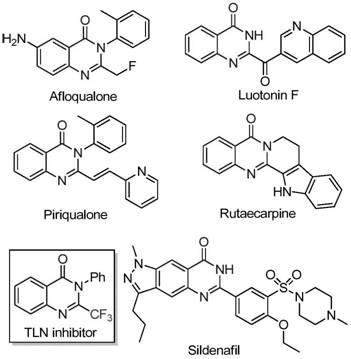
The pharmaceutical industry continuously seeks efficient pathways to access nitrogen-containing heterocycles due to their prevalence in bioactive molecules. A recent breakthrough detailed in patent CN111675662B introduces a robust preparation method for 2-trifluoromethyl substituted quinazolinone compounds, addressing long-standing challenges in synthetic efficiency and cost. Quinazolinones are privileged scaffolds found in numerous natural products and therapeutic agents, exhibiting a broad spectrum of biological activities including anti-cancer, anticonvulsant, and anti-inflammatory properties. The strategic incorporation of a trifluoromethyl group into these structures further enhances their pharmacokinetic profiles by improving metabolic stability and lipophilicity. This technical insight report analyzes the novel iron-catalyzed protocol, evaluating its potential to serve as a reliable pharmaceutical intermediate supplier solution for global R&D teams seeking high-purity building blocks.
The Limitations of Conventional Methods vs. The Novel Approach
The Limitations of Conventional Methods
Historically, the synthesis of trifluoromethyl-substituted quinazolinones has relied heavily on the cyclization of synthons such as anthranilamide, anthranilic acid, or isatoic anhydride with trifluoroacetic anhydride or ethyl trifluoroacetate. While effective in academic settings, these conventional routes suffer from significant drawbacks when evaluated for commercial viability. The reaction conditions are often severe, requiring harsh reagents that pose safety risks and complicate waste management. Furthermore, the starting materials, particularly specialized trifluoromethyl synthons, can be prohibitively expensive and difficult to source in bulk quantities. Narrow substrate scope is another critical limitation; many traditional methods fail to tolerate diverse functional groups, necessitating additional synthetic steps for protection and deprotection, which drastically reduces overall yield and increases the cost of goods sold (COGS).
The Novel Approach
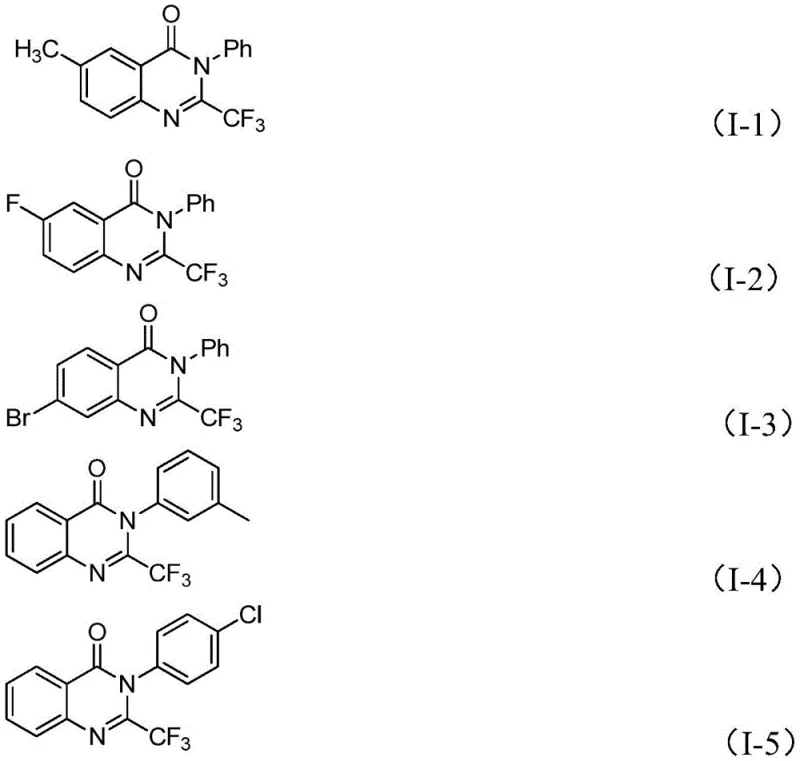
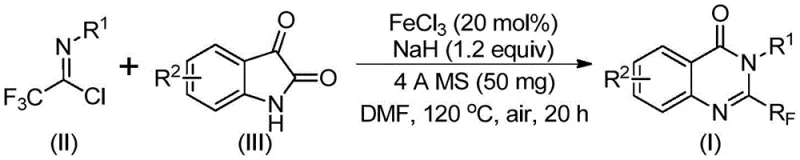
The methodology disclosed in the patent represents a paradigm shift by utilizing readily available trifluoroethylimidoyl chloride and isatin derivatives as starting materials. This approach bypasses the need for expensive anhydrides and leverages a cheap iron catalyst to drive the transformation. The reaction design allows for excellent functional group tolerance, enabling the synthesis of diverse derivatives without extensive optimization. By employing a two-stage temperature profile—initially reacting at 40°C and subsequently heating to 120°C—the process ensures high conversion rates while minimizing side reactions. This flexibility not only simplifies the operational workflow but also opens avenues for designing quinazolinone libraries with varied substitution patterns, making it an ideal candidate for cost reduction in API manufacturing.
Mechanistic Insights into FeCl3-Catalyzed Cyclization
The core of this innovation lies in the iron-catalyzed decarbonylation and cyclization mechanism. The reaction initiates with the formation of a carbon-nitrogen bond between the trifluoroethylimidoyl chloride and the isatin substrate, facilitated by sodium hydride acting as a base. This intermediate undergoes an iron-catalyzed transformation where the carbonyl group is extruded, leading to the formation of the quinazolinone ring system. The use of ferric chloride (FeCl3) is particularly advantageous as it acts as a Lewis acid to activate the substrates while remaining economically viable compared to noble metals. The presence of 4A molecular sieves plays a crucial role in scavenging moisture, thereby preventing the hydrolysis of sensitive intermediates and ensuring the reaction proceeds to completion with high fidelity.
From an impurity control perspective, this mechanism offers distinct advantages. The mild basic conditions provided by sodium hydride, combined with the specific reactivity of the iron catalyst, minimize the formation of polymeric byproducts often seen in harsher acidic cyclizations. The reaction tolerates various substituents on the aryl rings, including halogens, alkyl groups, and methoxy groups, without significant degradation. This robustness ensures that the final crude product contains fewer structurally related impurities, simplifying the downstream purification process. For R&D directors, this means a cleaner impurity profile and a more straightforward path to meeting stringent regulatory specifications for active pharmaceutical ingredients.
How to Synthesize 2-Trifluoromethyl Quinazolinones Efficiently
The synthesis protocol outlined in the patent provides a clear roadmap for laboratory and pilot-scale production. The procedure involves mixing the catalyst, base, and molecular sieves in an aprotic solvent like DMF, followed by the sequential addition of reactants. The two-step heating regimen is critical for maximizing yield, allowing the initial coupling to occur gently before driving the cyclization to completion at higher temperatures. Detailed standardized synthesis steps are provided below to ensure reproducibility and safety during scale-up operations.
- Mix ferric chloride (20 mol%), sodium hydride (1.2 equiv), and 4A molecular sieves in anhydrous DMF under air atmosphere.
- Add trifluoroethylimidoyl chloride and isatin derivative to the reaction mixture and stir at 40°C for 10 hours.
- Heat the reaction to 120°C and continue stirring for 20 hours, followed by filtration and column chromatography purification.
Commercial Advantages for Procurement and Supply Chain Teams
For procurement managers and supply chain heads, the transition to this iron-catalyzed method offers tangible strategic benefits beyond mere technical novelty. The primary advantage lies in the drastic simplification of the raw material supply chain. Isatin and trifluoroethylimidoyl chloride are commodity chemicals available from multiple global vendors, reducing the risk of supply disruption associated with proprietary or single-source reagents. Furthermore, the elimination of precious metal catalysts removes the need for expensive metal scavenging steps and rigorous residual metal testing, which are significant cost drivers in API production. This streamlined process translates directly into improved margin potential and faster time-to-market for new drug candidates.
- Cost Reduction in Manufacturing: The replacement of expensive reagents and precious metal catalysts with inexpensive iron salts significantly lowers the direct material costs. Additionally, the high atom economy of the decarbonylation pathway reduces waste generation, leading to lower disposal costs. The simplified workup procedure, involving standard filtration and chromatography, minimizes labor and solvent consumption, contributing to substantial overall cost savings in the manufacturing process.
- Enhanced Supply Chain Reliability: By relying on widely available starting materials like isatin and simple aromatic amines, manufacturers can diversify their supplier base and mitigate geopolitical or logistical risks. The robustness of the reaction conditions means that production is less susceptible to minor variations in raw material quality, ensuring consistent output. This reliability is crucial for maintaining continuous supply lines for critical pharmaceutical intermediates, preventing costly production delays.
- Scalability and Environmental Compliance: The use of DMF as a solvent, while requiring careful handling, is well-established in industrial settings with existing recovery infrastructure. The reaction operates under air atmosphere, eliminating the need for complex inert gas systems and reducing energy consumption associated with nitrogen purging. The absence of toxic heavy metals simplifies environmental compliance and wastewater treatment, aligning with modern green chemistry principles and corporate sustainability goals.
Frequently Asked Questions (FAQ)
The following questions address common technical and commercial inquiries regarding this synthesis method. These insights are derived directly from the experimental data and beneficial effects described in the patent documentation, providing clarity for stakeholders evaluating this technology for adoption.
Q: What are the key advantages of using FeCl3 over traditional catalysts for quinazolinone synthesis?
A: The use of ferric chloride (FeCl3) offers significant cost advantages over precious metal catalysts like palladium or rhodium. It is inexpensive, readily available, and demonstrates high tolerance for various functional groups, reducing the need for complex protection-deprotection strategies.
Q: How does this method improve the metabolic stability of the final drug molecule?
A: The introduction of the trifluoromethyl group at the 2-position significantly enhances the electronegativity and lipophilicity of the quinazolinone scaffold. This modification improves bioavailability and metabolic stability, which are critical parameters for oral drug candidates.
Q: Is this synthesis method scalable for industrial production?
A: Yes, the patent explicitly states that the method can be expanded to the gram level and provides possibilities for industrial scale application. The use of common solvents like DMF and robust reaction conditions supports scalability.
Partnering with NINGBO INNO PHARMCHEM: Your Reliable 2-Trifluoromethyl Quinazolinone Supplier
At NINGBO INNO PHARMCHEM, we recognize the critical importance of efficient synthetic routes in the development of next-generation therapeutics. Our team of expert chemists has extensively evaluated the FeCl3-catalyzed cyclization method and confirmed its viability for large-scale production. We possess extensive experience scaling diverse pathways from 100 kgs to 100 MT/annual commercial production, ensuring that your project can transition seamlessly from benchtop discovery to full-scale manufacturing. Our facilities are equipped with rigorous QC labs capable of meeting stringent purity specifications, guaranteeing that every batch of 2-trifluoromethyl quinazolinone delivered meets the highest international standards.
We invite you to collaborate with us to leverage this advanced technology for your pipeline. Contact our technical procurement team today to request a Customized Cost-Saving Analysis tailored to your specific volume requirements. We are ready to provide specific COA data and route feasibility assessments to demonstrate how our optimized processes can accelerate your development timelines and enhance your competitive edge in the global market.