
Advanced Chromatographic Purification of Iodixanol for Commercial Scale-Up and High Purity
The pharmaceutical industry continuously demands higher purity standards for contrast agents to ensure patient safety and diagnostic accuracy. Patent CN111440084B introduces a transformative purification method for Iodixanol, a non-ionic dimeric X-ray contrast agent widely used in angiography and CT-enhanced examinations. This innovation addresses the critical bottlenecks of traditional purification techniques by leveraging advanced chromatographic technologies. The method utilizes homogeneous reversed-phase silica gel as a stationary phase, enabling a streamlined one-step purification process that drastically improves efficiency. By achieving a purity greater than 95% and a yield exceeding 88%, this technology sets a new benchmark for manufacturing excellence. For global procurement leaders, this represents a significant opportunity to enhance supply chain reliability while maintaining stringent quality controls. The integration of this method into commercial production lines offers a robust solution for meeting the growing global demand for high-quality imaging agents.
The Limitations of Conventional Methods vs. The Novel Approach
The Limitations of Conventional Methods
Historically, the purification of Iodixanol has relied heavily on crystallization techniques that impose severe constraints on manufacturing scalability and cost efficiency. Prior art, such as CN1273574A, discloses methods requiring high heat energy and pressures exceeding the boiling point of the solution, which demands specialized and expensive production equipment. These harsh conditions not only increase energy consumption but also pose significant safety risks in a large-scale industrial setting. Furthermore, traditional recrystallization methods often necessitate repeated purification cycles to achieve pharmacopeia standards, leading to substantial product loss and extended processing times. The reliance on complex solvent systems in these legacy methods further complicates waste management and environmental compliance. Consequently, manufacturers face elevated operational costs and reduced throughput, limiting their ability to respond swiftly to market fluctuations. These inherent inefficiencies highlight the urgent need for a more streamlined and economically viable purification strategy.
The Novel Approach
The novel approach detailed in the patent data revolutionizes the purification landscape by adopting a single-step chromatographic process that eliminates the need for harsh crystallization conditions. By utilizing homogeneous reversed-phase silica gel, the method achieves superior separation efficiency, ensuring that the main single impurity remains below 0.1% and residual impurities stay under 0.05%. This precision is achieved through the use of a mobile phase consisting of ultrapure water and organic solvents like ethanol, which are safer and more cost-effective than traditional alternatives. The process completes elution within 14 column volumes, significantly reducing solvent consumption and processing time compared to multi-step crystallization. This simplification of the workflow not only lowers the barrier to entry for large-scale production but also enhances the overall stability of the purification yield. For supply chain managers, this translates to a more predictable and reliable production schedule, minimizing the risk of delays and ensuring consistent product availability.
Mechanistic Insights into Reversed-Phase Chromatographic Purification
The core of this technological breakthrough lies in the precise interaction between the Iodixanol molecule and the homogeneous reversed-phase silica gel stationary phase. The stationary phase, specifically UniSil C18 with a particle size of 30 μm and a pore size of 100Å, is engineered to provide a monodisperse structure that ensures consistent flow dynamics and separation performance. 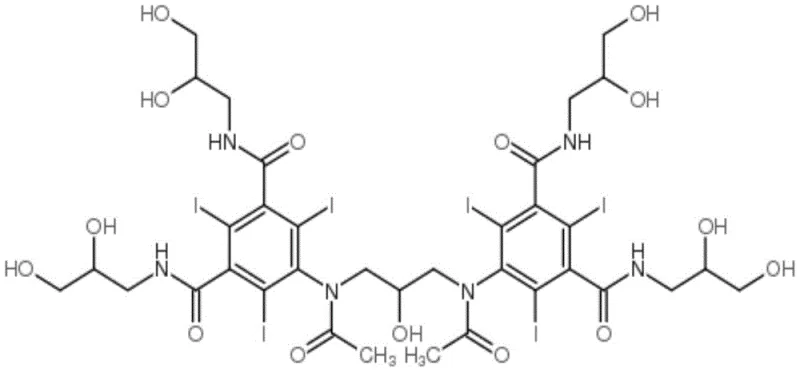 The large pore structure is critical for accommodating the bulky dimeric structure of Iodixanol, allowing for efficient diffusion and interaction without steric hindrance. The hydrophobic interactions between the C18 chains and the iodinated aromatic rings of the Iodixanol molecule facilitate the selective retention and elution of the target compound. By carefully controlling the mobile phase composition, specifically using an organic solvent-water mixture with a mass concentration of 1% to 10%, the process optimizes the resolution between the product and its impurities. This mechanistic precision ensures that the final product meets the rigorous purity specifications required for injectable pharmaceuticals. The ability to fine-tune these parameters provides R&D directors with a robust framework for method validation and regulatory compliance.
Impurity control is further enhanced through a strategic isocratic elution protocol that segments the collection of the target peak. The process begins with a column balancing step using an organic phase-to-aqueous solution, which prepares the stationary phase for optimal performance. During elution, a gradient of organic solvent concentration is applied, starting with a lower concentration to wash out weakly retained impurities and increasing to elute the target Iodixanol peak. This segmented collection strategy ensures that only the fractions meeting the strict purity requirements are combined, effectively excluding any trailing or leading impurities. The result is a purified solution where the main single impurity is less than 0.1%, a specification that is critical for minimizing potential toxicity in patients. This level of control demonstrates a deep understanding of chromatographic theory applied to practical industrial challenges, offering a reliable pathway for producing high-purity contrast agents.
How to Synthesize Iodixanol Efficiently
Implementing this purification method requires a systematic approach to ensure reproducibility and scalability from laboratory to commercial production. The process begins with the dissolution of the crude iodixanol extract, which typically has a purity of 80-85%, in pure water to create a homogeneous solution. This solution is then filtered through a membrane with a pore size of 0.4-0.5 μm to remove any particulate matter that could clog the chromatographic column. The clarified filtrate is subsequently loaded onto the column packed with the specialized silica gel, where the separation process takes place under controlled flow rates. The detailed standardized synthesis steps, including specific flow rates, column dimensions, and solvent ratios, are outlined in the technical guide below to ensure precise replication of the patent's success.
- Dissolve the crude iodixanol extract in pure water and filter through a 0.4-0.5 μm membrane to remove particulate matter.
- Load the filtered solution onto a chromatographic column packed with homogeneous reversed-phase silica gel (UniSil C18) and perform isocratic elution.
- Collect the target peak fractions in segments and combine the qualified component liquid to obtain purified iodixanol with >95% purity.
Commercial Advantages for Procurement and Supply Chain Teams
For procurement managers and supply chain heads, the adoption of this purification technology offers substantial strategic advantages that extend beyond mere technical specifications. The elimination of high-pressure and high-temperature crystallization steps significantly reduces the energy footprint of the manufacturing process, leading to direct operational cost savings. Furthermore, the reusability of the stationary phase and the reduced volume of mobile phase required per batch contribute to a lower cost of goods sold (COGS). These efficiencies allow manufacturers to offer more competitive pricing without compromising on quality, a critical factor in the highly regulated pharmaceutical market. The robustness of the method also ensures a stable supply of raw materials, mitigating the risks associated with production bottlenecks and equipment downtime. By streamlining the purification workflow, companies can achieve faster turnaround times, enhancing their ability to meet tight delivery schedules and maintain strong relationships with downstream partners.
- Cost Reduction in Manufacturing: The transition from multi-step crystallization to a one-step chromatographic process eliminates the need for expensive high-pressure equipment and reduces energy consumption significantly. The use of common organic solvents like ethanol and water in the mobile phase further lowers material costs compared to specialized crystallization solvents. Additionally, the high yield of over 88% minimizes raw material waste, ensuring that a greater proportion of the crude extract is converted into saleable product. These factors combine to create a leaner manufacturing model that drives down overall production expenses while maintaining high output levels.
- Enhanced Supply Chain Reliability: The simplicity and robustness of the chromatographic method reduce the likelihood of process failures and batch rejections, ensuring a consistent flow of product to the market. The use of commercially available stationary phases and solvents mitigates the risk of supply disruptions for specialized reagents. This reliability is crucial for maintaining inventory levels and meeting the just-in-time delivery requirements of global pharmaceutical clients. By stabilizing the production process, manufacturers can provide more accurate lead time estimates and build greater trust with their supply chain partners.
- Scalability and Environmental Compliance: The method is designed for easy scale-up from laboratory to industrial production, allowing manufacturers to respond quickly to increases in market demand. The reduced use of hazardous solvents and the lower energy requirements align with increasingly stringent environmental regulations and sustainability goals. This compliance not only avoids potential regulatory fines but also enhances the company's reputation as a responsible manufacturer. The ability to scale efficiently while maintaining environmental standards positions the technology as a future-proof solution for long-term growth.
Frequently Asked Questions (FAQ)
The following questions address common technical and commercial inquiries regarding the implementation and benefits of this purification technology. These answers are derived directly from the patent data and are intended to provide clarity for stakeholders evaluating the feasibility of this method. Understanding these details is essential for making informed decisions about process adoption and supply chain integration. The information provided here reflects the current state of the art in Iodixanol purification and highlights the key differentiators of this approach.
Q: What are the purity specifications achieved by this purification method?
A: The method ensures a main single impurity content of less than 0.1%, residual single impurities below 0.05%, and an overall purity greater than 95% with a stable yield exceeding 88%.
Q: How does this method compare to traditional crystallization techniques?
A: Unlike traditional methods requiring high heat and pressure, this chromatographic approach operates under milder conditions, reduces solvent consumption, and simplifies the process to a single purification step.
Q: Is the stationary phase reusable for cost efficiency?
A: Yes, the homogeneous reversed-phase silica gel stationary phase is designed for reusability, which significantly lowers long-term operational costs and enhances supply chain sustainability.
Partnering with NINGBO INNO PHARMCHEM: Your Reliable Iodixanol Supplier
At NINGBO INNO PHARMCHEM, we recognize the critical importance of adopting advanced purification technologies to meet the evolving needs of the global pharmaceutical market. Our team of experts possesses extensive experience scaling diverse pathways from 100 kgs to 100 MT/annual commercial production, ensuring that innovations like the one described in CN111440084B can be seamlessly integrated into your supply chain. We are committed to delivering products that meet stringent purity specifications through our rigorous QC labs, which utilize state-of-the-art analytical equipment to verify every batch. Our dedication to quality and efficiency makes us a trusted partner for companies seeking to optimize their manufacturing processes and reduce costs without sacrificing performance.
We invite you to collaborate with us to explore how this purification method can enhance your product portfolio and operational efficiency. Our technical procurement team is ready to provide a Customized Cost-Saving Analysis tailored to your specific production requirements. We encourage you to reach out to request specific COA data and route feasibility assessments to determine the best path forward for your project. By partnering with us, you gain access to a wealth of technical expertise and a reliable supply chain that can support your growth objectives in the competitive contrast agent market.
Engineering Bottleneck?
Can't scale up this synthesis? Upload your target structure or CAS, and our CDMO team will evaluate the industrial feasibility within 24 hours. Request Evaluation →