
Scalable Visible Light Catalysis for High-Purity 2-Substituted Benzoxazole Compounds Manufacturing
Scalable Visible Light Catalysis for High-Purity 2-Substituted Benzoxazole Compounds Manufacturing
The pharmaceutical and fine chemical industries are constantly seeking more sustainable and efficient pathways to construct privileged heterocyclic scaffolds. A significant breakthrough in this domain is detailed in Chinese Patent CN112480020A, which discloses a novel method for synthesizing 2-substituted benzoxazole compounds via visible light catalysis. This technology represents a paradigm shift from traditional thermal condensation reactions to a greener, photo-driven oxidative cyclization process. By utilizing abundant N-arylglycine derivatives as starting materials, the process leverages the synergistic effects of a transition metal salt and a photosensitizer under mild conditions. For R&D directors and procurement managers alike, this innovation offers a compelling alternative to legacy synthetic routes, promising enhanced purity profiles and reduced operational complexity. The ability to perform these transformations at room temperature using air as the terminal oxidant not only aligns with modern green chemistry principles but also opens new avenues for cost-effective manufacturing of high-value pharmaceutical intermediates.
The Limitations of Conventional Methods vs. The Novel Approach
The Limitations of Conventional Methods
Historically, the construction of the benzoxazole core has relied heavily on the condensation of 2-aminophenols with carboxylic acids, aldehydes, or their activated derivatives. These traditional protocols typically necessitate harsh reaction environments, including strong acidic media and elevated temperatures, often exceeding 100°C to drive the cyclization to completion. Such rigorous conditions pose significant challenges for industrial scalability, including high energy consumption, the generation of corrosive waste streams, and potential safety hazards associated with high-pressure reactors. Furthermore, the use of stoichiometric amounts of dehydrating agents or coupling reagents in some variations leads to poor atom economy and complicates downstream purification processes. For supply chain heads, these factors translate into higher production costs, longer lead times due to complex workups, and increased environmental compliance burdens. The reliance on thermal activation also limits the functional group tolerance, often resulting in decomposition of sensitive substrates or the formation of difficult-to-remove impurities that compromise the quality of the final API intermediate.
The Novel Approach
In stark contrast, the methodology described in the patent utilizes visible light photocatalysis to achieve intramolecular oxidative dehydrogenation coupling at ambient temperature. This approach eliminates the need for external heating and harsh acidic conditions, replacing them with a clean photon-driven mechanism. The reaction proceeds smoothly in common organic solvents like acetonitrile under an air atmosphere, utilizing molecular oxygen as a sustainable and cost-free oxidant. 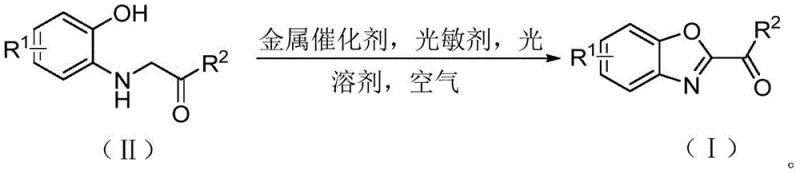 As illustrated in the reaction scheme, N-arylglycine derivatives undergo a seamless transformation into the target 2-substituted benzoxazoles through a radical-mediated pathway facilitated by the dual catalytic system. This mildness allows for the preservation of sensitive functional groups that would otherwise degrade under thermal stress. From a commercial perspective, this translates to a drastically simplified operational workflow where energy inputs are minimized, and the reliance on hazardous reagents is virtually eliminated. The simplicity of the setup—requiring only a light source and standard glassware—makes it highly attractive for both laboratory optimization and eventual plant-scale implementation.
Mechanistic Insights into Visible Light Photocatalytic Cyclization
The success of this transformation hinges on the sophisticated interplay between the photosensitizer, typically Ru(bpy)3Cl2·6H2O, and the transition metal catalyst, preferably cuprous iodide (CuI). Upon irradiation with blue LED light, the ruthenium complex absorbs photons to reach an excited state, initiating a single-electron transfer (SET) process. This photo-excited species interacts with the copper catalyst and the substrate to generate reactive radical intermediates. Specifically, the mechanism likely involves the oxidation of the alpha-amino acid derivative to an iminium ion or a radical cation, followed by nucleophilic attack from the phenolic oxygen. The presence of air is critical, as it serves to regenerate the active catalytic species and accept electrons, closing the catalytic cycle while producing water as the only byproduct. This redox-neutral or oxidative nature ensures high atom efficiency. For technical teams, understanding this mechanism is vital for troubleshooting and optimizing reaction parameters such as light intensity and oxygen flow rates to maximize turnover numbers and minimize catalyst loading.
Furthermore, the choice of catalysts plays a pivotal role in controlling the impurity profile of the final product. The use of copper salts, which are significantly cheaper and less toxic than precious metals like palladium or iridium often used in cross-coupling reactions, reduces the burden of heavy metal removal—a critical step in pharmaceutical manufacturing. The mild conditions prevent side reactions such as polymerization or over-oxidation that are common in thermal processes. The patent data indicates that various substituents on the aromatic ring, whether electron-donating methyl groups or electron-withdrawing chlorine atoms, are well-tolerated, suggesting a robust electronic flexibility in the catalytic cycle. This broad scope ensures that the process can be adapted for a wide library of benzoxazole derivatives without requiring extensive re-optimization for each new analog, thereby accelerating the drug discovery timeline and ensuring consistent quality across different batches of commercial production.
How to Synthesize 2-Substituted Benzoxazole Efficiently
The practical implementation of this visible light catalyzed synthesis is straightforward and designed for reproducibility. The protocol involves dissolving the N-arylglycine substrate in a polar aprotic solvent, adding the catalytic amounts of copper iodide and the ruthenium photosensitizer, and exposing the mixture to blue light. The reaction progress is easily monitored by thin-layer chromatography (TLC), typically reaching completion within 12 to 16 hours. Following the reaction, standard workup procedures involving solvent evaporation and column chromatography yield the pure product. The detailed standardized synthesis steps, including precise molar ratios and specific equipment configurations required for scaling, are outlined below to ensure successful replication in your facility.
- Prepare the reaction mixture by combining N-arylglycine derivative substrate, cuprous iodide catalyst (15 mol%), and Ru(bpy)3Cl2·6H2O photosensitizer (5 mol%) in acetonitrile solvent.
- Stir the mixture at room temperature (25°C) under an air atmosphere while irradiating with a blue LED light source for 12 to 16 hours.
- Monitor reaction completion via TLC, then concentrate the solution and purify the crude product using column chromatography to isolate the target benzoxazole.
Commercial Advantages for Procurement and Supply Chain Teams
For procurement managers and supply chain strategists, the adoption of this photocatalytic route offers substantial strategic benefits beyond mere technical novelty. The shift from thermal to photochemical processing fundamentally alters the cost structure of manufacturing benzoxazole intermediates. By operating at room temperature, the process eliminates the capital expenditure and ongoing operational costs associated with high-energy heating systems and specialized pressure vessels. The use of air as the oxidant removes the need for purchasing, storing, and handling hazardous chemical oxidants, thereby reducing raw material costs and improving workplace safety. Additionally, the simplified purification process, driven by fewer side reactions, leads to higher overall yields and reduced solvent consumption during workup. These factors collectively contribute to a leaner, more agile supply chain capable of responding rapidly to market demands while maintaining strict cost controls.
- Cost Reduction in Manufacturing: The elimination of expensive transition metals like palladium in favor of abundant copper salts significantly lowers the direct material cost of the catalyst system. Moreover, the avoidance of high-temperature conditions results in drastic energy savings, as no external heating is required throughout the reaction duration. The use of molecular oxygen from air as the terminal oxidant further reduces reagent costs compared to stoichiometric oxidants used in traditional methods. These cumulative savings allow for a more competitive pricing structure for the final benzoxazole intermediates, enhancing margin potential for downstream pharmaceutical applications without compromising on quality standards.
- Enhanced Supply Chain Reliability: The starting materials, N-arylglycine derivatives, are readily available and structurally diverse, ensuring a stable supply of feedstock for continuous production. The robustness of the reaction conditions means that the process is less susceptible to fluctuations in utility supplies, such as steam pressure, which can disrupt thermal processes. The mild nature of the reaction also extends the lifespan of reactor equipment by reducing corrosion and thermal stress, leading to lower maintenance downtime. This reliability ensures consistent delivery schedules for clients, mitigating the risk of production delays that can impact the broader drug development timeline and inventory management strategies.
- Scalability and Environmental Compliance: Scaling photochemical reactions has historically been challenging, but advancements in flow chemistry and LED technology have made this increasingly viable. The benign nature of the reagents and the absence of toxic byproducts simplify waste treatment protocols, ensuring compliance with stringent environmental regulations. The process generates minimal hazardous waste, primarily consisting of aqueous streams and spent solvents that are easier to treat than the acidic sludge from traditional condensation reactions. This environmental friendliness not only reduces disposal costs but also aligns with the sustainability goals of major pharmaceutical companies, making the supplier a more attractive partner for long-term contracts focused on green chemistry initiatives.
Frequently Asked Questions (FAQ)
The following questions address common technical and commercial inquiries regarding the implementation of this visible light catalyzed synthesis. These answers are derived directly from the experimental data and technical specifications provided in the patent documentation to ensure accuracy and relevance for industrial application. Understanding these nuances is essential for evaluating the feasibility of integrating this technology into existing manufacturing workflows.
Q: What are the primary advantages of this visible light method over traditional thermal cyclization?
A: Unlike traditional methods requiring harsh acidic conditions and high temperatures, this protocol operates at room temperature using air as a green oxidant, significantly reducing energy consumption and safety risks associated with high-pressure reactors.
Q: Is this process suitable for large-scale manufacturing of pharmaceutical intermediates?
A: Yes, the use of inexpensive copper salts and robust organic solvents like acetonitrile, combined with mild reaction conditions, makes this pathway highly amenable to commercial scale-up without the need for specialized high-energy equipment.
Q: What is the scope of substrates compatible with this catalytic system?
A: The method demonstrates broad substrate tolerance, successfully converting various N-arylglycine esters and amides bearing electron-donating or electron-withdrawing groups into the corresponding 2-substituted benzoxazoles with good yields.
Partnering with NINGBO INNO PHARMCHEM: Your Reliable 2-Substituted Benzoxazole Supplier
At NINGBO INNO PHARMCHEM, we recognize the transformative potential of visible light catalysis in modern organic synthesis. Our team of expert chemists possesses extensive experience scaling diverse pathways from 100 kgs to 100 MT/annual commercial production, ensuring that innovative laboratory methods like this are seamlessly translated into robust industrial processes. We are committed to delivering high-purity 2-substituted benzoxazole compounds that meet the rigorous quality standards required by the global pharmaceutical industry. Our state-of-the-art facilities are equipped with advanced photoreactors and stringent purity specifications, supported by rigorous QC labs that utilize cutting-edge analytical techniques to guarantee batch-to-batch consistency and regulatory compliance for every shipment we deliver.
We invite you to explore how this advanced synthetic route can optimize your supply chain and reduce your overall manufacturing costs. Contact our technical procurement team today to request a Customized Cost-Saving Analysis tailored to your specific project needs. We are ready to provide specific COA data and comprehensive route feasibility assessments to demonstrate how our capabilities can support your next breakthrough in drug development. Let us be your partner in turning complex chemical challenges into commercial successes.