
Advanced Organic Semiconductor Material Synthesis for High-Performance OLED Display & Optoelectronic Materials
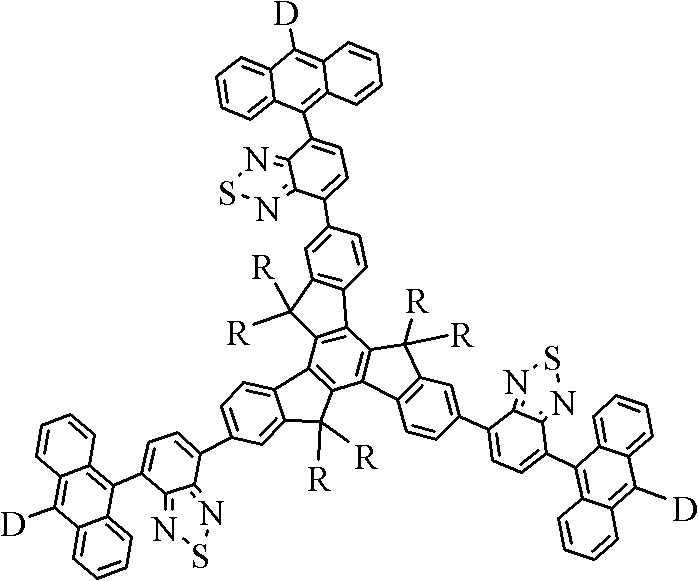
The rapid evolution of the optoelectronic industry demands materials that can withstand the rigorous performance standards of next-generation display technologies. Patent CN102807534A introduces a breakthrough organic semiconductor material designed specifically to address the critical limitations of blue light-emitting devices. This innovation utilizes a truxene core concurrently integrated with anthracene and diazosulfide units, creating a molecular architecture that stabilizes luminous efficiency and enhances film-forming performance. As a reliable organic semiconductor material supplier, we recognize that achieving panchromatic luminous efficiency requires solving the inherent instability of blue emitters. This patent provides a robust chemical solution that not only improves carrier transmission performance but also ensures the long-term operational stability required for commercial OLED panels. The structural design facilitates a balance between electron-donating and electron-deficient groups, which is paramount for high-efficiency electroluminescence.
The Limitations of Conventional Methods vs. The Novel Approach
The Limitations of Conventional Methods
Historically, the development of organic electroluminescent flat-panel monitors has been hindered by the poor performance of blue emitting materials. Conventional methods often suffer from low luminous efficiency and inadequate stability, which negatively impacts the overall device lifespan and color purity. Traditional small molecule emitters frequently exhibit poor film-forming properties, leading to crystallization issues that degrade performance over time. Furthermore, achieving a balance between hole and electron mobility in prior art materials has proven difficult, resulting in inefficient charge recombination zones. These technical bottlenecks have slowed the adoption of large-area white-light illuminating tools and high-resolution displays. The reliance on complex, multi-step syntheses with low yields in older methodologies further exacerbates cost and supply chain challenges for manufacturers seeking reliable organic semiconductor material supplier partnerships.
The Novel Approach
The novel approach detailed in the patent overcomes these hurdles by employing a truxene core as the central structural motif. This rigid core is functionalized with anthracene units, which significantly improve the stability of the organic semiconductor material and realize stabilized illumination. Simultaneously, the introduction of alkyl fatty chains as electron-donating groups enhances hole mobility and solubility, ensuring excellent film-forming properties during device fabrication. By incorporating diazosulfide as an electron-deficiency group, the material achieves a remarkable lifting of electroluminescent efficiency through improved electron transfer rates. This dual-functional design ensures charge balance within the emissive layer, significantly promoting luminous efficiency. The preparation method is characterized by simple operation and low cost, making it highly suitable for industrial production and cost reduction in display & optoelectronic materials manufacturing.
Mechanistic Insights into Truxene-Catalyzed Structural Assembly
The mechanistic success of this material lies in the precise orchestration of electronic properties within the molecular framework. The truxene core acts as a stable platform, while the anthracene units provide the necessary conjugation length for efficient light emission. The alkyl chains attached to the anthracene serve a dual purpose: they act as electron-donating groups to boost hole mobility and simultaneously improve the solubility of the high-purity organic semiconductor material in common organic solvents. This solubility is critical for solution-processable manufacturing techniques. On the opposite end of the electronic spectrum, the diazosulfide units function as strong electron-withdrawing groups. This creates an internal push-pull electronic system that facilitates rapid electron transfer. The coexistence of these electron-donating and electron-deficiency groups helps realize charge balance, which is the fundamental requirement for maximizing the external quantum efficiency of the OLED device.
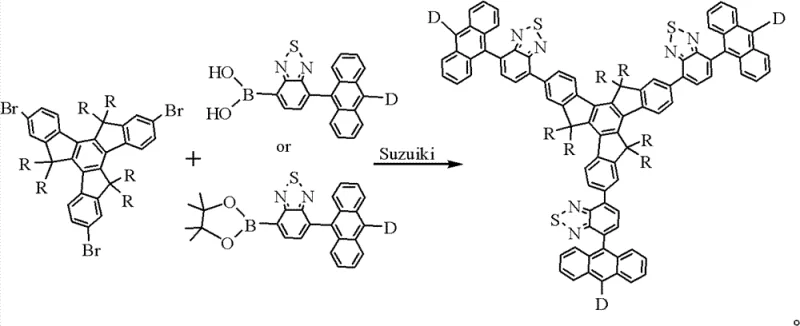
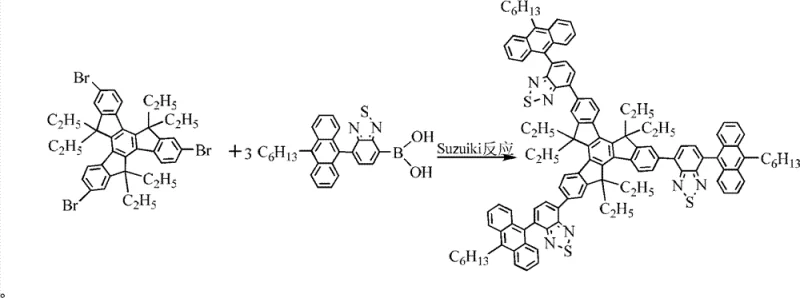
Impurity control is managed through the specificity of the Suzuki coupling reaction used in the final assembly step. The reaction conditions, operating between 60-130°C for 20-40 hours, allow for complete conversion of the brominated truxene intermediates. The use of specific palladium catalysts, such as Pd(PPh3)4 or Pd2(dba)3, ensures high selectivity, minimizing the formation of homocoupling byproducts. The purification process involves standard silica gel column chromatography, which effectively removes catalyst residues and unreacted starting materials. This rigorous control over the synthetic pathway ensures that the final commercial scale-up of complex organic semiconductor materials meets the stringent purity specifications required for electronic applications. The structural integrity of the truxene core prevents degradation under thermal stress, further contributing to the material's stability profile.
How to Synthesize Truxene-Based Organic Semiconductor Efficiently
The synthesis of this advanced material follows a logical, multi-step pathway that begins with the construction of the truxene core. The process initiates with the acid-catalyzed trimerization of 1-indanone, followed by alkylation to introduce solubility-enhancing groups. Subsequent bromination activates the core for cross-coupling. The detailed standardized synthesis steps see the guide below, which outlines the precise molar ratios and temperature controls necessary for reproducibility. This route is designed to be robust, allowing for the commercial scale-up of complex organic semiconductor materials without compromising on yield or purity. The use of readily available starting materials like 1-indanone and anthracene derivatives ensures a stable supply chain for production.
- Synthesize the truxene core by refluxing 1-indanone with acetic acid and concentrated hydrochloric acid at 100-120°C for 20-24 hours.
- Perform alkylation using n-Butyl Lithium at -78°C followed by 1-bromoalkane addition to introduce solubility-enhancing alkyl chains.
- Execute the final Suzuki coupling reaction between the brominated truxene derivative and the anthracene-benzothiadiazole boronic acid at 60-130°C.
Commercial Advantages for Procurement and Supply Chain Teams
For procurement and supply chain leaders, this patent represents a significant opportunity to optimize manufacturing costs and secure material availability. The synthesis route avoids exotic reagents, relying instead on commodity chemicals and standard catalytic processes. This simplicity translates directly into reduced lead time for high-purity organic semiconductor materials, as sourcing raw materials becomes more predictable. The robust nature of the Suzuki coupling reaction means that the process is forgiving and scalable, reducing the risk of batch failures. By adopting this technology, manufacturers can achieve substantial cost savings through improved yields and simplified purification workflows. The enhanced stability of the material also reduces waste associated with device failure, contributing to overall cost reduction in display & optoelectronic materials manufacturing.
- Cost Reduction in Manufacturing: The preparation method is explicitly described as having low cost and simple operation, which eliminates the need for complex, multi-stage purification protocols often required by less stable emitters. The use of standard palladium catalysts allows for established recovery and recycling protocols, further minimizing raw material expenses. By improving the luminous efficiency of the device, less material is required per unit area to achieve the same brightness, driving down the cost per panel. These qualitative improvements in process efficiency directly impact the bottom line without requiring speculative financial projections.
- Enhanced Supply Chain Reliability: The starting materials, including 1-indanone and various anthracene derivatives, are commercially available and can be sourced from multiple suppliers. This diversity in sourcing mitigates the risk of supply disruptions that often plague specialty chemical markets. The synthetic route is robust and does not rely on sensitive conditions that would require specialized infrastructure, making it easier to qualify multiple manufacturing sites. This flexibility ensures reducing lead time for high-purity organic semiconductor materials, allowing procurement teams to maintain leaner inventories while meeting production schedules.
- Scalability and Environmental Compliance: The reaction conditions, ranging from 60-130°C, are well within the operational limits of standard industrial reactors, facilitating the commercial scale-up of complex organic semiconductor materials. The solvents used, such as THF and dichloromethane, are common in the industry and have established waste management protocols. The high yields reported in the embodiments (e.g., 70-96% for intermediates) indicate a process that generates minimal waste relative to product output. This efficiency supports environmental compliance goals by reducing the volume of chemical waste requiring treatment.
Frequently Asked Questions (FAQ)
The following questions address common technical and commercial inquiries regarding the implementation of this organic semiconductor material. These answers are derived directly from the technical specifications and beneficial effects outlined in the patent data. Understanding these details is crucial for R&D teams evaluating the material for integration into existing OLED architectures. The information provided here serves as a foundation for deeper technical discussions with our engineering team.
Q: How does the truxene core improve OLED stability compared to conventional materials?
A: The truxene core provides a rigid, planar structure that enhances thermal stability and film-forming properties, preventing crystallization during device operation.
Q: What is the role of the diazosulfide unit in this semiconductor material?
A: The diazosulfide unit acts as an electron-deficient group that significantly improves the electron transfer rate, balancing charge transport within the emissive layer.
Q: Is this synthesis route suitable for large-scale industrial production?
A: Yes, the patent explicitly states the method features simple operation and low cost, utilizing standard Suzuki coupling conditions amenable to ton-scale manufacturing.
Partnering with NINGBO INNO PHARMCHEM: Your Reliable Organic Semiconductor Material Supplier
At NINGBO INNO PHARMCHEM, we possess extensive experience scaling diverse pathways from 100 kgs to 100 MT/annual commercial production, ensuring that your transition from lab to fab is seamless. Our commitment to quality is backed by stringent purity specifications and rigorous QC labs that verify every batch against the highest industry standards. We understand that the performance of your final display product depends on the consistency of the organic semiconductor material supplied. Our team is ready to support your specific needs, offering a partnership that goes beyond simple transaction to become a strategic asset in your supply chain.
We invite you to initiate a conversation with our technical procurement team to discuss how this technology can benefit your specific application. Request a Customized Cost-Saving Analysis to understand the potential economic impact of switching to this more efficient material. We are prepared to provide specific COA data and route feasibility assessments to accelerate your evaluation process. Let us help you engineer the next generation of high-performance displays.
Engineering Bottleneck?
Can't scale up this synthesis? Upload your target structure or CAS, and our CDMO team will evaluate the industrial feasibility within 24 hours. Request Evaluation →