
Advanced Palladium-Catalyzed Synthesis of 1,2,4-Triazole-3-One Compounds for Commercial Scale-Up
Introduction to Next-Generation Triazole Synthesis
The pharmaceutical and fine chemical industries are constantly seeking robust methodologies to construct nitrogen-containing heterocycles, which serve as critical scaffolds in drug discovery. A significant breakthrough in this domain is detailed in patent CN112538054B, which discloses a highly efficient preparation method for 1,2,4-triazole-3-one compounds. These heterocyclic structures are ubiquitous in bioactive molecules, exhibiting a wide spectrum of pharmacological activities including antifungal, anti-inflammatory, antitumor, antiviral, and anticonvulsant properties. As illustrated in the structural diversity of known bioactive agents, the ability to rapidly access these cores with high purity is paramount for accelerating drug development pipelines. The disclosed technology represents a paradigm shift from classical condensation reactions to a modern transition-metal catalyzed approach, offering a reliable pharmaceutical intermediate supplier pathway for complex molecule assembly.
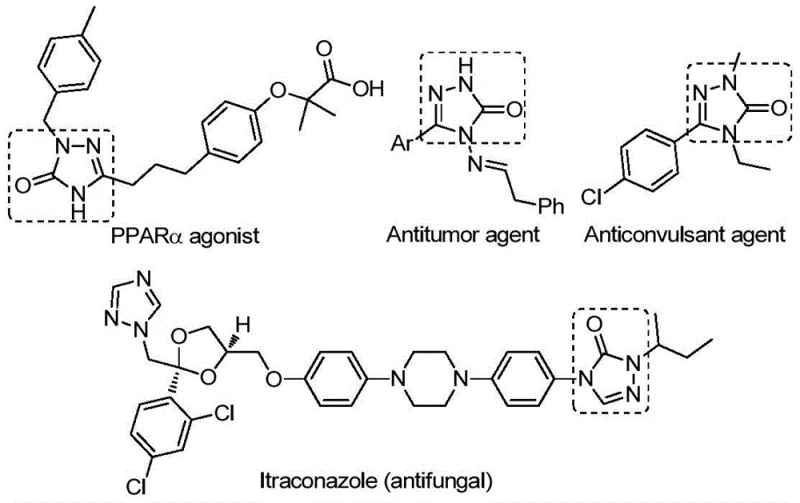
The strategic importance of this synthesis lies in its versatility and operational simplicity. Traditional routes often struggle with limited substrate scope and demanding reaction parameters, creating bottlenecks in the supply chain for high-purity OLED material or API precursors. By leveraging a palladium-catalyzed carbonylation tandem cyclization strategy, this invention overcomes historical limitations, enabling the synthesis of diverse derivatives substituted with different functional groups. This capability is essential for medicinal chemists aiming to explore structure-activity relationships (SAR) without being constrained by synthetic feasibility. Furthermore, the method's compatibility with scalable conditions positions it as a viable candidate for cost reduction in electronic chemical manufacturing and broader pharmaceutical applications.
The Limitations of Conventional Methods vs. The Novel Approach
The Limitations of Conventional Methods
Historically, the construction of the 1,2,4-triazole-3-one core has relied on several classical methodologies that are increasingly viewed as obsolete for modern large-scale production. Common traditional strategies include the cyclization of benzoyl hydrazide with urea under strong basic conditions, or the tandem cyclization of hydrazides with isocyanates. Other approaches involve the condensation of thioamides with hydrazines at elevated temperatures or the reaction of acyl isocyanates with monosubstituted hydrazines. These legacy methods are plagued by significant drawbacks that hinder their utility in a commercial setting. They typically require harsh reaction conditions, such as extreme pH levels or very high temperatures, which can degrade sensitive functional groups and lead to complex impurity profiles. Additionally, these processes often necessitate the pre-activation of substrates, adding extra synthetic steps that reduce overall atom economy and increase waste generation. The narrow substrate scope of these conventional techniques means that introducing diverse substituents often requires entirely different synthetic routes, complicating process development and increasing lead time for high-purity pharmaceutical intermediates.
The Novel Approach
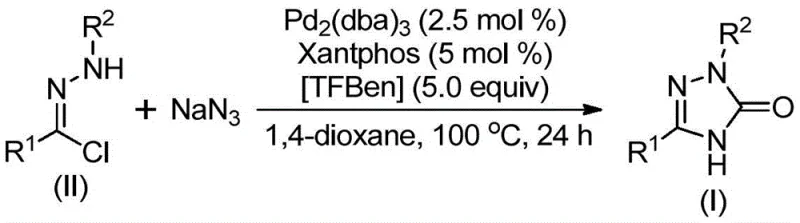
In stark contrast to these cumbersome legacy protocols, the novel method described in the patent utilizes a transition metal palladium-catalyzed carbonylation tandem cyclization reaction. This innovative approach starts from readily available and inexpensive chlorohydrazones and sodium azide, bypassing the need for hazardous isocyanates or difficult-to-handle urea derivatives. The core of this transformation involves the use of a palladium catalyst system, specifically tridibenzylideneacetone dipalladium paired with a Xantphos ligand, and TFBen serving as a safe solid carbon monoxide substitute. This combination allows the reaction to proceed under relatively mild thermal conditions, typically around 100°C in an aprotic solvent like 1,4-dioxane. The result is a streamlined one-pot process that efficiently constructs the triazole ring while installing the ketone functionality simultaneously. This methodology not only simplifies the operational workflow but also dramatically expands the range of accessible chemical space, allowing for the synthesis of compounds with aryl, alkyl, and heteroaryl substituents that were previously difficult to access. The reaction scheme below highlights the elegance of this transformation, converting simple starting materials directly into the valuable heterocyclic core.
Mechanistic Insights into Pd-Catalyzed Carbonylation Cyclization
Understanding the mechanistic underpinnings of this transformation is crucial for R&D directors focused on process optimization and impurity control. The reaction is believed to initiate with the oxidative addition of the palladium(0) catalyst into the carbon-chlorine bond of the chlorohydrazone substrate, generating a reactive divalent palladium intermediate. Simultaneously, the solid CO source, TFBen, undergoes thermal decomposition to release carbon monoxide in situ. This generated CO then inserts into the carbon-palladium bond, forming an acyl-palladium species. This step is critical as it avoids the safety hazards associated with handling high-pressure CO gas cylinders, making the process inherently safer for commercial scale-up of complex polymer additives or fine chemicals. Subsequently, the acyl-palladium intermediate reacts with sodium azide to form an acyl azide compound. This unstable intermediate rapidly undergoes a Curtius rearrangement, losing nitrogen gas to generate an isocyanate intermediate in situ. Finally, an intramolecular nucleophilic addition occurs where the hydrazine nitrogen attacks the electrophilic carbon of the isocyanate, closing the ring to yield the final 1,2,4-triazole-3-one product. This cascade sequence is highly efficient, minimizing the accumulation of reactive intermediates that could lead to side reactions.
From an impurity control perspective, the mild nature of this catalytic cycle offers distinct advantages over traditional high-temperature condensations. The use of a specific ligand system (Xantphos) stabilizes the palladium center, preventing the formation of palladium black and ensuring consistent catalytic turnover. This stability reduces the likelihood of homocoupling side products or dehalogenated byproducts that often plague cross-coupling reactions. Furthermore, the use of sodium azide in slight excess ensures complete consumption of the acyl-palladium intermediate, driving the reaction towards the desired Curtius rearrangement pathway. The choice of 1,4-dioxane as the solvent is also mechanistically significant; as an aprotic solvent, it effectively solubilizes the organic substrates while promoting the necessary coordination steps without interfering with the nucleophilic attacks. This precise control over the reaction environment results in a cleaner crude reaction profile, simplifying downstream purification and ensuring that the final product meets stringent purity specifications required for regulatory submissions.
How to Synthesize 1,2,4-Triazole-3-One Efficiently
Implementing this synthesis in a laboratory or pilot plant setting requires adherence to specific protocol parameters to maximize yield and reproducibility. The process is designed to be operationally simple, involving the charging of reagents into a standard reaction vessel followed by heating. The key to success lies in the precise stoichiometric balance between the chlorohydrazone, sodium azide, and the palladium catalyst system. While the reaction is robust, maintaining the recommended temperature range of 100°C to 120°C is essential to activate the CO surrogate without decomposing the sensitive azide components prematurely. The following section outlines the standardized procedure derived from the patent examples, providing a clear roadmap for technical teams to replicate these high-efficiency results.
- Combine palladium catalyst Pd2(dba)3, Xantphos ligand, TFBen, chlorohydrazone substrate, and sodium azide in an organic solvent like 1,4-dioxane.
- Heat the reaction mixture to 100°C and maintain stirring for 16 to 30 hours to ensure complete conversion.
- Perform post-treatment including filtration and silica gel mixing, followed by column chromatography purification to isolate the final product.
Commercial Advantages for Procurement and Supply Chain Teams
For procurement managers and supply chain heads, the adoption of this novel synthetic route offers tangible strategic benefits that extend beyond mere chemical curiosity. The primary advantage lies in the significant simplification of the raw material supply chain. Unlike traditional methods that may require custom-synthesized isocyanates or specialized activated esters, this process relies on chlorohydrazones and sodium azide, which are commodity chemicals available from multiple global suppliers. This diversification of the supply base mitigates the risk of single-source dependency and enhances supply chain reliability, ensuring continuous production even during market fluctuations. Furthermore, the elimination of hazardous gas handling infrastructure (for CO) reduces capital expenditure requirements for new production lines, allowing for faster deployment of manufacturing capacity. The operational simplicity also translates to reduced labor costs and lower training requirements for plant operators, contributing to overall cost reduction in pharmaceutical intermediate manufacturing.
- Cost Reduction in Manufacturing: The economic viability of this process is driven by the use of inexpensive starting materials and a highly efficient catalytic system. By avoiding multi-step pre-activation sequences and utilizing a tandem reaction that builds complexity in a single pot, the overall material throughput is significantly improved. The high yields reported, reaching up to 96% for certain substrates, mean that less raw material is wasted, directly lowering the cost of goods sold (COGS). Additionally, the simplified workup procedure, which involves basic filtration and chromatography, reduces solvent consumption and waste disposal costs compared to the extensive aqueous workups often required for traditional methods. This efficiency creates a leaner manufacturing process that is highly competitive in price-sensitive markets.
- Enhanced Supply Chain Reliability: The robustness of the reaction conditions contributes to a more predictable production schedule. The tolerance for various functional groups means that the same core process can be adapted for a wide library of derivatives without needing to requalify entirely new synthetic routes for each analog. This flexibility allows manufacturers to respond quickly to changing demand patterns for different API intermediates. Moreover, the use of stable solid reagents like TFBen eliminates the logistical challenges and safety regulations associated with transporting and storing compressed gases. This simplification of logistics ensures that production is less susceptible to external disruptions, providing a steady flow of high-quality intermediates to downstream customers.
- Scalability and Environmental Compliance: Scaling chemical processes from the bench to the plant floor often introduces new challenges, but this methodology is inherently designed for scalability. The use of a homogeneous catalytic system in a common solvent like dioxane facilitates heat transfer and mixing in large reactors. The absence of highly exothermic steps or dangerous high-pressure gas inputs makes the process safer to operate at the 100 kg to 100 MT scale. From an environmental perspective, the atom economy of the tandem cyclization is superior to stepwise condensations, resulting in less chemical waste. The ability to achieve high conversion rates also minimizes the burden on wastewater treatment facilities, aligning with increasingly strict global environmental regulations and supporting sustainable manufacturing practices.
Frequently Asked Questions (FAQ)
To assist technical decision-makers in evaluating this technology for their specific applications, we have compiled answers to common inquiries regarding the process details and capabilities. These insights are derived directly from the experimental data and technical disclosures within the patent documentation, ensuring accuracy and relevance for process development teams. Understanding these nuances is critical for assessing the feasibility of integrating this synthesis into existing production workflows or new product introductions.
Q: What are the advantages of using TFBen over traditional CO gas in this synthesis?
A: TFBen (1,3,5-tricarboxylic acid phenol ester) acts as a safe and solid carbon monoxide substitute, eliminating the need for high-pressure CO gas equipment and significantly improving operational safety and scalability in industrial settings.
Q: What is the substrate compatibility of this palladium-catalyzed method?
A: The method demonstrates excellent functional group tolerance, successfully accommodating various substituents including alkyl groups, aryl groups with electron-donating or withdrawing groups (like halogens and methoxy), and heterocycles such as furan and naphthyl.
Q: How does this method compare to traditional cyclization routes in terms of yield?
A: Unlike traditional methods which often suffer from harsh conditions and low yields, this novel approach achieves high reaction efficiency with isolated yields reaching up to 96% for optimized substrates, ensuring better material throughput.
Partnering with NINGBO INNO PHARMCHEM: Your Reliable 1,2,4-Triazole-3-One Supplier
At NINGBO INNO PHARMCHEM, we recognize the critical role that advanced synthetic methodologies play in accelerating drug discovery and commercialization. Our team of expert chemists has thoroughly analyzed the potential of the palladium-catalyzed carbonylation route described in CN112538054B and is fully prepared to leverage this technology for your projects. We possess extensive experience scaling diverse pathways from 100 kgs to 100 MT/annual commercial production, ensuring that the transition from laboratory bench to industrial reactor is seamless and efficient. Our state-of-the-art facilities are equipped with rigorous QC labs capable of meeting stringent purity specifications, guaranteeing that every batch of 1,2,4-triazole-3-one intermediate we deliver meets the highest quality standards required by the global pharmaceutical industry.
We invite you to collaborate with us to unlock the full potential of this efficient synthesis for your pipeline. Whether you require custom synthesis of specific analogs or large-scale supply of the core scaffold, our technical procurement team is ready to support your needs. Contact us today to request a Customized Cost-Saving Analysis tailored to your specific volume requirements. We encourage you to reach out for specific COA data and route feasibility assessments to see how our expertise can drive value and efficiency in your supply chain.