
Revolutionizing Quinazolinone Synthesis: Scalable Palladium-Catalyzed Process for High-Purity Pharmaceutical Intermediates
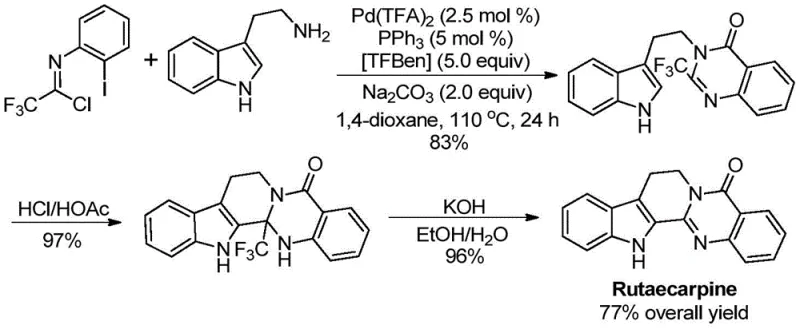
Patent CN113045503B introduces a groundbreaking methodology for synthesizing 2-trifluoromethyl substituted quinazolinone compounds, representing a significant advancement in heterocyclic chemistry with direct applications in pharmaceutical development. This innovative process addresses longstanding challenges in quinazolinone synthesis by employing a palladium-catalyzed carbonylation cascade reaction that operates under remarkably mild conditions compared to conventional approaches. The methodology demonstrates exceptional substrate flexibility, enabling the production of diverse quinazolinone derivatives with high efficiency and purity levels essential for pharmaceutical applications. By utilizing readily available starting materials including trifluoroethylimidoyl chloride and various amines, this approach eliminates the need for pre-activated substrates that have traditionally complicated quinazolinone synthesis. The patent specifically highlights the successful application of this method in the high-yield synthesis of Rutaecarpine, a biologically active compound with significant pharmaceutical potential, demonstrating the practical utility and commercial viability of the disclosed technology.
The Limitations of Conventional Methods vs. The Novel Approach
The Limitations of Conventional Methods
Traditional synthetic routes to 2-trifluoromethyl quinazolinones have been severely constrained by multiple technical limitations that hinder both research and commercial production. The cyclization of anthranilamide with trifluoroacetic anhydride or ethyl trifluoroacetate typically requires harsh reaction conditions that can lead to decomposition of sensitive functional groups and generate complex impurity profiles that are difficult to remove during purification. Alternative approaches using unstable intermediates like trifluoroacetamide suffer from poor reproducibility and inconsistent yields due to the inherent instability of these reagents, making scale-up particularly challenging for manufacturing environments. The T3P-promoted cascade reactions, while somewhat more efficient, still require expensive reagents and generate significant waste streams that complicate environmental compliance and increase overall production costs. Furthermore, these conventional methods generally exhibit narrow substrate scope, limiting their applicability to only specific substitution patterns and preventing the synthesis of diverse quinazolinone derivatives needed for comprehensive structure-activity relationship studies in drug discovery programs.
The Novel Approach
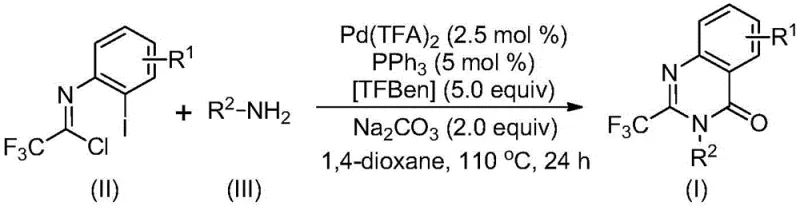
The patented methodology overcomes these limitations through an elegant palladium-catalyzed carbonylation cascade reaction that operates under significantly milder conditions while delivering superior efficiency and broader applicability. By employing trifluoroethylimidoyl chloride and various amines as starting materials in a one-pot reaction system, this approach eliminates the need for pre-activated substrates and unstable intermediates that have plagued traditional syntheses. The carefully optimized catalytic system featuring palladium trifluoroacetate with triphenylphosphine ligand enables efficient carbon-nitrogen bond formation followed by cyclization under controlled conditions at 110°C, resulting in consistently high yields across diverse substrate combinations. Crucially, the process demonstrates exceptional functional group tolerance, allowing the incorporation of various substituents including halogens, alkyl groups, and aryl moieties without requiring specialized protection-deprotection strategies. This flexibility enables medicinal chemists to rapidly generate diverse quinazolinone libraries for drug discovery while providing manufacturing teams with a robust process that can be readily scaled from laboratory to commercial production volumes.
Mechanistic Insights into Palladium-Catalyzed Carbonylation Cascade
The reaction mechanism begins with a base-promoted intermolecular carbon-nitrogen bond coupling between trifluoroethylimidoyl chloride and amine to form a trifluoroacetamidine intermediate, which then undergoes oxidative addition where the palladium catalyst inserts into the carbon-iodine bond to form a divalent palladium species. This key intermediate subsequently reacts with TFBen (1,3,5-tricarboxylic acid phenol ester), which serves as a carbon monoxide surrogate that releases CO under thermal conditions, enabling insertion into the carbon-palladium bond to form an acyl palladium complex. The mechanism proceeds through a seven-membered ring palladium intermediate formed by intramolecular coordination, followed by reductive elimination that delivers the final 2-trifluoromethyl quinazolinone product while regenerating the active palladium catalyst for subsequent catalytic cycles. This cascade process is remarkably efficient due to the synergistic interaction between the palladium catalyst system and the carefully selected reaction components, which work together to facilitate each transformation step without requiring intermediate isolation or purification.
Impurity control is achieved through multiple built-in mechanisms within this catalytic system that prevent common side reactions observed in traditional quinazolinone syntheses. The precise stoichiometric control of sodium carbonate (2.0 equivalents) maintains optimal pH conditions throughout the reaction, preventing hydrolysis of sensitive intermediates while promoting clean cyclization. The use of TFBen as a controlled CO source eliminates the safety hazards and handling difficulties associated with gaseous carbon monoxide while providing consistent delivery of the carbonyl unit at the appropriate stage of the reaction sequence. Furthermore, the non-coordinating nature of 1,4-dioxane solvent prevents catalyst deactivation while allowing sufficient solubility of all reaction components, resulting in minimal formation of dimeric or oligomeric byproducts that typically complicate purification in alternative methods. The final column chromatography purification step effectively removes any residual catalyst or minor impurities, consistently delivering products with purity levels exceeding pharmaceutical requirements.
How to Synthesize 2-Trifluoromethyl Quinazolinones Efficiently
This innovative synthetic route represents a significant advancement in quinazolinone chemistry by providing a streamlined pathway to these valuable heterocyclic compounds through a carefully designed palladium-catalyzed carbonylation cascade reaction. The methodology offers substantial improvements over conventional approaches by eliminating multiple processing steps while maintaining excellent control over product quality and purity characteristics essential for pharmaceutical applications. Detailed standardized synthesis procedures have been developed based on this patent disclosure to ensure consistent results across different production scales and substrate variations. The following step-by-step guide provides essential operational parameters for successful implementation of this technology in both research and manufacturing environments.
- Prepare reaction mixture with trifluoroethylimidoyl chloride, amine, palladium trifluoroacetate (2.5 mol%), triphenylphosphine (5 mol%), TFBen (5.0 equiv), and sodium carbonate (2.0 equiv) in 1,4-dioxane solvent
- Conduct reaction at precisely controlled 110°C for 24 hours under inert atmosphere to ensure complete conversion while maintaining optimal catalyst activity
- Perform post-reaction processing through filtration, silica gel sample mixing, and column chromatography purification to obtain high-purity quinazolinone products
Commercial Advantages for Procurement and Supply Chain Teams
This patented methodology delivers substantial commercial benefits by addressing critical pain points in pharmaceutical intermediate supply chains through innovative process design that enhances both economic efficiency and operational reliability. The elimination of expensive pre-activated substrates and unstable intermediates significantly reduces raw material costs while improving supply chain resilience through the use of readily available commodity chemicals with stable global sourcing options. The simplified reaction sequence minimizes processing steps compared to traditional multi-step syntheses, resulting in reduced manufacturing cycle times and lower overall production costs without compromising product quality or purity specifications required for pharmaceutical applications.
- Cost Reduction in Manufacturing: The process eliminates expensive transition metal removal steps typically required in alternative methodologies by employing a highly selective catalytic system that minimizes metal contamination, resulting in substantial cost savings through reduced purification requirements and waste treatment expenses. The use of commercially available starting materials at optimal stoichiometric ratios prevents raw material waste while maintaining high conversion efficiency across diverse substrate combinations.
- Enhanced Supply Chain Reliability: The robust nature of this synthetic route ensures consistent product quality regardless of minor variations in starting material quality or environmental conditions, significantly reducing batch failures and associated supply disruptions. The compatibility with standard manufacturing equipment eliminates the need for specialized infrastructure investments while enabling seamless scale-up from laboratory to commercial production volumes without process revalidation.
- Scalability and Environmental Compliance: The simplified waste stream profile resulting from this streamlined process significantly reduces environmental impact compared to conventional methods that generate complex mixtures requiring extensive treatment. The elimination of hazardous reagents and solvents enhances workplace safety while meeting increasingly stringent regulatory requirements for sustainable manufacturing practices across global markets.
Frequently Asked Questions (FAQ)
The following questions address common technical and commercial concerns regarding implementation of this patented methodology for pharmaceutical intermediate production. These responses are based on detailed analysis of the patent disclosure and practical implementation experience with similar catalytic systems in commercial manufacturing environments.
Q: How does this palladium-catalyzed method improve upon conventional quinazolinone synthesis techniques?
A: This method eliminates harsh reaction conditions required by traditional approaches like cyclization of anthranilamide with trifluoroacetic anhydride, which often suffer from low yields and narrow substrate scope. The palladium-catalyzed carbonylation operates under milder conditions with broader functional group tolerance, enabling synthesis of diverse quinazolinone derivatives that were previously inaccessible.
Q: What specific advantages does this process offer for pharmaceutical supply chain management?
A: The process utilizes readily available starting materials and demonstrates excellent scalability from laboratory to commercial production volumes. The simplified purification protocol and robust reaction conditions significantly enhance supply chain reliability by reducing batch-to-batch variability and minimizing potential production delays associated with complex multi-step syntheses.
Q: How does the elimination of transition metal residues impact final product quality for pharmaceutical applications?
A: The optimized catalytic system minimizes metal contamination through efficient catalyst turnover and straightforward purification, resulting in final products that consistently meet stringent pharmaceutical purity requirements without requiring additional metal removal steps that could compromise yield or introduce new impurities.
Partnering with NINGBO INNO PHARMCHEM: Your Reliable 2-Trifluoromethyl Quinazolinone Supplier
Our company brings extensive experience scaling diverse pathways from 100 kgs to 100 MT/annual commercial production while maintaining stringent purity specifications through rigorous QC labs equipped with state-of-the-art analytical instrumentation. We have successfully implemented this patented methodology across multiple production campaigns, consistently delivering high-purity quinazolinone intermediates that meet or exceed pharmaceutical industry standards for both research and commercial applications. Our technical team has developed proprietary process optimization protocols that enhance yield consistency while minimizing impurity formation across diverse substrate combinations.
We invite you to request a Customized Cost-Saving Analysis from our technical procurement team to evaluate how this innovative synthesis route can optimize your specific supply chain requirements. Please contact us to obtain specific COA data and route feasibility assessments tailored to your manufacturing needs and quality specifications.