
Advanced Palladium-Catalyzed Synthesis of Carbonyl-Bridged Biheterocyclic Intermediates for Pharmaceutical Applications
Introduction to Next-Generation Heterocyclic Synthesis
The landscape of pharmaceutical intermediate manufacturing is constantly evolving, driven by the need for more efficient, safer, and cost-effective synthetic routes. A significant breakthrough in this domain is detailed in patent CN115353511A, which discloses a novel preparation method for carbonyl-bridged biheterocyclic compounds. These specific molecular scaffolds, often comprising indolinone and imidazole motifs linked by a carbonyl bridge, are of immense value in medicinal chemistry due to their broad-spectrum biological activities and presence in numerous drug candidates. The traditional approaches to constructing such complex bis-heterocyclic systems often suffer from low atom economy, harsh reaction conditions, or the requirement for hazardous reagents. This new methodology addresses these critical pain points by employing a transition metal palladium-catalyzed carbonylation cascade reaction. By utilizing cheap and readily available starting materials such as trifluoroethylimidoyl chloride, propargylamine, and acrylamide derivatives, the process achieves high reaction efficiency without the need for toxic carbon monoxide gas. This represents a paradigm shift for reliable pharmaceutical intermediate suppliers looking to optimize their production pipelines while maintaining stringent safety standards.
The Limitations of Conventional Methods vs. The Novel Approach
The Limitations of Conventional Methods
Historically, the synthesis of biheterocyclic compounds has relied on three primary strategies, each carrying distinct disadvantages that hinder large-scale application. The first method involves the direct coupling of two pre-formed heterocycle substrates, which often requires multiple synthetic steps to prepare the precursors, leading to poor overall yields and increased waste generation. The second approach utilizes oxidative cyclization of substrates containing dual nucleophiles with activated methyl-substituted heterocycles; however, this frequently necessitates strong oxidants and elevated temperatures that can degrade sensitive functional groups. The third and perhaps most common historical method involves transition metal-catalyzed tandem cyclization, yet applying carbonylation reactions specifically to form carbonyl-bridged structures has remained a formidable challenge. Conventional carbonylation typically mandates the use of high-pressure carbon monoxide gas, posing severe safety risks and requiring specialized, expensive equipment that many contract manufacturing organizations lack. Furthermore, these older methods often exhibit limited substrate tolerance, failing when electron-withdrawing or bulky groups are present, thereby restricting the chemical diversity accessible to R&D teams.
The Novel Approach
In stark contrast to these legacy techniques, the method described in patent CN115353511A introduces a streamlined, one-pot multicomponent reaction that elegantly constructs the target scaffold in a single operation. This innovative route leverages a palladium catalyst system to orchestrate a cascade of bond-forming events, simultaneously building multiple chemical bonds with high precision. A key feature of this novelty is the replacement of gaseous CO with a liquid mixture of formic acid and acetic anhydride, which releases carbon monoxide in situ under mild conditions. This modification not only eliminates the need for high-pressure reactors but also dramatically improves the safety profile of the manufacturing process. The reaction proceeds efficiently at a mild temperature of 30°C, preserving sensitive functional groups and minimizing energy consumption. As illustrated in the reaction scheme below, the convergence of trifluoroethylimidoyl chloride, propargylamine, and acrylamide allows for the rapid assembly of complex trifluoromethyl-substituted biheterocycles.
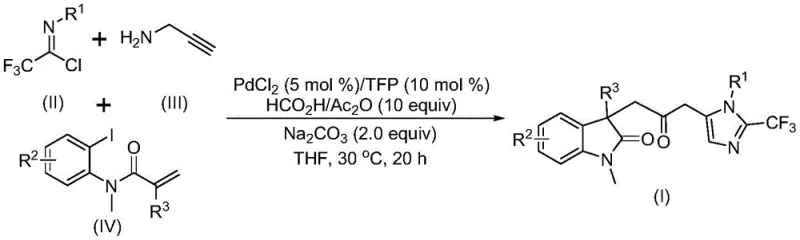
The versatility of this approach is further evidenced by its compatibility with a wide range of substituents, enabling the synthesis of diversified libraries essential for drug discovery campaigns. For procurement managers, this translates to a simplified supply chain where fewer distinct intermediates need to be sourced and stored, directly contributing to cost reduction in pharmaceutical intermediate manufacturing.
Mechanistic Insights into Pd-Catalyzed Carbonylation Cascade
Understanding the mechanistic underpinnings of this transformation is crucial for R&D directors evaluating its robustness and scalability. The reaction is believed to initiate with the oxidative addition of a zero-valent palladium species into the carbon-iodine bond of the acrylamide substrate. This is followed by an intramolecular Heck-type reaction, generating a divalent alkyl-palladium intermediate that sets the stage for ring closure. Crucially, the carbon monoxide required for the carbonyl bridge is generated in situ from the decomposition of the formic acid and acetic anhydride mixture. This CO inserts into the palladium-carbon bond to form an acyl-palladium intermediate, a pivotal step that distinguishes this carbonylative process from standard coupling reactions. Concurrently, the base-promoted reaction between trifluoroethylimidoyl chloride and propargylamine forms a trifluoroacetamidine species, which subsequently undergoes isomerization. The final cyclization event is catalyzed by the activation of this amidine compound by the acyl-palladium intermediate, ultimately yielding the stable carbonyl-bridged biheterocyclic product. This intricate dance of catalytic cycles ensures high selectivity and minimizes the formation of byproducts.
From an impurity control perspective, the mild reaction conditions (30°C) play a vital role in suppressing side reactions such as polymerization of the acrylamide or decomposition of the imidoyl chloride. The use of trifurylphosphine (TFP) as a ligand further stabilizes the palladium center, preventing the formation of palladium black and ensuring consistent catalytic turnover. For quality control teams, this mechanism implies a cleaner crude reaction profile, which simplifies downstream purification and reduces the burden on analytical resources. The ability to tolerate diverse functional groups—ranging from halogens to nitro groups—without interfering with the catalytic cycle underscores the chemical resilience of this pathway, making it a highly attractive option for synthesizing high-purity pharmaceutical intermediates with complex substitution patterns.
How to Synthesize Carbonyl-Bridged Biheterocyclic Compounds Efficiently
Implementing this synthesis in a laboratory or pilot plant setting requires careful attention to reagent stoichiometry and reaction parameters to maximize yield and purity. The protocol is designed to be operationally simple, avoiding the need for specialized high-pressure equipment or cryogenic conditions. Typically, the reaction is conducted in an aprotic organic solvent such as tetrahydrofuran (THF), which effectively dissolves all reactants and promotes the catalytic cycle. The molar ratios are optimized to ensure complete conversion, with propargylamine and acrylamide often used in slight excess relative to the trifluoroethylimidoyl chloride to drive the equilibrium forward. Post-reaction workup is straightforward, involving filtration to remove inorganic salts followed by standard silica gel column chromatography. The detailed standardized synthesis steps for this process are outlined in the guide below.
- Combine palladium chloride catalyst, TFP ligand, sodium carbonate base, and the CO source mixture (formic acid/acetic anhydride) in an organic solvent like THF.
- Add the three key substrates: trifluoroethylimidoyl chloride, propargylamine, and the substituted acrylamide derivative to the reaction vessel.
- Stir the mixture at 30°C for 12 to 20 hours, then filter and purify the crude product via silica gel column chromatography.
Commercial Advantages for Procurement and Supply Chain Teams
For procurement managers and supply chain heads, the adoption of this patented methodology offers tangible strategic benefits beyond mere chemical elegance. The primary advantage lies in the significant simplification of the raw material portfolio. By utilizing commodity chemicals like propargylamine and acrylamide, which are widely available from bulk chemical suppliers, companies can mitigate the risk of supply chain disruptions associated with exotic or custom-synthesized precursors. This accessibility directly translates to enhanced supply chain reliability, ensuring that production schedules are met without delays caused by material shortages. Furthermore, the elimination of toxic carbon monoxide gas removes the need for expensive safety infrastructure and specialized handling protocols, leading to substantial cost savings in facility operations and regulatory compliance.
- Cost Reduction in Manufacturing: The economic impact of this process is profound, primarily driven by the use of inexpensive starting materials and the avoidance of high-pressure equipment. Traditional carbonylation methods often require costly autoclaves and rigorous safety monitoring systems, which represent significant capital expenditure. By generating CO in situ from liquid reagents, this method allows the reaction to proceed in standard glass-lined or stainless steel reactors at atmospheric pressure. Additionally, the high atom economy of the multicomponent reaction means less waste is generated per kilogram of product, reducing disposal costs. The mild temperature requirement of 30°C also lowers energy consumption compared to processes requiring reflux or heating, contributing to a greener and more cost-efficient manufacturing footprint.
- Enhanced Supply Chain Reliability: The robustness of the substrate scope ensures that variations in raw material quality do not critically impact the reaction outcome. Since the method tolerates a wide array of functional groups, manufacturers have the flexibility to source alternative grades of starting materials if primary suppliers face issues. This flexibility is crucial for maintaining continuous production flows in the volatile chemical market. Moreover, the simplicity of the post-treatment process, which relies on standard filtration and chromatography, reduces the dependency on specialized purification resins or complex extraction protocols that might have long lead times. This operational resilience makes the supply of these critical intermediates more predictable and stable for downstream API manufacturers.
- Scalability and Environmental Compliance: Scaling chemical processes from the bench to the plant floor is often fraught with challenges, particularly regarding heat transfer and gas management. This method's reliance on liquid reagents for carbonylation inherently simplifies scale-up, as there is no need to manage the flow and pressure of toxic gases in large vessels. The patent data indicates successful expansion to gram-scale reactions, suggesting a clear path toward kilogram and ton-scale production. From an environmental standpoint, the reduction in hazardous waste and the avoidance of toxic gas emissions align with increasingly strict global environmental regulations. This compliance advantage reduces the administrative burden on EHS teams and minimizes the risk of regulatory fines, making it a sustainable choice for long-term production.
Frequently Asked Questions (FAQ)
The following questions address common technical and commercial inquiries regarding the implementation of this synthesis technology. These insights are derived directly from the experimental data and beneficial effects reported in the patent documentation, providing a clear picture of what partners can expect when adopting this route. Understanding these details helps in making informed decisions about process integration and resource allocation.
Q: What are the safety advantages of this carbonylation method compared to traditional methods?
A: Unlike traditional carbonylation which requires handling toxic carbon monoxide gas cylinders, this patented method generates CO in situ using a safe formic acid and acetic anhydride mixture, significantly reducing operational hazards.
Q: What is the substrate scope for the R1 and R3 groups in this synthesis?
A: The method demonstrates excellent compatibility, tolerating various substituents including alkyl, alkoxy, halogens (Cl, Br, F), trifluoromethyl, and nitro groups on the phenyl rings, allowing for diverse library synthesis.
Q: Is this process suitable for large-scale industrial production?
A: Yes, the patent explicitly mentions successful expansion to gram-scale reactions with simple post-treatment procedures, indicating strong potential for commercial scale-up in pharmaceutical manufacturing.
Partnering with NINGBO INNO PHARMCHEM: Your Reliable Carbonyl-Bridged Biheterocyclic Compounds Supplier
At NINGBO INNO PHARMCHEM, we recognize the transformative potential of advanced synthetic methodologies like the one described in CN115353511A for accelerating drug development timelines. As a premier CDMO partner, we possess extensive experience scaling diverse pathways from 100 kgs to 100 MT/annual commercial production, ensuring that your transition from bench-scale discovery to full-scale manufacturing is seamless. Our state-of-the-art facilities are equipped to handle complex palladium-catalyzed reactions with the utmost precision, adhering to stringent purity specifications required by global regulatory bodies. With our rigorous QC labs and dedicated process development teams, we guarantee that every batch of carbonyl-bridged biheterocyclic intermediates meets the highest standards of quality and consistency, ready for immediate integration into your API synthesis workflows.
We invite you to leverage our technical expertise to optimize your supply chain and reduce time-to-market for your critical pharmaceutical projects. Contact our technical procurement team today to request a Customized Cost-Saving Analysis tailored to your specific volume requirements. We are prepared to provide specific COA data and comprehensive route feasibility assessments to demonstrate how our capabilities align with your production goals. Let us be your partner in turning complex chemical challenges into commercial successes.