
Scalable Iron-Catalyzed Synthesis of 2-Trifluoromethyl Quinazolinones for Commercial API Production
Scalable Iron-Catalyzed Synthesis of 2-Trifluoromethyl Quinazolinones for Commercial API Production
The pharmaceutical industry continuously seeks robust and cost-effective synthetic routes for heterocyclic scaffolds that serve as critical building blocks for drug discovery and development. A significant breakthrough in this domain is documented in patent CN111675662B, which discloses a novel preparation method for 2-trifluoromethyl substituted quinazolinone compounds. This technology leverages an inexpensive iron catalyst system to facilitate the cyclization of readily available starting materials, addressing long-standing challenges regarding cost and scalability in the production of fluorinated heterocycles. The introduction of the trifluoromethyl group is particularly strategic, as it significantly enhances the electronegativity, metabolic stability, and lipophilicity of the target molecules, properties that are highly coveted in modern medicinal chemistry for improving bioavailability. By shifting away from expensive reagents and harsh conditions, this methodology offers a compelling value proposition for manufacturers aiming to optimize their supply chains for high-value pharmaceutical intermediates.
The Limitations of Conventional Methods vs. The Novel Approach
The Limitations of Conventional Methods
Historically, the synthesis of quinazolinone derivatives bearing trifluoromethyl functionalities has relied heavily on cyclization reactions involving specialized synthons such as trifluoroacetic anhydride or ethyl trifluoroacetate reacting with substrates like anthranilamide or isatoic anhydride. While these traditional pathways are chemically valid, they are often plagued by severe operational drawbacks that hinder their efficiency in a commercial setting. The reaction conditions required for these conventional methods are frequently harsh, necessitating extreme temperatures or pressures that increase energy consumption and safety risks. Furthermore, the starting materials, particularly the trifluoromethyl synthons, can be prohibitively expensive and difficult to source in bulk quantities, leading to volatile pricing and supply chain instability. Additionally, these older methods often suffer from narrow substrate scope and low yields, generating significant chemical waste and requiring complex purification steps to remove impurities, which ultimately drives up the cost of goods sold for the final active pharmaceutical ingredient.
The Novel Approach
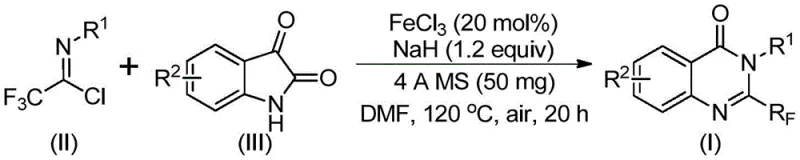
In stark contrast to the limitations of prior art, the method described in patent CN111675662B utilizes a strategy centered on the reaction between trifluoroethylimidoyl chloride and isatin derivatives. This innovative approach replaces costly reagents with cheap and easily obtainable raw materials, fundamentally altering the economic landscape of the synthesis. The core of this novelty lies in the use of ferric chloride (FeCl3) as a catalyst, which is not only abundant and inexpensive but also exhibits remarkable catalytic activity under the specified conditions. The process demonstrates excellent functional group tolerance, allowing for the synthesis of a diverse array of quinazolinone derivatives with substituents at various positions on the aromatic rings. This versatility means that a single optimized protocol can be applied to generate a library of compounds, streamlining the R&D process and accelerating the timeline from benchtop discovery to pilot plant production without the need for extensive re-optimization for each new analog.
Mechanistic Insights into FeCl3-Catalyzed Cyclization
The mechanistic pathway of this transformation is a sophisticated interplay of base-promoted bond formation and transition metal catalysis. Initially, the reaction involves an alkali-promoted formation of carbon-nitrogen bonds between the trifluoroethylimidoyl chloride and the isatin substrate. This step is facilitated by sodium hydride, which acts as a strong base to deprotonate the isatin nitrogen, rendering it nucleophilic enough to attack the imidoyl chloride. Following this initial coupling, the system undergoes a crucial iron-catalyzed decarbonylation and cyclization sequence. The ferric chloride coordinates with the intermediate species, lowering the activation energy required for the loss of carbon monoxide and the subsequent ring closure to form the stable quinazolinone core. This decarbonylative cyclization is the key step that differentiates this method from simple condensation reactions, allowing for the direct installation of the trifluoromethyl group at the 2-position with high regioselectivity.
From an impurity control perspective, the use of 4A molecular sieves in the reaction mixture plays a pivotal role in maintaining high product purity. These sieves effectively scavenge trace amounts of water that could otherwise hydrolyze the sensitive imidoyl chloride starting material or deactivate the Lewis acidic iron catalyst. By maintaining anhydrous conditions within the reaction vessel, the formation of hydrolysis byproducts is minimized, leading to a cleaner crude reaction profile. Furthermore, the choice of DMF as the solvent ensures that all reactants and the catalyst remain in solution throughout the temperature ramp from 40°C to 120°C, preventing precipitation that could lead to incomplete reactions or the formation of oligomeric side products. The result is a process that yields products with high structural integrity, reducing the burden on downstream purification units such as column chromatography or recrystallization.
How to Synthesize 2-Trifluoromethyl Quinazolinone Efficiently
The execution of this synthesis requires precise control over reaction parameters to maximize yield and minimize side reactions. The protocol dictates a two-stage temperature profile, beginning with a lower temperature phase to allow for the initial coupling without decomposing the sensitive reagents, followed by a higher temperature phase to drive the energetically demanding cyclization to completion. The use of specific molar ratios, such as 1.2 equivalents of sodium hydride and 20 mol% of ferric chloride, has been empirically determined to provide the optimal balance between reaction rate and cost efficiency. Detailed standard operating procedures regarding the addition order of reagents, stirring rates, and work-up protocols are critical for reproducibility, especially when scaling from milligram to kilogram quantities. For a comprehensive breakdown of the exact experimental steps and safety precautions required for this transformation, please refer to the standardized guide below.
- Mix ferric chloride (20 mol%), sodium hydride (1.2 equiv), 4A molecular sieves, trifluoroethylimidoyl chloride, and isatin in DMF solvent.
- Stir the reaction mixture at 40°C for 10 hours to initiate the alkali-promoted bond formation.
- Heat the reaction to 120°C and maintain for 20 hours under air atmosphere to complete the iron-catalyzed cyclization.
Commercial Advantages for Procurement and Supply Chain Teams
For procurement managers and supply chain directors, the adoption of this iron-catalyzed methodology represents a strategic opportunity to de-risk the supply of critical pharmaceutical intermediates. The shift from precious metal catalysts or exotic fluorinating agents to commodity chemicals like ferric chloride and isatin drastically simplifies the sourcing landscape. This change not only mitigates the risk of supply disruptions caused by the geopolitical volatility often associated with rare earth or precious metal mining but also stabilizes the cost structure of the raw material bill. The ability to source starting materials from multiple global suppliers ensures a competitive bidding environment, further driving down input costs and enhancing the overall margin profile of the final API manufacturing process.
- Cost Reduction in Manufacturing: The elimination of expensive trifluoroacetic anhydride and the replacement of noble metal catalysts with iron chloride results in a significant reduction in direct material costs. Since iron is one of the most abundant and cheapest transition metals available, the catalyst cost per kilogram of product is negligible compared to palladium or rhodium-based systems. Furthermore, the simplified work-up procedure, which avoids complex heavy metal scavenging steps typically required for precious metal residues, reduces the consumption of auxiliary chemicals and processing time, leading to substantial operational expenditure savings.
- Enhanced Supply Chain Reliability: The starting materials for this synthesis, specifically isatin derivatives and aromatic amines used to prepare the imidoyl chlorides, are widely produced commodities in the fine chemical industry. Their widespread availability means that lead times for raw material procurement can be significantly shortened, allowing for more agile inventory management and just-in-time manufacturing strategies. This reliability is crucial for maintaining continuous production schedules for high-demand drugs, ensuring that downstream formulation teams are never delayed by a lack of key intermediates.
- Scalability and Environmental Compliance: The process is designed with scalability in mind, having been demonstrated to work efficiently from gram scales up to potential industrial tonnage. The use of DMF, while requiring careful handling, is a well-understood solvent in large-scale chemical manufacturing with established recovery and recycling protocols. Additionally, the avoidance of stoichiometric amounts of toxic heavy metals aligns with increasingly stringent environmental regulations regarding waste disposal, reducing the compliance burden and the costs associated with hazardous waste treatment facilities.
Frequently Asked Questions (FAQ)
The following questions address common technical and commercial inquiries regarding the implementation of this synthesis technology. These answers are derived directly from the experimental data and beneficial effects reported in the patent literature, providing a factual basis for decision-making. Understanding these nuances is essential for R&D teams evaluating the feasibility of technology transfer and for commercial teams assessing the market potential of the resulting products.
Q: What are the primary advantages of using FeCl3 over traditional catalysts for quinazolinone synthesis?
A: The use of ferric chloride offers a substantial cost reduction compared to precious metal catalysts or expensive trifluoroacetylating agents. It provides high functional group tolerance and operates under relatively mild conditions, simplifying the purification process and reducing heavy metal contamination risks in the final API.
Q: Can this synthesis method be scaled for industrial production?
A: Yes, the patent explicitly states that the method is suitable for gram-level expansion and provides possibilities for industrial scale application. The use of cheap, commercially available raw materials like isatin and aromatic amines supports robust supply chain continuity for large-scale manufacturing.
Q: What is the typical yield range for this iron-catalyzed cyclization?
A: Experimental data from the patent indicates high reaction efficiency, with isolated yields ranging from 74% to 93% across various substituted substrates. This consistency demonstrates the reliability of the process for producing high-purity intermediates.
Partnering with NINGBO INNO PHARMCHEM: Your Reliable 2-Trifluoromethyl Quinazolinone Supplier
At NINGBO INNO PHARMCHEM, we recognize the transformative potential of this iron-catalyzed synthesis route for the production of high-value quinazolinone intermediates. As a dedicated CDMO partner, we possess extensive experience scaling diverse pathways from 100 kgs to 100 MT/annual commercial production, ensuring that your project transitions smoothly from the laboratory bench to full-scale manufacturing. Our facility is equipped with rigorous QC labs and adheres to stringent purity specifications, guaranteeing that every batch of 2-trifluoromethyl quinazolinone meets the exacting standards required for pharmaceutical applications. We are committed to leveraging our technical expertise to optimize this specific route, ensuring maximum yield and minimal impurity profiles for your specific drug candidates.
We invite you to engage with our technical team to discuss how this cost-effective synthesis can be integrated into your supply chain. By requesting a Customized Cost-Saving Analysis, you can gain a clear understanding of the economic benefits specific to your volume requirements. We encourage potential partners to contact our technical procurement team to索取 specific COA data and route feasibility assessments, allowing you to make informed decisions based on hard data and proven capability. Let us collaborate to bring your next generation of therapeutics to market faster and more efficiently.