
Advanced Mo/Cu Co-Catalyzed Synthesis of 3-Trifluoromethyl-1,2,4-Triazoles for Commercial API Manufacturing
Introduction to Next-Generation Triazole Synthesis
The pharmaceutical industry continuously seeks robust methodologies for constructing nitrogen-containing heterocycles, particularly the 1,2,4-triazole scaffold, which serves as a critical pharmacophore in numerous bioactive molecules. As illustrated in the structural diversity of modern therapeutics, compounds such as Sitagliptin and various anticonvulsant agents rely heavily on the unique electronic and steric properties imparted by the triazole ring. Patent CN113307778A introduces a groundbreaking preparation method for 3-trifluoromethyl substituted 1,2,4-triazole compounds, addressing the long-standing demand for efficient fluorination strategies in drug discovery. The incorporation of the trifluoromethyl group is known to drastically enhance metabolic stability, lipophilicity, and bioavailability, making these intermediates highly valuable for the development of next-generation active pharmaceutical ingredients (APIs). This novel approach leverages a synergistic molybdenum and copper co-catalytic system to facilitate a [3+2] cycloaddition, offering a streamlined alternative to classical synthetic routes.
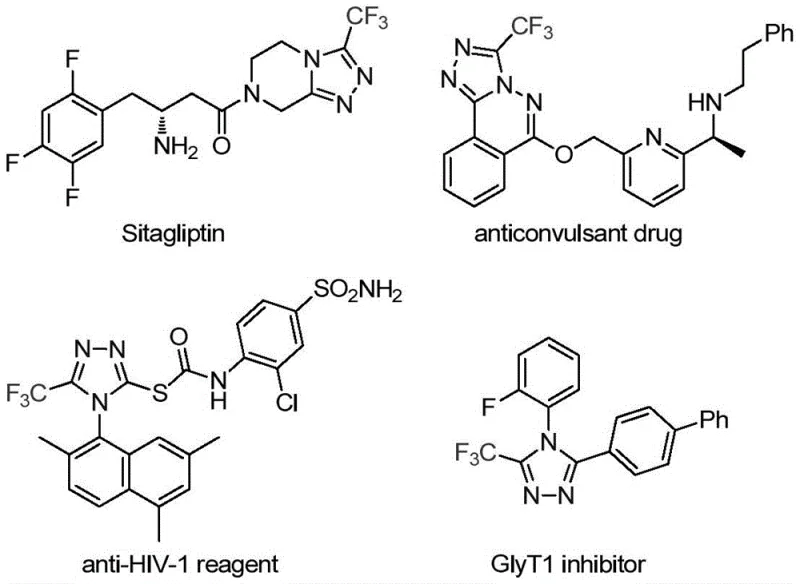
The Limitations of Conventional Methods vs. The Novel Approach
The Limitations of Conventional Methods
Historically, the construction of trifluoromethyl-substituted 1,2,4-triazoles has been plagued by significant synthetic challenges that hinder efficient commercial production. Traditional literature reports predominantly rely on the cyclization of trifluoroacetyl hydrazine with amidine compounds or the hydrazinolysis of trifluoromethyl-substituted 1,2,4-oxazolinones, processes that often necessitate harsh reaction conditions and involve hazardous reagents. Furthermore, copper-catalyzed multi-component reactions utilizing diazonium salts and trifluorodiazoethane have been explored, yet these methods frequently suffer from poor atom economy, limited substrate scope, and the generation of toxic byproducts that complicate downstream purification. The reliance on unstable intermediates like diazonium salts poses severe safety risks during scale-up, while the use of expensive or difficult-to-handle hydrazide derivatives increases the overall cost of goods sold (COGS). Consequently, there is an urgent need within the fine chemical sector for a safer, more direct, and economically viable synthetic pathway that avoids these pitfalls.
The Novel Approach
The methodology disclosed in patent CN113307778A represents a paradigm shift by employing a direct cycloaddition between trifluoroethylimidoyl chloride and functionalized isonitriles (NIITP). This innovative route utilizes a dual-catalyst system comprising molybdenum hexacarbonyl and cuprous acetate, which activates the isonitrile species for nucleophilic attack without requiring extreme temperatures or pressures. As depicted in the general reaction scheme, the process operates under mild thermal conditions (70-90°C) in common organic solvents like THF, significantly reducing energy consumption and equipment stress. The reaction proceeds through a copper-promoted [3+2] cycloaddition mechanism followed by the elimination of triphenylphosphine oxide, yielding the desired 3-trifluoromethyl-1,2,4-triazole core with high regioselectivity. This approach not only simplifies the operational workflow but also expands the chemical space accessible to medicinal chemists by tolerating a wide array of functional groups on the aromatic ring.
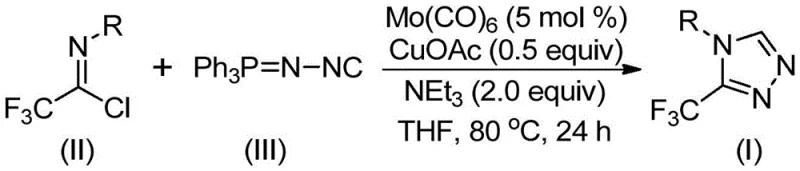
Mechanistic Insights into Mo/Cu Co-Catalyzed Cycloaddition
The success of this transformation lies in the intricate interplay between the molybdenum and copper centers, which orchestrate the activation of relatively inert bonds to form the heterocyclic ring. Mechanistically, the molybdenum hexacarbonyl acts as a crucial metal activator that coordinates with the functionalized isonitrile, increasing its electrophilicity and facilitating the initial bond formation. Simultaneously, the cuprous acetate promotes the cycloaddition step, guiding the trifluoroethylimidoyl chloride to react with the activated isonitrile complex to form a five-membered ring intermediate. This cooperative catalysis ensures that the reaction proceeds smoothly even with sterically hindered or electronically diverse substrates, preventing the formation of unwanted polymeric byproducts often seen in single-metal catalysis. The subsequent hydrolysis or elimination step removes the triphenylphosphine oxide moiety, driving the equilibrium towards the final triazole product and ensuring high conversion rates.
From an impurity control perspective, this mechanism offers distinct advantages for GMP manufacturing. The use of well-defined organometallic catalysts allows for predictable reaction kinetics, minimizing the generation of complex side products that are difficult to separate. The reaction conditions are sufficiently mild to prevent the decomposition of sensitive functional groups, such as nitro or halo substituents, which might degrade under the acidic or basic conditions required by older hydrazine-based methods. Furthermore, the post-treatment process described involves simple filtration and standard silica gel column chromatography, indicating that the crude reaction mixture is relatively clean. This high level of purity is essential for pharmaceutical intermediates, where strict limits on genotoxic impurities and heavy metals must be maintained to meet regulatory standards for downstream API synthesis.
How to Synthesize 3-Trifluoromethyl-1,2,4-Triazole Efficiently
To implement this technology in a laboratory or pilot plant setting, operators must adhere to precise stoichiometric ratios and environmental controls to maximize yield and reproducibility. The patent outlines a robust protocol where the molar ratio of trifluoroethylimidoyl chloride to functionalized isonitrile is optimized, typically favoring a slight excess of the isonitrile to drive the reaction to completion. The choice of solvent is critical, with tetrahydrofuran (THF) identified as the superior medium due to its ability to dissolve both the organic substrates and the metal catalysts effectively while maintaining thermal stability at the required 80°C reaction temperature. Detailed standard operating procedures regarding the addition sequence of reagents and the specific workup protocols are essential for consistent results.
- Combine molybdenum hexacarbonyl (5 mol %), cuprous acetate (0.5 equiv), triethylamine (2.0 equiv), and molecular sieves in an organic solvent such as THF.
- Add trifluoroethylimidoyl chloride and functionalized isonitrile (NIITP) to the reaction mixture under inert atmosphere.
- Heat the reaction mixture to 70-90°C for 18-30 hours, then filter and purify via column chromatography to isolate the target triazole compound.
Commercial Advantages for Procurement and Supply Chain Teams
For procurement managers and supply chain directors, the adoption of this synthetic route offers tangible strategic benefits that extend beyond mere chemical novelty. The primary advantage lies in the accessibility and cost-effectiveness of the starting materials; trifluoroethylimidoyl chloride and functionalized isonitriles are commercially available commodities that can be sourced from multiple global suppliers, mitigating the risk of single-source dependency. Unlike legacy methods that require custom-synthesized hydrazines or unstable diazo compounds, this process utilizes stable shelf-stable reagents, simplifying inventory management and reducing warehousing costs associated with hazardous material storage. The elimination of complex multi-step sequences in favor of a direct one-pot reaction significantly reduces the overall manufacturing lead time, allowing for faster response to market demands for clinical trial materials.
- Cost Reduction in Manufacturing: The economic viability of this process is driven by the use of inexpensive base metals like copper and molybdenum rather than precious metals such as palladium or rhodium, which are subject to volatile market pricing. By avoiding the need for cryogenic conditions or high-pressure reactors, the capital expenditure (CAPEX) required for equipment is substantially lowered, as standard glass-lined or stainless steel reactors capable of heating to 90°C are sufficient. Furthermore, the high atom economy of the cycloaddition reaction minimizes waste generation, leading to reduced costs associated with waste disposal and environmental compliance, thereby enhancing the overall profit margin for the final API.
- Enhanced Supply Chain Reliability: The robustness of the reaction conditions ensures high batch-to-batch consistency, a critical factor for maintaining a reliable supply of pharmaceutical intermediates. The broad substrate tolerance means that a single manufacturing platform can be adapted to produce a wide library of triazole derivatives simply by changing the aromatic amine precursor, providing flexibility to pivot production based on client needs without retooling the entire facility. This adaptability reduces the risk of supply disruptions caused by the obsolescence of specific synthetic routes and ensures continuity of supply for long-term commercial contracts.
- Scalability and Environmental Compliance: The patent explicitly notes that the method can be expanded to gram-level reactions with ease, indicating a clear path toward kilogram and ton-scale production. The use of THF as a solvent, while requiring recovery systems, is well-established in the industry with mature recycling technologies available, supporting green chemistry initiatives. The absence of highly toxic reagents like hydrazine hydrate or explosive diazo compounds significantly lowers the safety profile of the plant, reducing insurance premiums and regulatory scrutiny, which facilitates smoother permitting processes for capacity expansion.
Frequently Asked Questions (FAQ)
The following questions address common technical and commercial inquiries regarding the implementation of this trifluoromethyl triazole synthesis technology. These answers are derived directly from the experimental data and beneficial effects reported in the patent documentation, providing clarity for technical teams evaluating this route for potential licensing or contract manufacturing opportunities. Understanding these nuances is vital for assessing the feasibility of integrating this chemistry into existing production pipelines.
Q: What are the key advantages of the Mo/Cu co-catalyzed method over traditional triazole synthesis?
A: Unlike traditional methods requiring harsh hydrazinolysis or unstable diazonium salts, this patent describes a mild, one-pot cycloaddition using commercially available imidoyl chlorides and isonitriles at moderate temperatures (70-90°C), significantly improving operational safety and substrate tolerance.
Q: Can this synthesis method be scaled for industrial production?
A: Yes, the patent explicitly demonstrates that the reaction conditions are mild and operationally simple, allowing for easy expansion from milligram scale to gram-level reactions, which indicates strong potential for commercial scale-up in API manufacturing.
Q: What is the scope of substituents compatible with this trifluoromethyl triazole synthesis?
A: The method exhibits broad substrate scope, successfully tolerating various aryl groups including those with electron-donating (methyl, methoxy) and electron-withdrawing (fluoro, chloro, nitro) substituents, as well as phenethyl groups, yielding products with efficiencies ranging up to 99%.
Partnering with NINGBO INNO PHARMCHEM: Your Reliable 3-Trifluoromethyl-1,2,4-Triazole Supplier
At NINGBO INNO PHARMCHEM, we recognize the critical role that high-quality heterocyclic intermediates play in the development of life-saving medications. Our technical team possesses extensive experience scaling diverse pathways from 100 kgs to 100 MT/annual commercial production, ensuring that the transition from laboratory discovery to industrial manufacturing is seamless and efficient. We are committed to delivering high-purity 3-trifluoromethyl-1,2,4-triazole derivatives that meet stringent purity specifications, supported by our rigorous QC labs equipped with state-of-the-art analytical instrumentation to verify identity and assay.
We invite pharmaceutical partners to collaborate with us to leverage this advanced Mo/Cu co-catalyzed technology for their upcoming projects. By engaging with our technical procurement team, you can request a Customized Cost-Saving Analysis tailored to your specific volume requirements. We encourage you to contact us today to obtain specific COA data and comprehensive route feasibility assessments, ensuring that your supply chain is built on a foundation of scientific excellence and commercial reliability.