
Transforming Triazole Chemistry: Metal-Free Manufacturing of High-Purity Pharmaceutical Intermediates with Scalable Commercial Production
The recently granted Chinese patent CN113121462B introduces a groundbreaking synthetic methodology for producing high-value pharmaceutical intermediates featuring a trifluoromethyl-substituted triazole core structure. This innovation addresses critical limitations in conventional triazole synthesis by establishing a metal-free pathway that eliminates hazardous azide reagents while maintaining exceptional functional group tolerance across diverse molecular architectures. The technology represents a significant advancement in sustainable process chemistry by leveraging commercially accessible starting materials under mild reaction conditions that are inherently scalable for industrial implementation. Crucially, this approach delivers superior purity profiles essential for pharmaceutical applications while reducing environmental impact through simplified waste streams. The patent demonstrates robust performance across multiple substrate variations with consistent high-yield outcomes that position this methodology as a transformative solution for modern API intermediate manufacturing.
The Limitations of Conventional Methods vs. The Novel Approach
The Limitations of Conventional Methods
Traditional synthetic routes for trifluoromethyl-substituted triazoles predominantly rely on copper-catalyzed azide-alkyne cycloadditions or organocatalytic approaches involving reactive azide compounds that present significant safety hazards due to their explosive nature and stringent handling requirements. These methods frequently necessitate expensive transition metal catalysts that introduce complex purification challenges to meet pharmaceutical-grade purity standards while generating substantial metal-contaminated waste streams requiring specialized disposal protocols. Furthermore, conventional processes often operate under harsh conditions including cryogenic temperatures or high-pressure environments that complicate scale-up and increase operational costs through specialized equipment requirements and extended processing times. The inherent instability of azide intermediates also creates batch-to-batch variability that undermines consistent product quality essential for regulatory compliance in pharmaceutical manufacturing.
The Novel Approach
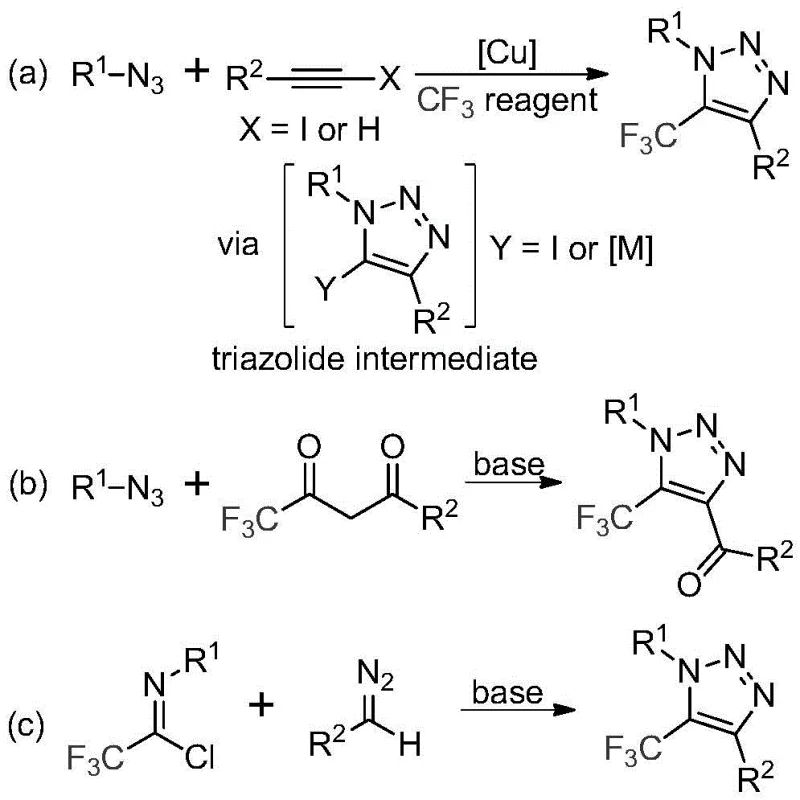
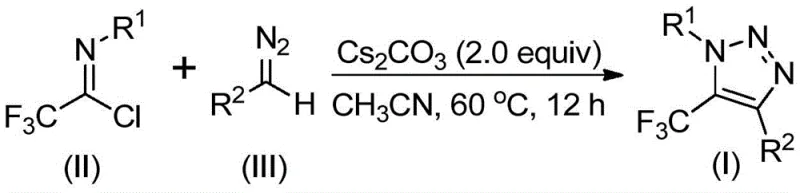
The patented methodology overcomes these limitations through an elegant base-promoted reaction between trifluoroethylimidoyl chloride and diazo compounds that completely avoids both transition metals and hazardous azides while operating under mild thermal conditions of 60°C in standard organic solvents. This innovative pathway utilizes cesium carbonate as an economical catalyst that facilitates carbon-carbon bond formation through nucleophilic addition followed by intramolecular cyclization to directly yield the target triazole structure without intermediate isolation steps. The process demonstrates remarkable substrate flexibility across various aryl and heteroaryl systems while maintaining consistent high conversion rates through optimized stoichiometric ratios that eliminate side reactions common in traditional approaches. Critically, this method achieves superior purity profiles by avoiding metal contamination pathways and simplifying downstream purification through standard chromatographic techniques that are readily adaptable to commercial manufacturing scales.
Mechanistic Insights into Base-Promoted Triazole Formation
The reaction mechanism proceeds through a well-defined sequence where cesium carbonate deprotonates the diazo compound to generate a nucleophilic species that attacks the electrophilic carbon of trifluoroethylimidoyl chloride. This initial addition forms a key tetrahedral intermediate that undergoes spontaneous elimination to create an imine species which then participates in an intramolecular cyclization through a concerted [3+2] dipolar addition process. The base catalyst plays a dual role in facilitating both the initial nucleophilic attack and subsequent proton transfer steps that drive the cyclization toward the thermodynamically stable triazole product. This mechanistic pathway avoids radical intermediates or metal coordination complexes that typically complicate traditional syntheses while maintaining excellent regioselectivity through electronic control of the cyclization step.
Impurity control is achieved through precise stoichiometric balance between reactants and catalyst that minimizes competing side reactions such as dimerization or hydrolysis pathways commonly observed in azide-based systems. The absence of transition metals eliminates potential metal-catalyzed degradation pathways that generate difficult-to-remove impurities requiring additional purification steps. Furthermore, the mild reaction temperature prevents thermal decomposition of sensitive functional groups while allowing selective crystallization during workup that enhances final product purity without requiring specialized equipment. This inherent selectivity profile ensures consistent production of high-purity intermediates meeting stringent pharmaceutical quality standards without costly post-synthesis remediation.
How to Synthesize High-Purity Trifluoromethyl Triazoles Efficiently
This innovative manufacturing process represents a significant advancement over conventional methodologies by eliminating hazardous reagents while maintaining exceptional yield profiles across diverse substrate combinations. The patented approach leverages commercially available starting materials under optimized conditions that ensure consistent product quality suitable for pharmaceutical applications. Detailed standardized synthesis procedures have been developed to enable seamless technology transfer from laboratory validation to commercial production environments while maintaining strict adherence to quality control parameters essential for regulatory compliance.
- Combine cesium carbonate catalyst with trifluoroethylimidoyl chloride and diazo compound in acetonitrile solvent under nitrogen atmosphere at room temperature.
- Heat the reaction mixture to 60°C and maintain for twelve hours while monitoring conversion through standard analytical techniques.
- Perform post-reaction processing including filtration through silica gel followed by column chromatography purification to isolate high-purity triazole product.
Commercial Advantages for Procurement and Supply Chain Teams
This manufacturing innovation delivers substantial value across procurement and supply chain operations by addressing critical pain points associated with traditional triazole synthesis methods while creating new opportunities for cost optimization and supply security. The elimination of hazardous materials reduces regulatory compliance burdens and associated handling costs while improving workplace safety metrics that directly impact operational continuity. Furthermore, the reliance on globally available starting materials creates more resilient supply chains less vulnerable to regional disruptions or single-source dependencies that commonly plague specialty chemical manufacturing.
- Cost Reduction in Manufacturing: The complete removal of expensive transition metal catalysts and hazardous azide reagents significantly reduces raw material costs while eliminating complex purification steps required to remove metal contaminants from final products. This streamlined process architecture minimizes solvent consumption and waste generation through higher atom economy and fewer processing stages compared to conventional methods.
- Enhanced Supply Chain Reliability: Utilization of commercially available starting materials with established global supply networks substantially improves sourcing flexibility while reducing lead time variability associated with specialized reagents requiring custom synthesis or restricted handling protocols. The simplified logistics profile enables more predictable inventory management and just-in-time delivery capabilities essential for modern pharmaceutical manufacturing operations.
- Scalability and Environmental Compliance: The mild reaction conditions and straightforward workup procedures facilitate seamless scale-up from laboratory validation to multi-ton production without requiring specialized equipment modifications or extensive process re-engineering efforts. This inherent scalability reduces time-to-market while generating cleaner waste streams that align with increasingly stringent environmental regulations governing chemical manufacturing operations.
Frequently Asked Questions (FAQ)
The following technical questions address common concerns raised by procurement specialists and R&D teams regarding implementation of this patented manufacturing technology. These responses are derived directly from experimental data presented in patent CN113121462B and reflect practical considerations for commercial adoption across diverse manufacturing environments.
Q: How does this method eliminate hazardous azide compounds while maintaining high reaction efficiency?
A: The process utilizes stable diazo compounds and trifluoroethylimidoyl chloride precursors in a base-promoted reaction pathway that bypasses traditional azide requirements entirely. This substitution eliminates explosion risks while maintaining high functional group tolerance through optimized cesium carbonate catalysis.
Q: What supply chain advantages does this metal-free process provide for pharmaceutical manufacturers?
A: By removing transition metal catalysts and hazardous reagents from the synthesis pathway, the method significantly simplifies raw material sourcing and eliminates costly metal removal steps. This creates more resilient supply chains through reliance on commercially available starting materials with established global distribution networks.
Q: How does this technology enable seamless scale-up from laboratory to commercial production?
A: The mild reaction conditions (60°C in acetonitrile) and straightforward workup procedure using standard filtration and chromatography techniques allow direct translation from gram-scale validation to multi-kilogram manufacturing without process re-engineering or specialized equipment requirements.
Partnering with NINGBO INNO PHARMCHEM: Your Reliable High-Purity Trifluoromethyl Triazole Supplier
Our company possesses extensive experience scaling diverse pathways from 100 kgs to 100 MT/annual commercial production while maintaining stringent purity specifications through advanced analytical capabilities in our rigorous QC labs. We specialize in transforming innovative synthetic methodologies like this patented triazole process into reliable manufacturing solutions that deliver consistent quality and supply security for critical pharmaceutical intermediates across global markets.
Request our Customized Cost-Saving Analysis today to evaluate how this technology can optimize your specific manufacturing requirements. Our technical procurement team stands ready to provide detailed COA data and route feasibility assessments tailored to your production needs.