
Advanced Palladium-Catalyzed Synthesis of 2-Trifluoromethyl Imidazoles for Commercial Scale-Up
Advanced Palladium-Catalyzed Synthesis of 2-Trifluoromethyl Imidazoles for Commercial Scale-Up
The pharmaceutical and agrochemical industries are constantly seeking robust methodologies to access fluorinated heterocycles, particularly imidazoles, due to their profound impact on metabolic stability and bioavailability. Patent CN111423381B introduces a groundbreaking preparation method for 2-trifluoromethyl substituted imidazole compounds that addresses critical bottlenecks in current synthetic workflows. This technology leverages a sophisticated palladium-catalyzed carbonylation cascade, utilizing readily available precursors to construct the imidazole core under exceptionally mild conditions. The significance of this advancement cannot be overstated, as trifluoromethylated imidazoles serve as pivotal scaffolds in numerous bioactive molecules, ranging from antihistamines to complex kinase inhibitors. By enabling the efficient assembly of these structures at low temperatures, this patent provides a viable pathway for the reliable pharmaceutical intermediate supplier to deliver high-value building blocks with superior purity profiles.
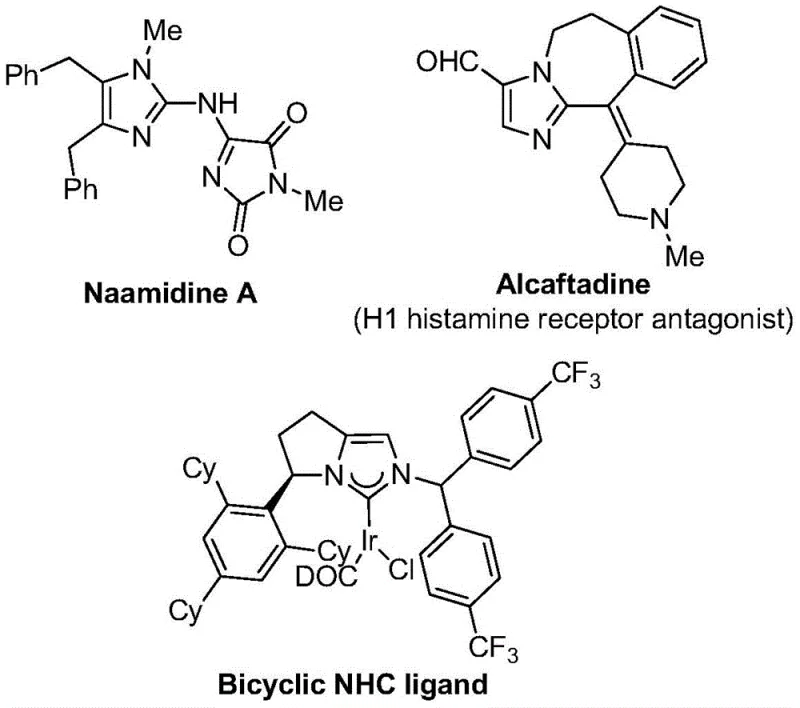
The structural diversity achievable through this method is exemplified by the wide array of biologically active compounds that rely on the imidazole motif. As illustrated in the reference structures, molecules like Naamidine A and Alcaftadine demonstrate the therapeutic potential inherent in this heterocyclic system. The introduction of the trifluoromethyl group further enhances these properties by modulating lipophilicity and electronic characteristics, making the resulting compounds highly desirable for drug discovery programs. Consequently, mastering the synthesis of these specific derivatives is a strategic priority for any organization aiming to lead in the development of next-generation therapeutics and functional materials.
The Limitations of Conventional Methods vs. The Novel Approach
The Limitations of Conventional Methods
Historically, the synthesis of nitrogen-containing heterocycles bearing trifluoromethyl groups has been fraught with significant challenges that hinder large-scale production. Traditional approaches often rely on the direct reaction of substrates with specialized trifluoromethyl synthons such as trifluorodiazoethane. While effective in academic settings, these reagents are frequently unstable, potentially explosive, and difficult to handle safely in an industrial environment. Furthermore, many existing protocols require harsh reaction conditions, including elevated temperatures or strong bases, which can lead to the decomposition of sensitive functional groups and the formation of complex impurity profiles. These limitations not only increase the cost of goods sold due to safety mitigation measures but also restrict the scope of substrates that can be utilized, thereby limiting the chemical space available for medicinal chemists to explore during lead optimization phases.
The Novel Approach
In stark contrast to these legacy methods, the technology disclosed in patent CN111423381B offers a transformative solution by employing a transition metal palladium-catalyzed carbonylation series reaction. This novel approach utilizes cheap and easily obtained starting materials, specifically trifluoroethylimidoyl chloride, propargylamine, and diaryl iodonium salts, to efficiently construct the target imidazole framework. The reaction proceeds smoothly at a remarkably mild temperature of 30°C, drastically reducing energy consumption and thermal stress on the reactants. By avoiding hazardous gaseous carbon monoxide and instead generating it in situ from formic acid and acetic anhydride, the process enhances operational safety. This methodology not only simplifies the synthetic route but also exhibits exceptional substrate compatibility, allowing for the incorporation of diverse functional groups without compromising yield or purity, thus broadening the utility of this method for industrial applications.

Mechanistic Insights into Pd-Catalyzed Carbonylation and Cyclization
The elegance of this synthesis lies in its intricate yet efficient mechanistic pathway, which orchestrates multiple bond-forming events in a single pot. The reaction initiates with the formation of a trifluoroacetamidine intermediate through an intermolecular carbon-nitrogen bond promoted by the alkaline environment provided by sodium bicarbonate. Following isomerization, the palladium catalyst engages with the alkyne moiety of the propargylamine derivative, undergoing palladation to generate a key alkenyl palladium intermediate. This species subsequently isomerizes to an alkyl palladium intermediate, setting the stage for the crucial carbonylation step. Under the influence of carbon monoxide released from the formic acid/acetic anhydride mixture, an acyl palladium intermediate is formed. The cycle culminates with the oxidative addition of the diaryl iodonium salt to generate a tetravalent palladium species, followed by reductive elimination to release the final 2-trifluoromethyl-substituted imidazole product and regenerate the active catalyst.
From a quality control perspective, this mechanism offers distinct advantages regarding impurity control. The use of diaryl iodonium salts as arylating agents is particularly beneficial because they are highly reactive towards oxidative addition, often outcompeting side reactions that might occur with less reactive aryl halides. This high selectivity ensures that the desired C-C and C-N bonds are formed with precision, minimizing the generation of homocoupling byproducts or unreacted starting materials. Furthermore, the mild reaction temperature of 30°C prevents thermal degradation of the intermediates, which is a common source of colored impurities and tars in high-temperature heterocycle syntheses. The result is a crude reaction mixture that is cleaner and easier to purify, directly translating to higher overall yields and reduced solvent usage during the downstream isolation processes.
How to Synthesize 2-Trifluoromethyl Imidazole Efficiently
Implementing this synthesis requires precise attention to the stoichiometry of the reagents and the order of addition to maximize catalytic turnover. The protocol dictates a specific molar ratio of palladium chloride to triphenylphosphine to sodium bicarbonate, typically around 0.05:0.1:2, to maintain the optimal balance between catalytic activity and base-mediated deprotonation steps. The reaction is conducted in an aprotic organic solvent, with tetrahydrofuran (THF) being the preferred medium due to its ability to effectively dissolve all components and promote the reaction kinetics. Detailed standardized operating procedures regarding the specific addition rates, stirring speeds, and quenching protocols are essential for reproducibility. For a comprehensive guide on executing this transformation with maximum efficiency, please refer to the step-by-step synthesis instructions provided below.
- Combine palladium chloride, triphenylphosphine, sodium bicarbonate, acetic anhydride, formic acid, trifluoroethylimidoyl chloride, propargylamine, and diaryl iodonium salt in an organic solvent like THF.
- Stir the reaction mixture at a mild temperature of 30°C for 16 to 24 hours to ensure complete conversion via the carbonylation cascade.
- Upon completion, filter the mixture, mix with silica gel, and purify using column chromatography to isolate the high-purity 2-trifluoromethyl substituted imidazole product.
Commercial Advantages for Procurement and Supply Chain Teams
For procurement managers and supply chain directors, the adoption of this patented methodology represents a strategic opportunity to optimize the sourcing of critical heterocyclic intermediates. The shift from hazardous, specialty reagents to commodity chemicals like propargylamine and simple aromatic amines fundamentally alters the cost structure of the supply chain. By eliminating the need for cryogenic storage or specialized containment for explosive diazo compounds, the logistical burden is significantly reduced. This simplification allows for more flexible inventory management and reduces the risk of supply disruptions caused by regulatory restrictions on hazardous materials. Furthermore, the high atom economy and selectivity of the reaction mean that less raw material is wasted, contributing to a more sustainable and cost-effective manufacturing model that aligns with modern green chemistry principles.
- Cost Reduction in Manufacturing: The economic benefits of this process are driven primarily by the use of inexpensive, commercially available starting materials and the elimination of complex safety infrastructure. Since the reaction operates at near-ambient temperatures (30°C), there is a substantial reduction in energy costs associated with heating or cooling large-scale reactors. Additionally, the avoidance of expensive and unstable trifluoromethylating agents lowers the direct material cost per kilogram of the final product. The high yields reported across a broad range of substrates indicate that the process is robust, minimizing the financial losses associated with batch failures or extensive reprocessing. These factors combine to create a manufacturing route that is inherently more economical than traditional high-pressure or high-temperature alternatives.
- Enhanced Supply Chain Reliability: Supply chain resilience is greatly improved by the reliance on stable, shelf-stable reagents that are widely produced by the global chemical industry. Trifluoroethylimidoyl chlorides and diaryl iodonium salts can be sourced from multiple vendors, reducing dependency on single-source suppliers. The mild reaction conditions also mean that the process can be executed in a wider variety of manufacturing facilities without requiring specialized high-pressure equipment, thereby increasing the available capacity for production. This flexibility ensures that lead times for high-purity pharmaceutical intermediates can be maintained even during periods of high market demand or logistical constraints, providing a competitive advantage in time-to-market for new drug candidates.
- Scalability and Environmental Compliance: Scaling this reaction from gram to multi-ton levels is facilitated by the homogeneous nature of the catalytic system and the absence of gaseous reagents that require complex mass transfer engineering. The in situ generation of carbon monoxide avoids the regulatory hurdles and safety risks associated with transporting and storing bulk CO gas. Moreover, the simplified workup procedure, which involves filtration and standard chromatography, reduces the volume of aqueous waste generated compared to extractive workups often required for acidic or basic byproducts. This streamlined approach not only lowers waste disposal costs but also ensures compliance with increasingly stringent environmental regulations regarding solvent use and effluent treatment in fine chemical manufacturing.
Frequently Asked Questions (FAQ)
Understanding the technical nuances of this synthesis is vital for stakeholders evaluating its potential for integration into existing pipelines. The following questions address common inquiries regarding the operational parameters and scope of the technology. These answers are derived directly from the experimental data and technical disclosures within the patent documentation, ensuring accuracy and relevance for technical decision-makers. By clarifying these aspects, we aim to facilitate a smoother transition from laboratory evaluation to commercial adoption.
Q: What are the key advantages of this Pd-catalyzed method over traditional trifluoromethylation routes?
A: Unlike traditional methods that often require hazardous trifluorodiazoethane or harsh conditions, this patent describes a mild process at 30°C using stable, commercially available starting materials like trifluoroethylimidoyl chloride and diaryl iodonium salts, significantly improving operational safety and substrate compatibility.
Q: What is the role of formic acid and acetic anhydride in this reaction mechanism?
A: Formic acid and acetic anhydride serve as an in situ source of carbon monoxide (CO). This eliminates the need for handling toxic CO gas cylinders, making the carbonylation step safer and more feasible for standard laboratory and pilot plant setups.
Q: Does this synthesis method support diverse functional groups on the aromatic rings?
A: Yes, the method demonstrates excellent substrate tolerance. It successfully accommodates various substituents such as methyl, tert-butyl, methoxy, halogens (chlorine, bromine), trifluoromethyl, and nitro groups on both the imidoyl chloride and the iodonium salt components, allowing for the synthesis of a wide library of derivatives.
Partnering with NINGBO INNO PHARMCHEM: Your Reliable 2-Trifluoromethyl Imidazole Supplier
At NINGBO INNO PHARMCHEM, we recognize the transformative potential of this palladium-catalyzed methodology for the production of high-value fluorinated heterocycles. Our team of expert process chemists possesses extensive experience scaling diverse pathways from 100 kgs to 100 MT/annual commercial production, ensuring that the transition from benchtop discovery to industrial manufacturing is seamless and efficient. We are committed to delivering products that meet stringent purity specifications, utilizing our rigorous QC labs to verify that every batch of 2-trifluoromethyl imidazole conforms to the highest standards required by the global pharmaceutical industry. Our state-of-the-art facilities are equipped to handle the specific requirements of this chemistry, including the safe handling of palladium catalysts and the precise control of reaction parameters necessary for optimal yield.
We invite potential partners to engage with our technical procurement team to discuss how this advanced synthesis route can be tailored to your specific project needs. Whether you require a Customized Cost-Saving Analysis for your current supply chain or need to evaluate the feasibility of new analogs, we are prepared to provide comprehensive support. Please contact us to request specific COA data and route feasibility assessments, and let us demonstrate how our expertise in complex heterocycle synthesis can accelerate your development timelines and enhance your competitive position in the market.