
Advanced Metal-Free Synthesis of Trifluoromethyl-1,2,4-Triazoles for Scalable Pharmaceutical Production
Introduction to Advanced Triazole Scaffold Synthesis
The development of efficient synthetic routes for nitrogen-containing heterocycles remains a cornerstone of modern medicinal chemistry, particularly for scaffolds found in blockbuster therapeutics. Patent CN113105402A introduces a groundbreaking preparation method for 3,4,5-trisubstituted 1,2,4-triazole compounds, a structural motif prevalent in high-value pharmaceuticals such as Maraviroc, Sitagliptin, and Deferasirox. These molecules are critical intermediates in the production of antiviral, antidiabetic, and iron-chelating agents, where the introduction of a trifluoromethyl group significantly enhances metabolic stability and lipophilicity. The disclosed technology leverages a non-metal-promoted synthesis strategy, utilizing cheap and readily available arylethanones and trifluoroethylimine hydrazide as primary building blocks.
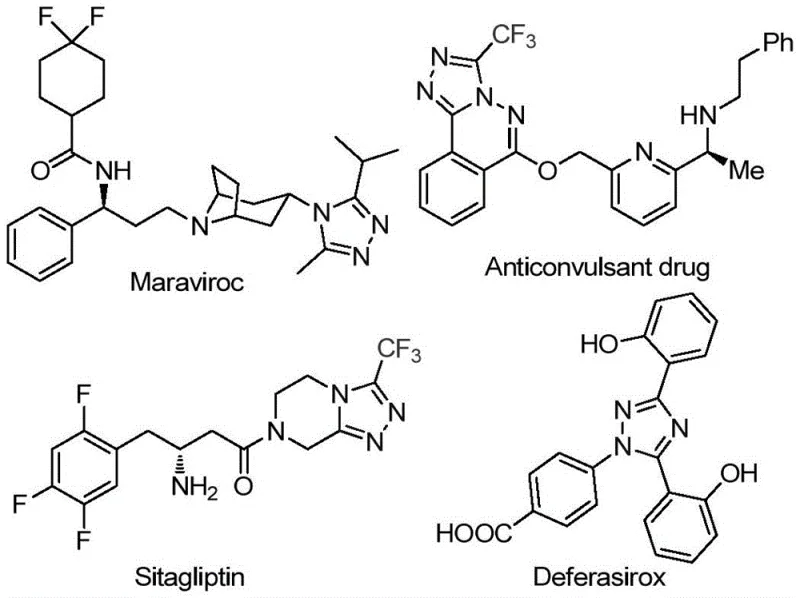
This innovation addresses the growing demand for reliable pharmaceutical intermediate suppliers who can deliver complex heterocyclic structures with high purity and consistency. By eliminating the need for toxic heavy metal catalysts and严苛 anhydrous conditions, this method not only streamlines the laboratory workflow but also paves the way for greener, more sustainable industrial manufacturing processes. The ability to access these privileged scaffolds through a simplified operational protocol represents a significant leap forward for R&D teams aiming to accelerate lead optimization and process development timelines.
The Limitations of Conventional Methods vs. The Novel Approach
The Limitations of Conventional Methods
Historically, the synthesis of polysubstituted 1,2,4-triazoles has relied heavily on transition metal catalysis or harsh reaction conditions that complicate downstream processing. Traditional pathways often necessitate the use of copper or palladium catalysts, which introduce significant cost burdens due to the high price of these precious metals and the stringent regulatory requirements for removing residual metals from final Active Pharmaceutical Ingredients (APIs). Furthermore, many existing protocols require strictly anhydrous and oxygen-free environments, demanding specialized equipment and inert gas manifolds that increase capital expenditure and operational complexity. These factors collectively hinder the scalability of conventional methods, making them less attractive for cost reduction in API manufacturing where margin compression is a constant pressure.
The Novel Approach
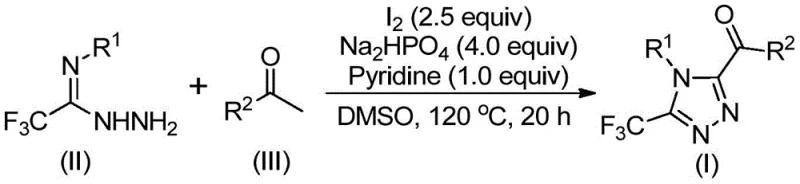
In stark contrast, the novel approach detailed in the patent utilizes a tandem reaction sequence promoted by elemental iodine in dimethyl sulfoxide (DMSO), effectively bypassing the need for expensive transition metals. This method capitalizes on the dual role of iodine as both an oxidant and a promoter for the Kornblum oxidation of arylethanones to aryl diketones, which subsequently undergo condensation and cyclization. The reaction proceeds efficiently at temperatures between 90°C and 130°C without the necessity for rigorous exclusion of air or moisture, drastically simplifying the engineering controls required for production. This shift towards organocatalytic-like conditions using abundant halogens offers a robust alternative that maintains high conversion rates while minimizing the environmental footprint associated with heavy metal waste disposal.
Mechanistic Insights into Iodine-Promoted Tandem Cyclization
The core of this synthetic breakthrough lies in the intricate interplay between iodine, DMSO, and the hydrazide substrate, facilitating a cascade of transformations that construct the triazole ring in a single pot. Initially, the arylethanone undergoes iodination followed by Kornblum oxidation mediated by DMSO to generate an reactive alpha-dicarbonyl intermediate in situ. This electrophilic species then engages in a dehydration condensation with the trifluoroethylimine hydrazide to form a hydrazone intermediate, which serves as the precursor for the final ring closure. Under the combined promotional action of iodine and the base system (sodium dihydrogen phosphate and pyridine), the hydrazone undergoes an intramolecular cyclization to yield the target 3,4,5-trisubstituted 1,2,4-triazole structure.
From an impurity control perspective, this mechanism offers distinct advantages by avoiding radical pathways often associated with metal catalysis that can lead to unpredictable byproduct profiles. The use of stoichiometric iodine ensures complete consumption of the starting ketone, while the mild basic conditions prevent the degradation of sensitive functional groups such as esters or halides that might be present on the aromatic rings. The reaction tolerates a wide range of substituents, including electron-donating groups like methoxy and methyl, as well as electron-withdrawing groups like chloro and trifluoromethyl, demonstrating exceptional chemoselectivity. This mechanistic robustness ensures that the resulting crude product contains fewer difficult-to-remove impurities, thereby reducing the burden on purification units and enhancing the overall yield of high-purity pharmaceutical intermediates.
How to Synthesize 3,4,5-Trisubstituted 1,2,4-Triazole Efficiently
The operational simplicity of this protocol makes it highly accessible for both laboratory-scale discovery and pilot-plant operations. The process begins by combining the arylethanone and elemental iodine in DMSO, heating the mixture to initiate the oxidation phase before introducing the hydrazide and base components for the cyclization step. This one-pot strategy eliminates the need for isolating unstable intermediates, saving time and solvent usage. For detailed standard operating procedures regarding specific molar ratios, temperature ramping, and workup techniques, please refer to the comprehensive guide below.
- Mix arylethanone and elemental iodine in dimethyl sulfoxide (DMSO) and heat to 90-110°C for 4-6 hours to initiate Kornblum oxidation.
- Add additional iodine, sodium dihydrogen phosphate, pyridine, and trifluoroethylimine hydrazide to the reaction mixture.
- Heat the solution to 110-130°C for 12-20 hours to complete the cyclization, then filter and purify via column chromatography.
Commercial Advantages for Procurement and Supply Chain Teams
For procurement managers and supply chain directors, the adoption of this iodine-promoted synthesis route presents a compelling value proposition centered on cost efficiency and supply security. The elimination of precious metal catalysts removes a volatile cost component from the bill of materials, while the use of commodity chemicals like arylethanones ensures a stable and diversified supplier base. The simplified reaction conditions reduce energy consumption and equipment wear, contributing to a leaner manufacturing overhead that can be passed down as competitive pricing for bulk orders.
- Cost Reduction in Manufacturing: The substitution of expensive transition metal catalysts with inexpensive elemental iodine results in substantial raw material savings. Additionally, the avoidance of strict anhydrous conditions lowers the cost of solvent drying and inert gas consumption, while the simplified post-treatment involving filtration and standard chromatography reduces labor and utility costs associated with complex purification trains.
- Enhanced Supply Chain Reliability: Since the key starting materials, such as substituted arylethanones and trifluoroethylimine hydrazide, are widely available from multiple global chemical vendors, the risk of supply disruption is significantly minimized. This commoditization of inputs allows for flexible sourcing strategies and better negotiation leverage, ensuring continuous production flow even during market fluctuations.
- Scalability and Environmental Compliance: The process is inherently scalable, having been demonstrated effectively from gram-level experiments to potential multi-kilogram batches without loss of efficiency. The absence of heavy metals simplifies wastewater treatment and waste disposal compliance, aligning with increasingly stringent environmental regulations and corporate sustainability goals without requiring expensive remediation technologies.
Frequently Asked Questions (FAQ)
The following questions address common technical and commercial inquiries regarding the implementation of this synthesis technology. These insights are derived directly from the experimental data and beneficial effects reported in the patent documentation, providing clarity on reaction scope and operational parameters.
Q: Why is this iodine-promoted method superior to traditional metal-catalyzed routes?
A: Traditional methods often rely on expensive transition metal catalysts like copper or palladium, which pose challenges regarding residual metal limits in pharmaceuticals. This patent utilizes inexpensive elemental iodine and avoids heavy metals entirely, simplifying purification and reducing regulatory burdens.
Q: What are the key advantages for large-scale manufacturing of these triazoles?
A: The process operates under relatively mild conditions without strict anhydrous or oxygen-free requirements. The starting materials, such as arylethanones, are commodity chemicals, ensuring a robust and cost-effective supply chain suitable for industrial scale-up.
Q: Can this method accommodate diverse functional groups on the aromatic rings?
A: Yes, the method demonstrates excellent substrate tolerance. It successfully synthesizes derivatives with various substituents including methyl, methoxy, chloro, and trifluoromethyl groups at ortho, meta, and para positions, allowing for broad structural diversity in drug design.
Partnering with NINGBO INNO PHARMCHEM: Your Reliable 3,4,5-Trisubstituted 1,2,4-Triazole Supplier
At NINGBO INNO PHARMCHEM, we recognize the strategic importance of efficient heterocycle synthesis in the development of next-generation therapeutics. As a leading CDMO partner, we possess extensive experience scaling diverse pathways from 100 kgs to 100 MT/annual commercial production, ensuring that our clients receive consistent quality regardless of order volume. Our state-of-the-art facilities are equipped with rigorous QC labs capable of meeting stringent purity specifications, guaranteeing that every batch of 3,4,5-trisubstituted 1,2,4-triazole intermediate adheres to the highest industry standards for pharmaceutical applications.
We invite you to collaborate with us to leverage this advanced metal-free technology for your specific project needs. Our technical team is ready to provide a Customized Cost-Saving Analysis tailored to your target molecule, optimizing the route for maximum economic efficiency. Please contact our technical procurement team today to request specific COA data and route feasibility assessments, and let us help you accelerate your path to market with reliable, high-quality chemical solutions.