
Scalable Cobalt-Catalyzed Synthesis of Tetrahydro-beta-carbolinone Intermediates for Commercial API Production
Scalable Cobalt-Catalyzed Synthesis of Tetrahydro-beta-carbolinone Intermediates for Commercial API Production
The pharmaceutical industry continuously seeks robust synthetic methodologies that balance high purity with economic viability, particularly for complex heterocyclic scaffolds like tetrahydro-beta-carbolinones. Patent CN115260188A introduces a transformative approach to constructing these vital nitrogen-containing heterocycles, which serve as core structures in numerous bioactive molecules, including antiviral agents and anxiolytics. This technology leverages a transition metal cobalt-catalyzed C-H activation carbonylation strategy, marking a significant departure from traditional palladium-dependent routes. By utilizing earth-abundant cobalt catalysts and solid carbon monoxide surrogates, this method addresses critical pain points in modern drug substance manufacturing, offering a pathway that is not only chemically efficient but also aligned with green chemistry principles and cost-reduction mandates essential for a reliable pharmaceutical intermediate supplier.
The Limitations of Conventional Methods vs. The Novel Approach
The Limitations of Conventional Methods
Historically, the construction of the tetrahydro-beta-carbolinone skeleton via carbonylation has relied heavily on precious transition metal catalysts, specifically palladium complexes. These conventional protocols often suffer from substantial economic and operational drawbacks that hinder their utility in large-scale commercial settings. The primary limitation is the exorbitant cost of palladium precursors, which directly inflates the raw material expenditure for API manufacturing. Furthermore, palladium catalysis frequently necessitates rigorous purification steps to remove trace heavy metal residues to meet stringent pharmacopeial limits, adding complexity and time to the downstream processing. Additionally, many traditional carbonylation reactions require the use of gaseous carbon monoxide, a highly toxic and hazardous reagent that demands specialized high-pressure equipment and strict safety protocols, thereby increasing the capital expenditure and operational risk for manufacturing facilities attempting the commercial scale-up of complex pharmaceutical intermediates.
The Novel Approach
In stark contrast, the methodology disclosed in CN115260188A utilizes a cobalt-catalyzed system that effectively circumvents the limitations associated with precious metals. The core innovation lies in the use of cobalt acetate tetrahydrate as a cheap and readily available catalyst, paired with 1,3,5-tricarboxylic acid phenol ester as a safe, solid carbon monoxide substitute. This combination allows the reaction to proceed under relatively mild thermal conditions (120-140°C) without the need for high-pressure CO gas infrastructure. The reaction exhibits exceptional substrate compatibility, tolerating a wide array of functional groups including halogens, alkoxy, and alkyl chains on the indole ring. As illustrated in the reaction scheme below, the transformation efficiently converts tryptamine derivatives into the desired cyclized products with high atom economy.
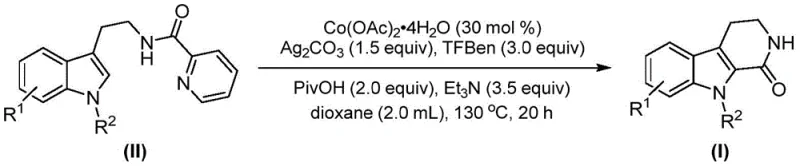
This novel approach not only simplifies the operational workflow by eliminating hazardous gas handling but also significantly reduces the environmental footprint of the synthesis. The ability to achieve high yields (often exceeding 90%) with such a cost-effective catalyst system represents a paradigm shift for procurement teams looking to optimize the cost structure of their supply chain for nitrogen heterocycle building blocks.
Mechanistic Insights into Cobalt-Catalyzed C-H Activation Carbonylation
Understanding the mechanistic underpinnings of this cobalt-catalyzed transformation is crucial for R&D directors evaluating its robustness and reproducibility. The reaction initiates with the oxidation of the cobalt(II) catalyst by silver carbonate, generating a reactive cobalt(III) species in situ. This high-valent cobalt center then coordinates with the nitrogen atom of the tryptamine derivative, directing the activation of the proximal C-H bond at the 2-position of the indole ring. This C-H activation step is the turnover-limiting phase where the specificity of the reaction is determined, ensuring that functionalization occurs exclusively at the desired position without affecting other sensitive moieties on the substrate. Following activation, the carbon monoxide released from the thermal decomposition of the phenol ester surrogate inserts into the cobalt-carbon bond, forming a key acyl-cobalt(III) intermediate.
The final stage of the catalytic cycle involves an intramolecular nucleophilic attack by the amine nitrogen onto the acyl carbon, followed by reductive elimination and hydrolysis to release the tetrahydro-beta-carbolinone product and regenerate the active catalyst species. This mechanism highlights the dual role of the additives: silver carbonate acts as both an oxidant to maintain the cobalt in its active state and a base to neutralize acidic byproducts, while pivalic acid serves as a crucial proton shuttle to facilitate the C-H cleavage step. From an impurity control perspective, this well-defined catalytic cycle minimizes the formation of side products commonly associated with radical pathways, resulting in a cleaner crude reaction profile that simplifies the subsequent purification burden and ensures high-purity pharmaceutical intermediate output.
How to Synthesize Tetrahydro-beta-carbolinone Efficiently
The practical execution of this synthesis is designed for ease of operation, making it highly attractive for process chemistry teams aiming to transfer laboratory protocols to pilot or production scales. The procedure involves a straightforward one-pot reaction where all reagents, including the cobalt catalyst, oxidant, CO source, and substrate, are combined in a polar aprotic solvent such as dioxane. The mixture is then heated to approximately 130°C for a duration of 16 to 24 hours, allowing sufficient time for the C-H activation and cyclization events to reach completion. Detailed standardized synthetic steps for this protocol are provided in the guide below.
- Combine cobalt acetate tetrahydrate, silver carbonate, 1,3,5-tricarboxylic acid phenol ester, pivalic acid, triethylamine, and the tryptamine derivative substrate in dioxane solvent.
- Heat the reaction mixture to 130°C and maintain stirring for 20 hours under inert atmosphere to facilitate C-H activation and carbonylation.
- Upon completion, filter the mixture, adsorb the crude product onto silica gel, and purify via column chromatography to isolate the target tetrahydro-beta-carbolinone.
Commercial Advantages for Procurement and Supply Chain Teams
For procurement managers and supply chain heads, the adoption of this cobalt-catalyzed methodology offers tangible strategic advantages that extend beyond mere chemical curiosity. The shift from precious palladium to base-metal cobalt fundamentally alters the cost dynamics of producing tetrahydro-beta-carbolinone derivatives, removing the volatility associated with precious metal markets. Moreover, the use of a solid CO surrogate eliminates the logistical complexities and safety costs of managing toxic gas cylinders, streamlining the procurement of raw materials and enhancing overall site safety.
- Cost Reduction in Manufacturing: The replacement of expensive palladium catalysts with inexpensive cobalt acetate tetrahydrate results in a drastic reduction in catalyst loading costs. Since cobalt is an earth-abundant metal, its price point is orders of magnitude lower than that of palladium, leading to substantial cost savings in the bill of materials. Additionally, the simplified workup procedure, which avoids complex heavy metal scavenging steps typically required for Pd-catalyzed reactions, reduces the consumption of purification media and solvents, further driving down the overall cost of goods sold for these critical API intermediates.
- Enhanced Supply Chain Reliability: The reliance on commercially available and stable reagents ensures a consistent and reliable supply chain. Unlike specialized ligands or air-sensitive palladium complexes that may have long lead times or limited suppliers, cobalt acetate and the tryptamine starting materials are commodity chemicals available from multiple global vendors. This diversification of the supply base mitigates the risk of production stoppages due to raw material shortages, ensuring continuity of supply for downstream drug manufacturing processes and reducing lead time for high-purity pharmaceutical intermediates.
- Scalability and Environmental Compliance: The protocol is inherently scalable, having been demonstrated to work efficiently on gram scales with the potential for kilogram-level production. The avoidance of gaseous carbon monoxide removes a major barrier to scaling, as it negates the need for specialized high-pressure autoclaves. Furthermore, the reduced toxicity profile of the catalyst and reagents aligns with increasingly stringent environmental regulations, facilitating easier waste disposal and lowering the environmental compliance costs associated with the manufacturing of complex organic molecules.
Frequently Asked Questions (FAQ)
The following questions address common technical and commercial inquiries regarding the implementation of this cobalt-catalyzed synthesis route. These answers are derived directly from the experimental data and beneficial effects described in the patent documentation, providing clarity for technical decision-makers evaluating this technology for integration into their existing manufacturing portfolios.
Q: Why is cobalt preferred over palladium for this carbonylation reaction?
A: Cobalt catalysts, such as cobalt acetate tetrahydrate, are significantly more abundant and cost-effective than precious palladium catalysts. Furthermore, utilizing earth-abundant metals simplifies the regulatory burden regarding heavy metal residues in final pharmaceutical products, reducing downstream purification costs.
Q: What is the substrate scope for this synthesis method?
A: The method demonstrates excellent functional group tolerance. It accommodates various substituents at the R1 and R2 positions, including methyl, methoxy, halogens (Cl, Br), benzyl, and allyl groups, yielding products with high efficiency (up to 95% yield) across diverse electronic environments.
Q: Is this process suitable for large-scale manufacturing?
A: Yes, the patent explicitly mentions the potential for industrial scale-up. The use of stable solid reagents like 1,3,5-tricarboxylic acid phenol ester as a CO surrogate eliminates the need for handling hazardous carbon monoxide gas, enhancing safety and feasibility for commercial production facilities.
Partnering with NINGBO INNO PHARMCHEM: Your Reliable Tetrahydro-beta-carbolinone Supplier
At NINGBO INNO PHARMCHEM, we recognize the critical importance of efficient and scalable synthetic routes in the development of next-generation therapeutics. Our team of expert process chemists has thoroughly analyzed the cobalt-catalyzed carbonylation technology described in CN115260188A and is fully prepared to leverage this methodology for your projects. We possess extensive experience scaling diverse pathways from 100 kgs to 100 MT/annual commercial production, ensuring that the transition from benchtop discovery to industrial manufacturing is seamless. Our state-of-the-art facilities are equipped with rigorous QC labs capable of meeting stringent purity specifications, guaranteeing that every batch of tetrahydro-beta-carbolinone intermediate delivered meets the highest quality standards required by global regulatory bodies.
We invite you to collaborate with us to optimize your supply chain and reduce your manufacturing costs. By partnering with our technical procurement team, you can request a Customized Cost-Saving Analysis tailored to your specific volume requirements. We encourage potential partners to contact us directly to obtain specific COA data for our reference standards and to discuss route feasibility assessments for your target molecules, ensuring a robust and economically viable supply solution for your pharmaceutical development needs.