
Advanced Palladium-Catalyzed Synthesis of 2-Trifluoromethyl Quinazolinone Derivatives for Commercial Scale-Up
Advanced Palladium-Catalyzed Synthesis of 2-Trifluoromethyl Quinazolinone Derivatives for Commercial Scale-Up
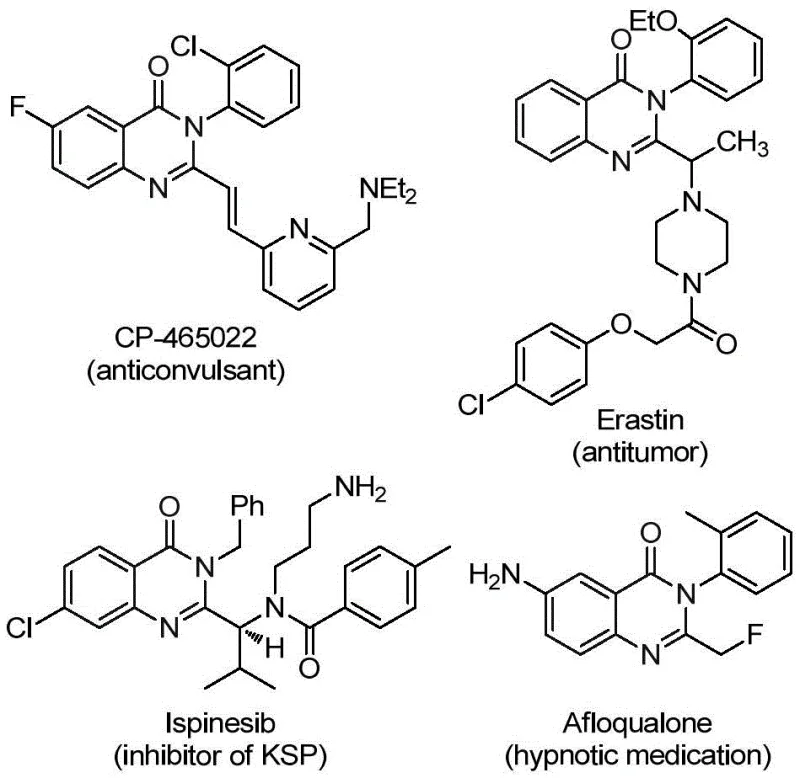
The pharmaceutical industry continuously seeks robust synthetic methodologies to access complex heterocyclic scaffolds that serve as the backbone for next-generation therapeutics. Patent CN112125856A introduces a groundbreaking preparation method for 2-trifluoromethyl substituted quinazolinone derivatives, addressing critical bottlenecks in current manufacturing processes. Quinazolinone derivatives are privileged structures found in numerous bioactive molecules, exhibiting a wide spectrum of pharmacological activities including anti-inflammatory, antiviral, antifungal, anticonvulsant, and anticancer properties. The strategic introduction of a trifluoromethyl group at the 2-position significantly enhances the physicochemical profile of these molecules, improving metabolic stability, lipophilicity, and bioavailability. As illustrated in the structural diversity of known bioactive compounds, the ability to efficiently construct this core motif is paramount for drug discovery and development pipelines.
This novel methodology leverages a transition metal palladium-catalyzed carbonylation tandem reaction, utilizing 1,3,5-tricarboxylate phenol ester (TFBen) as a safe and effective solid carbon monoxide substitute. By circumventing the need for toxic carbon monoxide gas, this process not only enhances operational safety but also simplifies the engineering controls required for industrial implementation. The reaction proceeds under relatively mild thermal conditions, typically around 90°C, and demonstrates exceptional tolerance for a broad range of functional groups. For procurement and supply chain leaders, this represents a significant opportunity to secure a reliable pharmaceutical intermediate supplier capable of delivering high-purity building blocks with reduced regulatory burden and enhanced process safety.
The Limitations of Conventional Methods vs. The Novel Approach
The Limitations of Conventional Methods
Historically, the synthesis of 2-trifluoromethyl substituted quinazolinone derivatives has been fraught with significant technical and economic challenges that hinder efficient commercial scale-up of complex pharmaceutical intermediates. Traditional routes often rely on the cyclization of anthranilamides with ethyl trifluoroacetate, trifluoroacetic anhydride, or trifluoroacetic acid, which frequently necessitate harsh reaction conditions and result in moderate to low yields. Alternative strategies involving the cyclization of anthranilic esters with unstable trifluoroacetamides or the use of isatoic anhydride with trifluoroacetic anhydride suffer from similar drawbacks, including the requirement for expensive or pre-activated substrates. Furthermore, methods employing T3P-promoted tandem reactions, while effective in some contexts, often involve costly coupling reagents and generate substantial waste streams. These legacy processes typically exhibit narrow substrate scopes, limiting the chemical diversity accessible to medicinal chemists and complicating the optimization of structure-activity relationships during lead development phases.
The Novel Approach
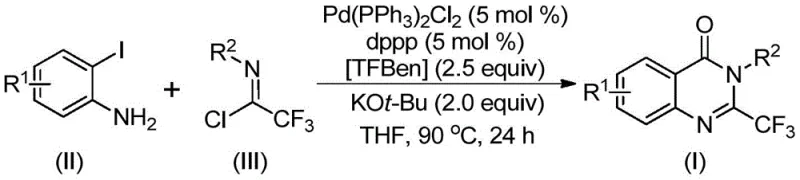
In stark contrast to these cumbersome legacy protocols, the patented method described in CN112125856A offers a streamlined and economically viable pathway for cost reduction in API manufacturing. The core innovation lies in the utilization of readily available o-iodoaniline and trifluoroethylimidoyl chloride as starting materials, coupled with a palladium catalyst system and the solid CO surrogate TFBen. This approach eliminates the direct handling of hazardous carbon monoxide gas, replacing it with a stable solid that releases CO in situ under heating conditions. The reaction mechanism facilitates a seamless tandem process where carbon-nitrogen bond formation and carbonyl insertion occur efficiently to construct the quinazolinone ring system. As depicted in the general reaction scheme, this methodology allows for the modular assembly of diverse derivatives by simply varying the substituents on the aniline or imidoyl chloride components, thereby offering unparalleled flexibility for library synthesis.
Mechanistic Insights into Palladium-Catalyzed Carbonylation Tandem Reaction
For R&D directors focused on process robustness and impurity control, understanding the mechanistic underpinnings of this transformation is crucial. The reaction is believed to initiate with a base-promoted intermolecular carbon-nitrogen bond coupling between the o-iodoaniline and the trifluoroethylimidoyl chloride, generating a trifluoroacetamidine intermediate. Subsequently, the palladium catalyst, specifically bis(triphenylphosphine)palladium(II) dichloride in the presence of the dppp ligand, undergoes oxidative addition into the carbon-iodine bond of the aromatic ring to form a divalent palladium species. Under the applied thermal conditions of 90°C, the TFBen additive decomposes to release carbon monoxide, which then inserts into the carbon-palladium bond to generate an acyl-palladium intermediate. This key step is facilitated by the unique ability of TFBen to act as a controlled source of CO, preventing the accumulation of toxic gas in the reactor headspace.
Following CO insertion, the basic environment provided by potassium tert-butoxide promotes the coordination of the nitrogen atom to the palladium center, forming a seven-membered palladacycle intermediate. This cyclic structure is pivotal for directing the subsequent reductive elimination step, which closes the quinazolinone ring and regenerates the active palladium catalyst. This well-defined catalytic cycle ensures high turnover numbers and minimizes the formation of side products associated with uncontrolled radical pathways or incomplete cyclization. The use of aprotic solvents like tetrahydrofuran (THF) further optimizes the reaction efficiency by ensuring complete solubility of all reagents and stabilizing the charged intermediates. Consequently, this mechanistic precision translates directly into superior product purity profiles, reducing the burden on downstream purification units and enhancing the overall yield of high-purity OLED material or pharmaceutical precursors.
How to Synthesize 2-Trifluoromethyl Quinazolinone Efficiently
The practical execution of this synthesis is designed for reproducibility and ease of operation, making it highly attractive for contract development and manufacturing organizations. The protocol involves charging a reaction vessel with the palladium catalyst, ligand, base, TFBen, and the two primary substrates in an organic solvent, followed by heating to the specified temperature. The simplicity of the reagent setup allows for rapid screening of different substrate combinations to explore chemical space effectively. Detailed standard operating procedures regarding stoichiometry, addition rates, and quenching protocols are essential for maintaining consistency across batches. For a comprehensive guide on the specific molar ratios and workup procedures validated in the patent examples, please refer to the standardized synthesis steps outlined below.
- Combine palladium catalyst Pd(PPh3)2Cl2, ligand dppp, base KOt-Bu, solid CO surrogate TFBen, trifluoroethylimidoyl chloride, and o-iodoaniline in an organic solvent like THF.
- Heat the reaction mixture to 90°C and maintain stirring for 16 to 30 hours to allow the carbonylation and cyclization to proceed completely.
- Upon completion, filter the mixture, mix with silica gel, and purify via column chromatography to isolate the target 2-trifluoromethyl quinazolinone derivative.
Commercial Advantages for Procurement and Supply Chain Teams
From a strategic sourcing perspective, this technology offers compelling advantages that address the core concerns of procurement managers and supply chain heads regarding cost, reliability, and scalability. The shift away from gaseous carbon monoxide to a solid surrogate fundamentally alters the risk profile of the manufacturing process, eliminating the need for specialized gas handling infrastructure and continuous monitoring systems. This reduction in capital expenditure and operational complexity directly contributes to significant cost savings in production without compromising on quality or throughput. Furthermore, the starting materials, such as various substituted o-iodoanilines and trifluoroethylimidoyl chlorides, are commercially available from multiple global suppliers, ensuring a resilient supply chain that is not dependent on single-source vendors for exotic reagents.
- Cost Reduction in Manufacturing: The economic benefits of this process are driven by the use of inexpensive and abundant raw materials combined with a catalytic system that operates at low loading levels. By avoiding the use of expensive coupling reagents like T3P and eliminating the logistical costs associated with transporting and storing toxic gases, the overall cost of goods sold is drastically reduced. Additionally, the high conversion rates observed across a wide range of substrates minimize raw material waste, further enhancing the economic efficiency of the process. The simplified post-treatment workflow, which typically involves filtration and standard chromatography, reduces solvent consumption and labor hours compared to multi-step traditional syntheses.
- Enhanced Supply Chain Reliability: Securing a reliable pharmaceutical intermediate supplier is critical for maintaining uninterrupted drug production schedules. This method's reliance on stable, shelf-stable solids rather than reactive gases or moisture-sensitive liquids ensures that inventory can be managed more effectively with longer shelf lives. The robustness of the reaction conditions means that minor fluctuations in environmental parameters are less likely to cause batch failures, thereby increasing the predictability of delivery timelines. This stability is particularly valuable when scaling up from laboratory quantities to multi-ton commercial production, where consistency is key to meeting regulatory commitments and market demand.
- Scalability and Environmental Compliance: The environmental footprint of chemical manufacturing is increasingly scrutinized, and this process aligns well with green chemistry principles. The avoidance of toxic CO gas significantly lowers the potential for accidental releases and reduces the regulatory burden associated with hazardous air pollutants. The use of common organic solvents like THF, which can be recovered and recycled, supports sustainable manufacturing practices. Moreover, the reaction's tolerance for diverse functional groups allows for the late-stage functionalization of complex molecules, potentially shortening synthetic routes and reducing the total volume of waste generated per kilogram of final product.
Frequently Asked Questions (FAQ)
To assist technical teams in evaluating the feasibility of integrating this technology into their existing workflows, we have compiled answers to common inquiries based on the patent specifications. These questions address the versatility of the method, the specific reaction conditions required, and the nature of the byproducts formed. Understanding these details is essential for conducting accurate route feasibility assessments and determining the optimal strategy for process validation. The following responses provide a technical overview derived directly from the experimental data and claims presented in the intellectual property documentation.
Q: What are the primary advantages of this synthesis method over conventional routes?
A: This method avoids the use of toxic carbon monoxide gas by utilizing a solid surrogate (TFBen), operates under milder conditions compared to traditional cyclization methods, and utilizes cheap, readily available starting materials like o-iodoaniline and trifluoroethylimidoyl chloride.
Q: What is the substrate scope for this palladium-catalyzed reaction?
A: The reaction demonstrates excellent compatibility with various substituents on both the o-iodoaniline and the imidoyl chloride components, including halogens (F, Cl, Br), alkyl groups, nitro groups, and naphthyl groups, allowing for the synthesis of diverse derivatives.
Q: Is this process suitable for large-scale manufacturing?
A: Yes, the process is highly scalable due to the use of stable solid reagents instead of hazardous gases, simple post-treatment procedures involving filtration and chromatography, and the use of common organic solvents like THF.
Partnering with NINGBO INNO PHARMCHEM: Your Reliable 2-Trifluoromethyl Quinazolinone Supplier
At NINGBO INNO PHARMCHEM, we recognize the critical role that advanced synthetic methodologies play in accelerating drug development and optimizing commercial production. Our team of expert chemists possesses extensive experience scaling diverse pathways from 100 kgs to 100 MT/annual commercial production, ensuring that promising laboratory discoveries are successfully translated into viable industrial processes. We are committed to delivering high-purity intermediates that meet stringent purity specifications, supported by our rigorous QC labs equipped with state-of-the-art analytical instrumentation. By leveraging innovations such as the palladium-catalyzed carbonylation method described in CN112125856A, we can offer our partners a competitive edge through improved process efficiency and reduced time-to-market for their therapeutic candidates.
We invite you to engage with our technical procurement team to discuss how this specific synthesis route can be tailored to your project needs. Whether you require a Customized Cost-Saving Analysis for an existing program or need to evaluate the scalability of a new target, our experts are ready to provide specific COA data and route feasibility assessments. Partnering with us ensures access to a supply chain that prioritizes safety, quality, and innovation, enabling you to focus on your core mission of developing life-saving medicines while we manage the complexities of chemical manufacturing.