
Advanced One-Pot Synthesis of 2-Trifluoromethyl Quinazolinones for Commercial Scale-Up
Advanced One-Pot Synthesis of 2-Trifluoromethyl Quinazolinones for Commercial Scale-Up
The pharmaceutical and fine chemical industries are constantly seeking robust, scalable methodologies for constructing complex heterocyclic scaffolds that serve as critical building blocks for next-generation therapeutics. Patent CN112480015B introduces a groundbreaking multi-component one-pot strategy for the efficient synthesis of 2-trifluoromethyl substituted quinazolinones, a privileged structural motif found in numerous bioactive molecules. Quinazolinone derivatives are renowned for their diverse pharmacological profiles, exhibiting potent antifungal, antibacterial, antiviral, anti-inflammatory, and anticancer activities, as seen in established drugs like methaqualone and afloqualone. The strategic incorporation of a trifluoromethyl group further enhances these properties by improving metabolic stability, lipophilicity, and bioavailability, making these compounds highly desirable targets for drug discovery programs.
This novel synthetic route addresses significant bottlenecks in current manufacturing processes by leveraging a palladium-catalyzed carbonylation cascade that utilizes inexpensive and readily available nitro compounds as starting materials. Unlike traditional methods that often rely on hazardous high-pressure carbon monoxide or expensive pre-functionalized substrates, this invention employs molybdenum hexacarbonyl as a safe and solid carbon monoxide surrogate. The process is characterized by its operational simplicity, broad substrate compatibility, and high reaction efficiency, positioning it as a superior alternative for the reliable production of high-purity pharmaceutical intermediates required by global supply chains.
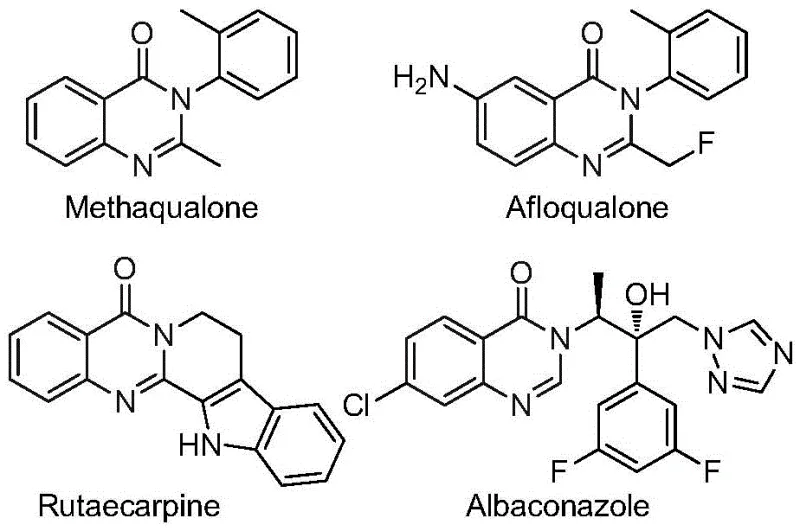
The Limitations of Conventional Methods vs. The Novel Approach
The Limitations of Conventional Methods
Historically, the construction of the quinazolinone core has been fraught with synthetic challenges that hinder cost-effective manufacturing and rapid scale-up. Conventional pathways often necessitate the use of harsh reaction conditions, such as high-pressure carbon monoxide atmospheres, which require specialized and expensive reactor equipment, thereby increasing capital expenditure and operational risk. Furthermore, many existing protocols depend on ruthenium or platinum catalysts, which are not only costly but also pose significant challenges regarding residual metal removal to meet stringent pharmaceutical purity standards. Other methods involve multi-step sequences requiring pre-activation of substrates, such as the conversion of amines to amides prior to cyclization, which drastically reduces overall atom economy and generates substantial chemical waste. These inefficiencies result in lower yields, extended production timelines, and a narrower scope of compatible functional groups, limiting the chemical diversity accessible to medicinal chemists.
The Novel Approach
In stark contrast, the methodology disclosed in patent CN112480015B represents a paradigm shift towards greener and more economical synthesis. By utilizing a palladium-catalyzed system with 1,3-bis(diphenylphosphino)propane (dppp) as a ligand, the reaction achieves high conversion rates under relatively mild thermal conditions at 120°C. The use of nitro compounds as direct precursors eliminates the need for pre-reduction steps, as the reduction occurs in situ facilitated by the molybdenum carbonyl species. This one-pot design significantly streamlines the workflow, reducing solvent consumption, labor costs, and purification burdens. The ability to tolerate a wide array of substituents, including halogens and electron-withdrawing groups, ensures that this platform technology can be adapted for the synthesis of a vast library of analogues, thereby accelerating lead optimization campaigns in drug development.
Mechanistic Insights into Palladium-Catalyzed Carbonylation Cascade
The mechanistic pathway of this transformation is a sophisticated orchestration of reduction, coupling, and cyclization events driven by the synergistic action of palladium and molybdenum species. The reaction initiates with the reduction of the nitro compound to the corresponding amine by molybdenum hexacarbonyl, which simultaneously serves as the source of carbon monoxide upon thermal decomposition. This generated amine then undergoes a base-promoted nucleophilic attack on the trifluoroethylimidoyl chloride, forming a key trifluoroacetamidine intermediate. Subsequently, the palladium catalyst inserts into the carbon-iodine bond of the imidoyl chloride moiety, generating a reactive organopalladium species. The released carbon monoxide then inserts into the carbon-palladium bond to form an acyl-palladium intermediate, setting the stage for ring closure.
Under the influence of the base, an intramolecular cyclization occurs via the formation of a palladium-nitrogen bond, creating a seven-membered cyclic palladium intermediate. The final step involves a reductive elimination that releases the desired 2-trifluoromethyl substituted quinazolinone product and regenerates the active palladium catalyst for the next cycle. This elegant mechanism not only ensures high regioselectivity but also minimizes the formation of side products, resulting in a clean impurity profile that is critical for downstream processing. The robustness of this catalytic cycle allows for the efficient conversion of diverse substrates, making it a reliable tool for the commercial scale-up of complex pharmaceutical intermediates.
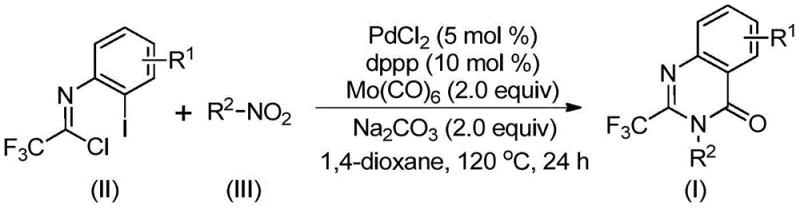
How to Synthesize 2-Trifluoromethyl Quinazolinones Efficiently
The practical implementation of this synthesis is designed for ease of execution in both laboratory and pilot plant settings. The protocol involves charging a reaction vessel with the palladium catalyst, ligand, base, carbon monoxide substitute, and the two primary organic substrates in a suitable aprotic solvent such as 1,4-dioxane. The mixture is then heated to 120°C and stirred for a period ranging from 16 to 30 hours, depending on the specific electronic nature of the substrates. Following the reaction, the workup procedure is straightforward, involving simple filtration to remove inorganic salts and metal residues, followed by silica gel treatment and standard column chromatography to isolate the pure product. For detailed standardized operating procedures and specific stoichiometric ratios optimized for different substrates, please refer to the guide below.
- Combine palladium chloride, dppp ligand, sodium carbonate, Mo(CO)6, trifluoroethylimidoyl chloride, and nitro compound in an organic solvent like 1,4-dioxane.
- Heat the reaction mixture to 120°C and maintain stirring for 16 to 30 hours to allow the carbonylation cascade and cyclization to proceed.
- Upon completion, filter the mixture, mix with silica gel, and purify via column chromatography to isolate the target 2-trifluoromethyl quinazolinone.
Commercial Advantages for Procurement and Supply Chain Teams
For procurement managers and supply chain directors, the adoption of this synthetic route offers tangible strategic benefits that extend beyond mere chemical novelty. The shift from high-pressure gas reactions to a solid-state carbon monoxide source fundamentally alters the safety profile and infrastructure requirements of the manufacturing facility. By eliminating the need for specialized high-pressure autoclaves, companies can utilize standard glass-lined or stainless steel reactors, significantly lowering capital investment barriers and expanding the pool of qualified contract manufacturing organizations (CMOs) capable of producing these intermediates. This flexibility enhances supply chain resilience by reducing dependency on single-source vendors with specialized equipment.
- Cost Reduction in Manufacturing: The economic viability of this process is driven by the utilization of commodity chemicals as starting materials. Nitro compounds and trifluoroethylimidoyl chlorides are widely available in the global market at competitive price points compared to pre-activated amides or brominated precursors used in older methods. Furthermore, the one-pot nature of the reaction consolidates multiple synthetic steps into a single operation, which drastically reduces solvent usage, energy consumption, and labor hours. The avoidance of expensive noble metals like ruthenium or platinum in favor of a more standard palladium system, combined with the potential for catalyst recycling, contributes to substantial overall cost savings in API manufacturing without compromising on quality.
- Enhanced Supply Chain Reliability: Supply continuity is often threatened by the scarcity of exotic reagents or the logistical complexities of transporting hazardous gases. This methodology mitigates those risks by relying on stable, shelf-stable solid reagents that are easy to store and transport. The broad substrate scope means that if a specific nitro compound faces temporary supply constraints, the chemistry is robust enough to accommodate alternative substitution patterns or sourcing strategies without requiring a complete process redevelopment. This adaptability ensures a steady flow of materials for clinical trials and commercial production, reducing lead time for high-purity pharmaceutical intermediates.
- Scalability and Environmental Compliance: As regulatory pressures regarding waste disposal and environmental impact intensify, the efficiency of this process becomes a key asset. The high atom economy and reduced generation of hazardous by-products align with green chemistry principles, simplifying waste treatment protocols and lowering disposal costs. The reaction has been demonstrated to be scalable from gram quantities to larger batches, indicating a smooth path for technology transfer to multi-ton production scales. This scalability ensures that as demand for the final drug product grows, the supply of the intermediate can be ramped up rapidly to meet market needs without encountering the typical bottlenecks associated with complex multi-step syntheses.
Frequently Asked Questions (FAQ)
To assist technical teams in evaluating the feasibility of this technology for their specific projects, we have compiled answers to common inquiries based on the patent data. These questions address critical aspects regarding reaction conditions, substrate compatibility, and purification strategies. Understanding these technical nuances is essential for project managers planning the integration of this synthetic route into their existing pipelines. The following insights are derived directly from the experimental data and embodiments provided in the intellectual property documentation.
Q: What are the primary advantages of this one-pot synthesis method over traditional routes?
A: This method eliminates the need for high-pressure carbon monoxide gas and expensive pre-activated substrates. It utilizes cheap nitro compounds and operates under relatively mild thermal conditions, significantly simplifying the operational complexity and reducing safety risks associated with high-pressure gas handling.
Q: What is the substrate scope for this palladium-catalyzed reaction?
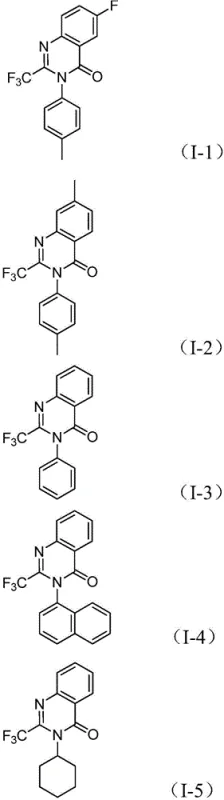
A: The reaction demonstrates excellent functional group tolerance. It accommodates various substituents on the aromatic ring, including halogens (F, Cl, Br), alkyl groups (methyl), and electron-withdrawing groups (trifluoromethyl). Both aryl and alkyl nitro compounds can be effectively utilized.
Q: Is this process suitable for large-scale industrial production?
A: Yes, the patent explicitly states that the method is scalable from gram-level laboratory synthesis to industrial production. The use of commercially available reagents and standard organic solvents like 1,4-dioxane facilitates easy technology transfer and scale-up without requiring specialized high-pressure reactors.
Partnering with NINGBO INNO PHARMCHEM: Your Reliable 2-Trifluoromethyl Quinazolinone Supplier
At NINGBO INNO PHARMCHEM, we recognize the critical role that advanced synthetic methodologies play in accelerating drug development and ensuring market readiness. Our team of expert chemists has extensively analyzed the technology described in patent CN112480015B and is fully prepared to leverage this palladium-catalyzed carbonylation strategy for your custom synthesis needs. We possess extensive experience scaling diverse pathways from 100 kgs to 100 MT/annual commercial production, ensuring that your transition from benchtop discovery to full-scale manufacturing is seamless. Our state-of-the-art facilities are equipped with rigorous QC labs capable of meeting stringent purity specifications, guaranteeing that every batch of 2-trifluoromethyl quinazolinone intermediate delivered meets the highest industry standards for potency and impurity control.
We invite you to collaborate with us to optimize this process for your specific target molecules. By partnering with our technical procurement team, you can gain access to a Customized Cost-Saving Analysis that evaluates the economic benefits of switching to this one-pot method for your specific portfolio. We encourage you to contact us today to request specific COA data for similar structures and discuss route feasibility assessments tailored to your project timelines. Let us help you secure a reliable supply of high-quality intermediates while driving down your overall cost of goods sold through innovative chemistry.