
Advanced Synthesis of 3-Trifluoromethyl-1,2,4-Triazoles: A Breakthrough in Heterocyclic Chemistry for Pharma Applications
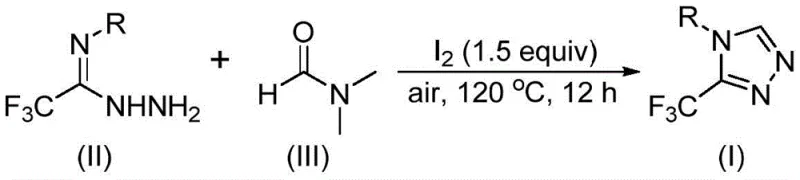
The pharmaceutical and agrochemical industries continuously demand efficient routes to fluorinated heterocycles, particularly 1,2,4-triazoles, which serve as critical scaffolds in numerous bioactive molecules. Patent CN114920707B introduces a transformative preparation method for 3-trifluoromethyl substituted 1,2,4-triazole compounds, addressing long-standing challenges in synthetic efficiency and cost. This innovation leverages the ubiquitous solvent N,N-dimethylformamide (DMF) not merely as a medium, but as a vital carbon source, enabling a tandem cyclization promoted by molecular iodine. The significance of this technology lies in its ability to construct complex fluorinated cores found in drugs like Sitagliptin and Factor IXa inhibitors through a simplified, one-pot protocol. By integrating the carbon source directly into the solvent system, the process drastically reduces the complexity of reagent handling and waste generation, offering a compelling value proposition for manufacturers seeking to optimize their supply chains for high-purity pharmaceutical intermediates.
The Limitations of Conventional Methods vs. The Novel Approach
The Limitations of Conventional Methods
Traditional synthetic routes to trifluoromethyl-substituted triazoles often suffer from significant operational bottlenecks that hinder large-scale production. Conventional methodologies typically rely on pre-functionalized C1 synthons or specialized reagents that are expensive, moisture-sensitive, and difficult to source in bulk quantities. These processes frequently necessitate stringent reaction conditions, such as strictly anhydrous environments or inert gas atmospheres, which impose heavy infrastructure costs on manufacturing facilities. Furthermore, multi-step sequences involving isolation of unstable intermediates lead to cumulative yield losses and increased solvent consumption. The reliance on transition metal catalysts in some existing methods also introduces the risk of heavy metal contamination, requiring costly purification steps to meet regulatory standards for active pharmaceutical ingredients. These factors collectively inflate the cost of goods sold and extend lead times, creating friction in the supply chain for critical drug intermediates.
The Novel Approach
In stark contrast, the methodology disclosed in CN114920707B represents a paradigm shift by utilizing DMF, a commodity chemical, as the primary carbon donor. This approach eliminates the need for exotic reagents, replacing them with molecular iodine, a readily available and inexpensive promoter. The reaction operates under air atmosphere at moderate temperatures between 110°C and 130°C, removing the necessity for specialized glovebox techniques or rigorous drying protocols. The versatility of this system is demonstrated by its tolerance for a wide range of functional groups on the hydrazide substrate, including alkyl, alkoxy, thioalkyl, and halogen substituents. By collapsing the synthesis into a single pot where the solvent actively participates in bond formation, the process achieves high atom economy and operational simplicity. This novel strategy not only accelerates the discovery phase by allowing rapid access to diverse analogs but also provides a robust platform for commercial scale-up of complex heterocycles.
Mechanistic Insights into Iodine-Promoted Tandem Cyclization
The mechanistic elegance of this transformation lies in the dual reactivity of the DMF molecule, which can participate via either its formyl or methyl group depending on the specific reaction pathway activated. When the formyl group acts as the carbon source, it undergoes a condensation reaction with the trifluoroethyliminohydrazide to generate a hydrazone intermediate. This species subsequently experiences intramolecular cyclization followed by the elimination of dimethylamine, ultimately yielding the desired 3-trifluoromethyl-1,2,4-triazole core. Alternatively, when the N-methyl group serves as the carbon donor, molecular iodine first activates the DMF to form an amine salt. Following the elimination of hydrogen iodide, a nucleophilic addition occurs with the hydrazide, leading to the expulsion of N-methylformamide and the generation of an azadiene intermediate. This intermediate then undergoes intramolecular nucleophilic addition and oxidative aromatization to finalize the ring closure. Understanding these pathways is crucial for R&D teams optimizing reaction parameters, as it highlights the critical role of iodine in activating the solvent and driving the thermodynamic equilibrium toward the aromatic product.
From an impurity control perspective, the mechanism suggests that side reactions are minimized due to the driving force of aromatization and the volatility of byproducts like dimethylamine. The use of air as the oxidant in the aromatization step further simplifies the system by avoiding stoichiometric oxidants that could generate hazardous waste. The robustness of the trifluoromethyl group throughout this harsh oxidative environment underscores the stability of the final product, ensuring that the valuable fluorine content is retained without defluorination side reactions. This mechanistic stability is paramount for maintaining the high purity specifications required in pharmaceutical applications, where trace impurities can impact the safety profile of the final drug substance. The ability to tune the electronic nature of the R-group on the hydrazide allows chemists to fine-tune the nucleophilicity and reaction rate, providing a handle for process optimization across different substrate classes.
How to Synthesize 3-Trifluoromethyl-1,2,4-Triazole Efficiently
The practical execution of this synthesis is designed for ease of operation, making it accessible for both laboratory discovery and pilot plant operations. The protocol involves simply combining the trifluoroethyliminohydrazide starting material with molecular iodine in DMF solvent. The mixture is then heated to the specified temperature range under ambient air conditions. Following the reaction period, standard workup procedures such as filtration and silica gel chromatography are sufficient to isolate the target compound. This straightforward workflow minimizes the need for specialized equipment or highly trained personnel, thereby reducing operational overhead. For detailed standardized synthesis steps and specific molar ratios optimized for different substrates, please refer to the guide below.
- Combine trifluoroethyliminohydrazide, molecular iodine, and DMF solvent in a reaction vessel under air atmosphere.
- Heat the mixture to 110-130°C and maintain reaction for 10-15 hours to facilitate tandem cyclization.
- Perform post-treatment including filtration, washing, and column chromatography to isolate the pure triazole product.
Commercial Advantages for Procurement and Supply Chain Teams
For procurement managers and supply chain directors, the adoption of this synthetic route offers tangible strategic benefits that extend beyond simple chemistry. The primary advantage is the drastic simplification of the raw material portfolio. By utilizing DMF, a solvent already present in almost every chemical facility, the need to procure and store specialized, high-cost C1 building blocks is eliminated. This consolidation of materials reduces inventory complexity and mitigates the risk of supply disruptions associated with niche reagents. Furthermore, the operational simplicity of running reactions under air without strict moisture control lowers the barrier for contract manufacturing organizations (CMOs) to adopt the process, increasing the pool of potential suppliers and fostering competitive pricing dynamics in the market.
- Cost Reduction in Manufacturing: The economic impact of this technology is driven by the replacement of expensive reagents with commodity chemicals. Molecular iodine is significantly cheaper than many transition metal catalysts or specialized organometallic reagents used in alternative routes. Additionally, the dual function of DMF as both solvent and reactant reduces the overall volume of materials required, leading to lower waste disposal costs. The elimination of rigorous drying and degassing steps also translates to reduced energy consumption and shorter cycle times, contributing to substantial cost savings in utility and labor expenses over the lifecycle of the product.
- Enhanced Supply Chain Reliability: Supply chain resilience is bolstered by the use of globally available starting materials. Trifluoroethyliminohydrazides can be synthesized from readily accessible aromatic amines and trifluoroacetic acid derivatives, ensuring a stable upstream supply. The robustness of the reaction conditions means that production is less susceptible to delays caused by equipment failures related to inert gas systems or drying trains. This reliability ensures consistent delivery schedules for downstream API manufacturers, reducing the risk of stockouts and enabling more accurate demand forecasting for long-term projects.
- Scalability and Environmental Compliance: Scaling this process from gram to ton scale is facilitated by the absence of hazardous reagents and the use of standard heating equipment. The reaction generates minimal hazardous waste compared to methods requiring stoichiometric oxidants or heavy metals. The byproducts, primarily dimethylamine or formamide derivatives, are manageable within standard wastewater treatment protocols. This environmental profile aligns with increasingly stringent global regulations on chemical manufacturing, reducing the compliance burden and potential liability for production sites. The ease of scale-up ensures that supply can be rapidly ramped up to meet clinical trial demands or commercial launch volumes without extensive process re-engineering.
Frequently Asked Questions (FAQ)
The following questions address common technical and commercial inquiries regarding the implementation of this patented synthesis method. These insights are derived directly from the experimental data and beneficial effects described in the patent documentation, providing clarity for technical teams evaluating the feasibility of this route for their specific projects. Understanding these details helps in making informed decisions about process adoption and resource allocation.
Q: What are the key advantages of using DMF as a carbon source in this synthesis?
A: Using DMF eliminates the need for separate, expensive C1 building blocks. It serves a dual role as both the reaction medium and the reactant, significantly simplifying the process and reducing raw material costs.
Q: Does this method require strict anhydrous or anaerobic conditions?
A: No, one of the major operational benefits of this patented process is that it proceeds efficiently under standard air atmosphere without the need for rigorous anhydrous or oxygen-free environments, facilitating easier scale-up.
Q: What is the substrate scope for the R group in the trifluoroethyliminohydrazide?
A: The method demonstrates broad compatibility, successfully accommodating various substituted aryl groups including those with electron-donating (alkyl, alkoxy) and electron-withdrawing (halogen, trifluoromethyl) substituents at ortho, meta, and para positions.
Partnering with NINGBO INNO PHARMCHEM: Your Reliable 3-Trifluoromethyl-1,2,4-Triazole Supplier
At NINGBO INNO PHARMCHEM, we recognize the critical role that efficient heterocyclic synthesis plays in accelerating drug development timelines. Our team of expert chemists has extensively evaluated the methodology described in CN114920707B and possesses the technical capability to implement this iodine-promoted cyclization at various scales. We bring extensive experience scaling diverse pathways from 100 kgs to 100 MT/annual commercial production, ensuring that the transition from lab bench to manufacturing plant is seamless. Our state-of-the-art facilities are equipped with rigorous QC labs capable of meeting stringent purity specifications, guaranteeing that every batch of 3-trifluoromethyl-1,2,4-triazole intermediate meets the highest quality standards required for pharmaceutical applications.
We invite you to collaborate with us to leverage this advanced synthetic technology for your next project. By partnering with our technical procurement team, you can request a Customized Cost-Saving Analysis tailored to your specific volume requirements. We encourage you to reach out today to obtain specific COA data and route feasibility assessments, allowing us to demonstrate how our expertise can optimize your supply chain and reduce your overall manufacturing costs while ensuring a reliable supply of high-quality intermediates.