
Advanced Palladium-Catalyzed Synthesis of 1,2,4-Triazole-3-Ones for Commercial Scale-Up
Advanced Palladium-Catalyzed Synthesis of 1,2,4-Triazole-3-Ones for Commercial Scale-Up
The pharmaceutical and agrochemical industries continuously seek robust synthetic routes for nitrogen-containing heterocycles due to their prevalence in bioactive molecules. A significant breakthrough in this domain is documented in Chinese Patent CN112538054B, which discloses a highly efficient preparation method for 1,2,4-triazole-3-one compounds. This patent introduces a transition metal palladium-catalyzed carbonylation tandem cyclization reaction that fundamentally shifts the paradigm from traditional, cumbersome syntheses to a streamlined, one-pot process. The core innovation lies in utilizing inexpensive chlorohydrazones and sodium azide as starting materials, coupled with a phenol ester (TFBen) serving as a safe carbon monoxide substitute. This methodology not only simplifies the operational workflow but also dramatically expands the scope of accessible chemical space, allowing for the rapid generation of diverse libraries essential for drug discovery programs targeting antifungal, antitumor, and anticonvulsant activities.
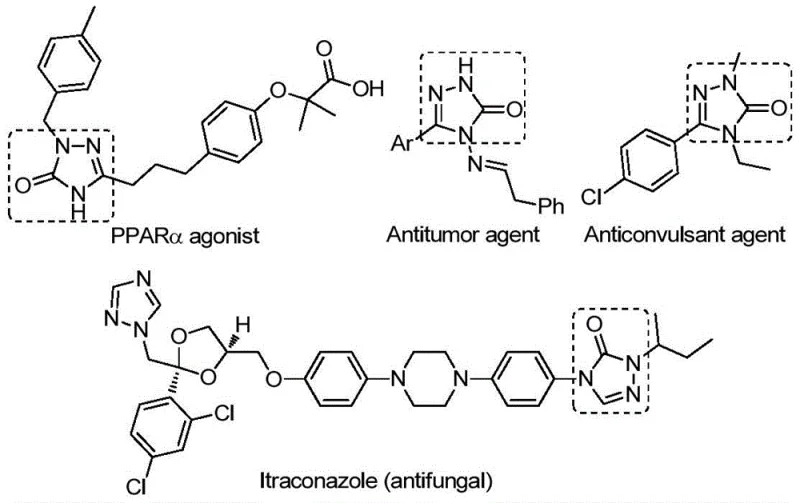
The strategic importance of the 1,2,4-triazole-3-one scaffold cannot be overstated, as evidenced by its presence in numerous high-value therapeutic agents ranging from PPARα agonists to potent antifungals like Itraconazole. The ability to access these structures efficiently is a critical bottleneck in modern medicinal chemistry. By leveraging the catalytic system described in CN112538054B, manufacturers can overcome historical limitations associated with heterocycle synthesis. The reaction operates under relatively mild thermal conditions (100-120°C) in common organic solvents like 1,4-dioxane, ensuring compatibility with sensitive functional groups often found in complex drug candidates. This technological advancement positions the 1,2,4-triazole-3-one motif as a more accessible building block for reliable pharmaceutical intermediate supplier networks aiming to accelerate pipeline development.
The Limitations of Conventional Methods vs. The Novel Approach
The Limitations of Conventional Methods
Prior to the development of this palladium-catalyzed protocol, the synthesis of 1,2,4-triazole-3-one derivatives was fraught with significant chemical and operational challenges that hindered widespread adoption in process chemistry. Traditional literature methods typically relied on the cyclization of benzoyl hydrazides with urea under strong basic conditions, or the tandem reaction of hydrazides with isocyanates, which often required hazardous reagents and strict anhydrous environments. Other approaches involved the condensation of thioamides with hydrazines at excessively high temperatures, leading to poor energy efficiency and difficult temperature control during scale-up. Furthermore, many existing routes necessitated the pre-activation of substrates, adding extra synthetic steps that cumulatively reduced the overall atom economy and increased waste generation. These conventional pathways frequently suffered from narrow substrate scope, failing to tolerate electron-withdrawing or sterically hindered groups, which resulted in low yields and limited the structural diversity available to chemists designing new active pharmaceutical ingredients.
The Novel Approach
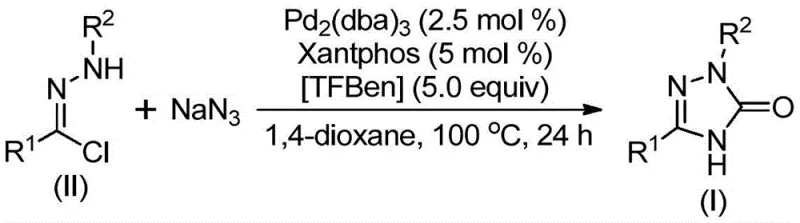
In stark contrast to these legacy methods, the novel approach detailed in the patent utilizes a sophisticated palladium-catalyzed carbonylation cascade that elegantly constructs the triazolone ring in a single operation. By employing chlorohydrazones as the electrophilic partner and sodium azide as the nitrogen source, the reaction bypasses the need for pre-formed isocyanates or harsh cyclization promoters. The use of TFBen (1,3,5-tricarboxylic acid phenol ester) as a solid carbon monoxide surrogate is particularly ingenious, as it eliminates the safety hazards associated with handling gaseous CO while providing a steady release of the carbonyl unit in situ. This method demonstrates exceptional versatility, successfully accommodating a wide array of substituents including alkyl, aryl, naphthyl, and halogen groups on both the nitrogen and carbon positions of the heterocycle. The operational simplicity, combined with high reaction efficiency and excellent yields reaching up to 96% for certain substrates, represents a transformative improvement for cost reduction in pharmaceutical intermediate manufacturing.
Mechanistic Insights into Pd-Catalyzed Carbonylation Cyclization
Understanding the mechanistic underpinnings of this transformation is vital for R&D directors aiming to optimize the process for specific analogs. The reaction is believed to initiate with the oxidative addition of the palladium(0) catalyst into the carbon-chlorine bond of the chlorohydrazone substrate, generating a reactive divalent palladium intermediate. Simultaneously, the TFBen additive undergoes thermal decomposition to release carbon monoxide, which subsequently inserts into the carbon-palladium bond to form an acyl-palladium species. This acyl intermediate then reacts with sodium azide to generate an acyl azide transiently, which immediately undergoes a Curtius rearrangement to yield an isocyanate intermediate. The final ring closure occurs via an intramolecular nucleophilic addition where the hydrazine nitrogen attacks the electrophilic carbon of the isocyanate, forging the five-membered 1,2,4-triazole-3-one ring. This intricate cascade highlights the precision of the catalytic cycle, where each step is carefully balanced to prevent side reactions such as homocoupling or hydrolysis.
From an impurity control perspective, the mild nature of this catalytic system offers distinct advantages over thermal cyclization methods. Because the reaction proceeds through well-defined organometallic intermediates rather than high-energy radical or ionic species, the formation of polymeric byproducts or decomposition products is significantly minimized. The use of Xantphos as a bidentate ligand stabilizes the palladium center, preventing catalyst aggregation and ensuring consistent turnover numbers throughout the 16 to 30-hour reaction window. Furthermore, the choice of aprotic solvents like 1,4-dioxane is critical, as protic solvents could interfere with the acyl azide intermediate or promote premature hydrolysis. This mechanistic robustness ensures that the final crude product contains fewer difficult-to-remove impurities, thereby simplifying downstream purification and enhancing the overall purity profile of the high-purity pharmaceutical intermediates produced.
How to Synthesize 1,2,4-Triazole-3-One Efficiently
The practical execution of this synthesis is designed to be straightforward, making it highly attractive for both laboratory-scale optimization and pilot plant operations. The protocol involves charging a reaction vessel with the palladium catalyst precursor Pd2(dba)3, the Xantphos ligand, the CO source TFBen, the specific chlorohydrazone substrate, and sodium azide in a molar ratio optimized for maximum conversion. The mixture is suspended in an organic solvent, preferably 1,4-dioxane, and heated to a temperature range of 100-120°C. Maintaining this thermal profile for 16 to 30 hours allows the tandem cyclization to reach completion, as monitored by standard analytical techniques. Following the reaction, the workup procedure is remarkably simple, involving filtration to remove inorganic salts and catalyst residues, followed by silica gel treatment and column chromatography. For detailed standardized operating procedures and specific stoichiometric ratios for various substrates, please refer to the guide below.
- Combine Pd2(dba)3 catalyst, Xantphos ligand, TFBen carbon monoxide source, chlorohydrazone substrate, and sodium azide in an organic solvent like 1,4-dioxane.
- Heat the reaction mixture to 100-120°C and maintain stirring for 16 to 30 hours to ensure complete conversion.
- Upon completion, filter the mixture, mix with silica gel, and purify via column chromatography to isolate the target 1,2,4-triazole-3-one compound.
Commercial Advantages for Procurement and Supply Chain Teams
For procurement managers and supply chain heads, the adoption of this patented technology offers compelling economic and logistical benefits that directly impact the bottom line. The primary driver for cost efficiency is the utilization of commodity chemicals as starting materials; chlorohydrazones can be rapidly synthesized from readily available acid chlorides and hydrazines, while sodium azide and TFBen are bulk industrial chemicals with stable pricing. By eliminating the need for exotic reagents or multi-step activation sequences, the overall material cost per kilogram of the final API intermediate is significantly reduced. Moreover, the simplified post-treatment process, which avoids complex aqueous workups or crystallization struggles, reduces solvent consumption and waste disposal costs, contributing to substantial cost savings in the overall manufacturing budget without compromising on quality standards.
- Cost Reduction in Manufacturing: The elimination of expensive activating agents and the use of a catalytic amount of palladium (as low as 2.5 mol%) drastically lowers the raw material expenditure compared to stoichiometric traditional methods. The high atom economy of the carbonylation step ensures that the majority of the input mass is converted into the desired product, minimizing waste generation fees. Additionally, the ability to run the reaction in a single pot reduces labor hours and equipment occupancy time, further driving down the operational expenditure associated with producing complex heterocyclic scaffolds.
- Enhanced Supply Chain Reliability: Since all key reagents including the palladium catalyst, ligands, and substrates are commercially available from multiple global suppliers, the risk of supply chain disruption is minimized. The robustness of the reaction conditions means that production schedules are less likely to be delayed by sensitivity to moisture or oxygen, which often plagues other organometallic processes. This reliability ensures a consistent flow of materials to downstream formulation teams, reducing lead time for high-purity pharmaceutical intermediates and enabling more predictable inventory management strategies for long-term projects.
- Scalability and Environmental Compliance: The process has been demonstrated to be scalable beyond the milligram scale, with the patent noting successful expansion to larger batches suitable for industrial application. The use of a solid CO surrogate instead of toxic gas enhances workplace safety and simplifies regulatory compliance regarding hazardous material handling. Furthermore, the reduced solvent usage and simpler purification steps align with green chemistry principles, lowering the environmental footprint of the manufacturing process and facilitating easier approval from environmental health and safety auditors during facility inspections.
Frequently Asked Questions (FAQ)
The following questions address common technical and commercial inquiries regarding the implementation of this synthesis technology. These insights are derived directly from the experimental data and beneficial effects reported in the patent documentation, providing a clear picture of what partners can expect when integrating this route into their supply chain. Understanding these nuances helps in making informed decisions about process adoption and resource allocation for upcoming development campaigns.
Q: What are the key advantages of this palladium-catalyzed method over traditional synthesis?
A: Unlike traditional methods requiring harsh conditions or pre-activated substrates, this novel approach utilizes cheap chlorohydrazones and sodium azide under mild conditions (100°C), offering broader substrate compatibility and higher yields up to 96%.
Q: Is this process suitable for large-scale industrial production?
A: Yes, the patent explicitly demonstrates scalability beyond 1 mmol levels. The use of commercially available reagents and simple post-treatment (filtration and chromatography) facilitates easy scale-up for commercial manufacturing.
Q: What types of substituents are tolerated in this reaction?
A: The method exhibits excellent functional group tolerance, successfully synthesizing derivatives with alkyl (t-Bu, i-Pr), aryl (phenyl, naphthyl), and halogen (F, Br) substituents on both the R1 and R2 positions.
Partnering with NINGBO INNO PHARMCHEM: Your Reliable 1,2,4-Triazole-3-One Supplier
At NINGBO INNO PHARMCHEM, we recognize the critical role that efficient synthetic methodologies play in accelerating drug development timelines. As a premier CDMO partner, we possess extensive experience scaling diverse pathways from 100 kgs to 100 MT/annual commercial production, ensuring that your project transitions smoothly from benchtop discovery to full-scale manufacturing. Our state-of-the-art facilities are equipped to handle palladium-catalyzed reactions with stringent purity specifications, supported by rigorous QC labs that guarantee every batch meets the highest international standards. We are committed to leveraging advanced technologies like the one described in CN112538054B to deliver superior value to our global clientele.
We invite you to collaborate with us to explore the full potential of this 1,2,4-triazole-3-one synthesis platform for your specific pipeline needs. Our technical team is ready to provide a Customized Cost-Saving Analysis tailored to your target molecule, demonstrating exactly how this route can optimize your budget. Please contact our technical procurement team today to request specific COA data for related analogs and comprehensive route feasibility assessments that will empower your next breakthrough in pharmaceutical innovation.