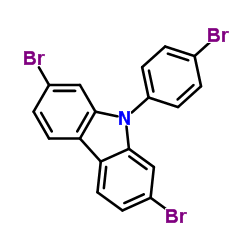
2,7-Dibromo-9-(4-Bromophenyl)-9H-Carbazole
- CAS No.1313900-20-7
- GradeIndustrial / Pharmaceutical
- Availability● In Stock
High-purity OLED intermediate used in organic light-emitting diode material synthesis. Available in bulk quantities with strict quality control.
Request Bulk PricingProduct Technical Details
Product Overview
2,7-Dibromo-9-(4-Bromophenyl)-9H-Carbazole is a specialized organic chemical intermediate designed primarily for the synthesis of advanced organic light-emitting diode (OLED) materials. As a halogenated carbazole derivative, this compound serves as a critical building block in the construction of high-performance emissive layers and host materials used in next-generation display technologies. Our manufacturing process ensures exceptional purity levels, making it suitable for demanding electronic applications where consistency and performance are paramount.
This compound features a robust carbazole core substituted with bromine atoms at the 2, 7, and 4 prime positions. This specific substitution pattern facilitates efficient cross-coupling reactions, such as Suzuki or Buchwald-Hartwig couplings, which are essential for constructing complex conjugated systems required in modern optoelectronics. The high degree of functionalization allows chemists to extend the pi-conjugation system effectively, tuning the electronic properties for specific color emission or charge transport characteristics.
Technical Specifications
| Parameter | Value |
|---|---|
| Chemical Name | 2,7-Dibromo-9-(4-Bromophenyl)-9H-Carbazole |
| CAS Number | 1313900-20-7 |
| Molecular Formula | C18H10Br3N |
| Molecular Weight | 479.99 g/mol |
| Appearance | White Powder |
| Purity (Assay) | ≥99.0% |
| Packing | 25 kg/drum or customized |
Industrial Applications
The primary application of this material lies within the organic electronics sector, specifically in the fabrication of OLED panels. It is utilized as a precursor for synthesizing host materials that facilitate energy transfer to dopant molecules, thereby enhancing the efficiency and lifespan of the display device. Additionally, it finds use in the development of phosphorescent emitters and charge transport layers due to its favorable hole-transporting properties inherent to the carbazole structure.
Beyond displays, derivatives of this compound are investigated for use in organic photovoltaics (OPV) and organic field-effect transistors (OFET). The stability of the carbazole backbone combined with the reactivity of the bromine substituents makes it a versatile candidate for various organic semiconductor research and development projects. Manufacturers relying on this intermediate benefit from its reliability in scale-up processes, ensuring consistent batch-to-batch performance.
Quality Assurance and Safety
We adhere to strict quality management systems to guarantee the integrity of every batch produced. Each shipment is accompanied by a Certificate of Analysis (COA) detailing purity, residual solvents, and heavy metal content. Our facilities operate under controlled conditions to minimize contamination risks. Regarding safety, this compound should be handled in accordance with standard laboratory safety protocols for organic bromides. Proper personal protective equipment, including gloves and eye protection, is recommended during handling.
Storage requirements include keeping the material in a cool, ventilated area away from direct sunlight and moisture to prevent degradation. The packaging is designed to maintain stability during transit, with options available for bulk industrial orders. Our logistics team ensures timely delivery globally, supporting R&D centers and production facilities alike. For specific technical data sheets or custom synthesis requirements, our support team is available to provide detailed documentation and assistance.