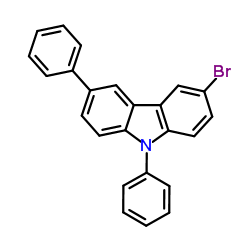
3-Bromo-6,9-Diphenyl-9H-Carbazole
- CAS No.1160294-85-8
- GradeIndustrial / Pharmaceutical
- Availability● In Stock
High-purity 3-Bromo-6,9-Diphenyl-9H-Carbazole (CAS 1160294-85-8) designed for advanced OLED material synthesis. Reliable bulk supply with strict quality control.
Request Bulk PricingProduct Technical Details
Product Overview
3-Bromo-6,9-Diphenyl-9H-Carbazole is a specialized organic intermediate engineered for the fabrication of high-performance organic light-emitting diode (OLED) materials. As a brominated carbazole derivative, this compound serves as a critical building block in the synthesis of complex host and emissive materials used in next-generation display technologies. Our manufacturing process ensures exceptional structural integrity and chemical stability, making it an ideal precursor for researchers and industrial producers focused on organic electroluminescence.
The carbazole core is renowned for its excellent hole-transporting properties and thermal stability. By introducing phenyl groups and a bromine substituent at specific positions, this molecule offers enhanced solubility and reactivity for further functionalization. We prioritize consistent batch-to-bquality to support scalable production environments.
Technical Specifications
| Parameter | Value |
|---|---|
| Chemical Name | 3-Bromo-6,9-Diphenyl-9H-Carbazole |
| CAS Number | 1160294-85-8 |
| Molecular Formula | C24H16BrN |
| Molecular Weight | 398.29 g/mol |
| Purity (Assay) | ≥99.0% |
| Appearance | White powder |
Industrial Applications
This intermediate is primarily utilized in the development of OLED layers, including hole transport layers (HTL) and emissive layers (EML). Its chemical structure facilitates efficient charge carrier mobility, which is essential for achieving high luminance and low operating voltages in organic electronic devices. Manufacturers leverage this compound to create custom phosphorescent and fluorescent emitters that meet rigorous efficiency standards.
Beyond display panels, derivatives of this carbazole structure are increasingly explored in organic photovoltaics and sensor technologies. The high purity level ensures minimal impurity-induced quenching, thereby maximizing the lifespan and performance of the final electronic components. Our technical team supports clients in optimizing synthesis routes for specific device architectures.
Quality Assurance and Packaging
Quality control is paramount in our production facility. Each batch undergoes rigorous analysis using high-performance liquid chromatography (HPLC) and nuclear magnetic resonance (NMR) to verify structural correctness and purity levels. We provide comprehensive documentation, including Certificates of Analysis (COA), to ensure full transparency and compliance with international chemical safety standards.
Standard packaging consists of 25 kg drums, designed to protect the material from moisture and light during transit. Custom packaging solutions are available to accommodate specific logistical requirements or smaller research quantities. For optimal stability, we recommend storing the product in a cool, ventilated area away from direct sunlight and incompatible substances. Our global logistics network ensures timely delivery to support uninterrupted manufacturing schedules.