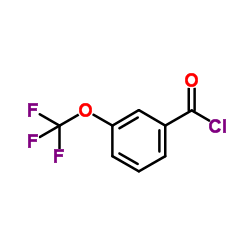
3-(Trifluoromethoxy)benzoyl Chloride
- CAS No.86270-03-3
- GradeIndustrial / Pharmaceutical
- Availability● In Stock
High-purity 3-(Trifluoromethoxy)benzoyl chloride (CAS 86270-03-3), a key fluorinated intermediate for advanced organic synthesis in pharmaceutical and agrochemical R&D.
Request Bulk PricingProduct Technical Details
Product Overview
3-(Trifluoromethoxy)benzoyl chloride is a high-value fluorinated aromatic acyl chloride widely employed as a versatile building block in complex organic synthesis. With its electron-withdrawing trifluoromethoxy group at the meta-position, this compound exhibits enhanced reactivity and stability, making it particularly suitable for constructing bioactive molecules in pharmaceutical and agrochemical innovation pipelines.
Specifications
| Molecular Formula | C8H4ClF3O2 |
|---|---|
| Molecular Weight | 224.56 g/mol |
| Appearance | Colorless transparent liquid |
| Assay | ≥98.0% |
| Moisture | ≤0.2% |
| Density | 1.43 g/cm³ |
| Boiling Point | 204.1°C |
| Flash Point | 78.7°C |
| Refractive Index | 1.467 |
Industrial Applications
This compound serves primarily as a specialty intermediate in the synthesis of active pharmaceutical ingredients (APIs) and crop protection agents. Its trifluoromethoxy moiety imparts desirable metabolic stability, lipophilicity, and binding affinity to target molecules—critical attributes in modern drug design. Common transformations include nucleophilic acyl substitution to form amides, esters, or ketones, enabling rapid diversification of molecular scaffolds.
- Ideal for introducing the 3-(trifluoromethoxy)benzoyl pharmacophore into lead compounds
- Compatible with standard Schotten-Baumann and Friedel-Crafts acylation protocols
- Supplied under strict quality control to ensure batch-to-batch consistency for GMP-relevant research
Stored in a cool, well-ventilated area away from moisture and incompatible materials, 3-(trifluoromethoxy)benzoyl chloride is typically packed in 200 kg drums or customized containers per client specifications. As a moisture-sensitive reagent, handling under inert atmosphere is recommended to maintain integrity during scale-up processes.