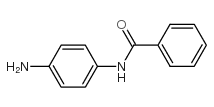
4'-Aminobenzanilide
- CAS No.17625-83-1
- GradeIndustrial / Pharmaceutical
- Availability● In Stock
High-purity 4'-Aminobenzanilide (CAS 17625-83-1), a key aromatic intermediate for organic pigment synthesis.
Request Bulk PricingProduct Technical Details
Product Overview
4'-Aminobenzanilide is a high-value aromatic amide compound widely employed as a chemical intermediate in the production of organic pigments and specialty dyes. With a molecular formula of C13H12N2O and a molecular weight of 212.25 g/mol, this compound features dual functional groups—an aniline moiety and a benzamide linkage—that enable versatile reactivity in electrophilic substitution and condensation reactions.
Specifications
| Molecular Formula | C13H12N2O |
|---|---|
| Molecular Weight | 212.25 g/mol |
| CAS Number | 17625-83-1 |
| Appearance | Rice white powder |
| Purity | ≥99.0% |
| Melting Point | 127–131 °C (lit.) |
| Boiling Point | 278.1 °C at 760 mmHg |
| Density | 1.171 g/cm³ |
| Flash Point | 122 °C |
| Refractive Index | 1.41 |
Industrial Applications
As a critical building block in colorant chemistry, 4'-Aminobenzanilide serves primarily in the synthesis of high-performance organic pigments used in coatings, inks, and plastics. Its structural motif contributes to chromophore stability and color fastness, making it indispensable in formulations requiring thermal and light resistance. The compound is not intended for pharmaceutical, cosmetic, or food applications and is strictly supplied for industrial R&D and manufacturing purposes under B2B compliance frameworks.
Key advantages of our 4'-Aminobenzanilide include:
- Consistent ≥99.0% assay purity verified by HPLC and NMR
- Low residual solvent and heavy metal content
- Optimized particle morphology for efficient downstream processing
- Compliant with global chemical regulatory standards (REACH, TSCA)
Handling and Storage
Store in a cool, dry, and well-ventilated area in tightly sealed containers to prevent moisture absorption and oxidation. Keep away from heat sources and incompatible materials such as strong oxidizing agents. Standard industrial hygiene practices are recommended during handling.