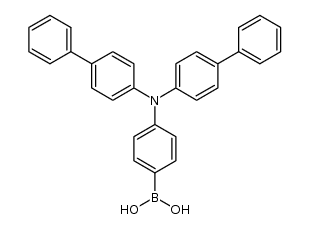
4-(Dibiphenyl-4-ylamino)phenylboronic Acid
- CAS No.943836-24-6
- GradeIndustrial / Pharmaceutical
- Availability● In Stock
High-purity 4-(Dibiphenyl-4-ylamino)phenylboronic Acid designed for advanced OLED material synthesis. Offers exceptional stability and reactivity for electronic applications.
Request Bulk PricingProduct Technical Details
Product Overview
4-(Dibiphenyl-4-ylamino)phenylboronic Acid is a specialized organic intermediate engineered for the synthesis of high-performance organic light-emitting diode (OLED) materials. This compound features a robust biphenylamine structure coupled with a reactive boronic acid group, making it an essential building block for constructing complex hole transport layers and emissive dopants. Our manufacturing process ensures consistent molecular integrity, supporting the rigorous demands of modern display and lighting technologies.
As a key precursor in organic electronics, this chemical facilitates efficient cross-coupling reactions, particularly Suzuki-Miyaura couplings, which are fundamental in assembling conjugated systems required for charge transport. The high level of purification minimizes impurities that could otherwise quench luminescence or degrade device longevity.
Key Specifications
| Parameter | Specification |
|---|---|
| Chemical Name | 4-(Dibiphenyl-4-ylamino)phenylboronic Acid |
| CAS Number | 943836-24-6 |
| Molecular Formula | C30H24BNO2 |
| Molecular Weight | 441.33 g/mol |
| Purity (Assay) | ≥98.0% |
| Appearance | White to off-white powder |
| Packing | 25 kg/drum or customized |
| Storage | Cool, ventilated place |
Industrial Applications
This intermediate is primarily utilized in the fabrication of organic semiconductors. Its structural properties enable the creation of materials with optimized energy levels, crucial for balancing electron and hole injection in OLED devices. Manufacturers leverage this compound to develop next-generation displays with higher efficiency and lower power consumption. The biphenyl moiety provides excellent thermal stability, while the boronic acid functionality allows for versatile synthetic modifications.
Beyond display technologies, this chemical finds relevance in the research and development of organic photovoltaics and sensor materials. Its reliability in synthesis routes makes it a preferred choice for laboratories and production facilities aiming to scale up organic electronic components without compromising on quality or performance metrics.
Quality Assurance
- Rigorous quality control testing via HPLC and NMR to ensure structural accuracy.
- Batch-to-batch consistency guaranteed for large-scale manufacturing needs.
- Comprehensive Certificate of Analysis (COA) provided with every shipment.
- Packaged in moisture-resistant containers to maintain chemical stability during transit.
- Supported by a global supply chain ensuring timely delivery for production schedules.
Handling and Storage
To preserve the efficacy of 4-(Dibiphenyl-4-ylamino)phenylboronic Acid, storage in a cool, dry, and well-ventilated environment is essential. The material should be kept away from strong oxidizing agents and moisture to prevent hydrolysis of the boronic acid group. Proper handling procedures, including the use of personal protective equipment, are recommended during weighing and processing to ensure safety and product integrity.