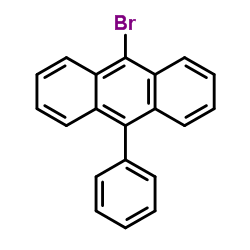
9-Bromo-10-phenylanthracene
- CAS No.23674-20-6
- GradeIndustrial / Pharmaceutical
- Availability● In Stock
High-purity 9-Bromo-10-phenylanthracene (CAS 23674-20-6), a key intermediate for OLED material synthesis with ≥99.0% assay.
Request Bulk PricingProduct Technical Details
Product Overview
9-Bromo-10-phenylanthracene is a high-value aromatic halogenated compound widely employed as a critical building block in the synthesis of advanced organic electronic materials. With a molecular formula of C20H13Br and a molecular weight of 333.22 g/mol, this compound features a rigid anthracene core substituted with both bromine and phenyl groups at strategic positions, enabling efficient cross-coupling reactions in modern optoelectronic applications.
Specifications
| Molecular Formula | C20H13Br |
|---|---|
| Molecular Weight | 333.221 g/mol |
| Density | 1.393 g/cm³ |
| Melting Point | 154–155°C |
| Boiling Point | 449.7°C |
| Flash Point | 221.3°C |
| Refractive Index | 1.717 |
| Appearance | Slight yellow powder |
| Assay | ≥99.0% |
| Moisture | ≤0.5% |
| Total Impurities | ≤1.0% |
Industrial Applications
This compound serves primarily as a specialized intermediate in the production of organic light-emitting diode (OLED) materials. Its bromine functionality allows for precise palladium-catalyzed coupling reactions—such as Suzuki or Buchwald-Hartwig aminations—to construct complex emissive or charge-transport layers in next-generation display and lighting technologies. Due to its structural rigidity and tunable electronic properties, 9-Bromo-10-phenylanthracene is instrumental in developing high-efficiency blue emitters and host materials.
Key advantages for industrial users include:
- High chemical purity ensuring consistent reaction yields
- Excellent thermal stability suitable for vacuum deposition processes
- Reliable batch-to-batch reproducibility under GMP-aligned manufacturing
Stored in a cool, well-ventilated area away from direct sunlight, the product is typically packed in 25 kg fiber drums but can be customized per client specifications. As a non-controlled, non-hazardous intermediate under standard regulatory frameworks, it supports compliant, large-scale production of advanced optoelectronic components worldwide.