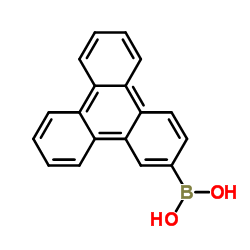
Triphenylen-2-ylboronic Acid
- CAS No.654664-63-8
- GradeIndustrial / Pharmaceutical
- Availability● In Stock
High-purity Triphenylen-2-ylboronic Acid (CAS 654664-63-8) designed for advanced OLED material synthesis. Available in bulk quantities with strict quality control.
Request Bulk PricingProduct Technical Details
Product Overview
Triphenylen-2-ylboronic Acid is a sophisticated organoboron compound extensively utilized in the synthesis of advanced organic electronic materials. As a critical building block, this chemical features a robust triphenylene core coupled with a reactive boronic acid functional group. This unique structural configuration enables precise cross-coupling reactions, making it indispensable for researchers and manufacturers focused on high-performance optoelectronic devices. Our facility produces this intermediate under stringent quality protocols to ensure consistency across large-scale production batches.
Chemical Properties and Specifications
The molecular integrity of Triphenylen-2-ylboronic Acid is paramount for downstream application success. With a molecular formula of C18H13BO2 and a molecular weight of 272.11 g/mol, this compound exhibits excellent stability under recommended storage conditions. The high assay level guarantees minimal impurity interference during sensitive synthesis processes. Below are the detailed technical specifications for our standard grade product.
| Parameter | Specification |
|---|---|
| CAS Number | 654664-63-8 |
| Molecular Formula | C18H13BO2 |
| Molecular Weight | 272.11 g/mol |
| Appearance | White powder |
| Assay | ≥99.0% |
| Refractive Index | 1.762 |
| Packaging | 25 kg/drum |
Industrial Applications
This boronic acid derivative serves as a pivotal precursor in the fabrication of Organic Light-Emitting Diodes (OLEDs). Its primary function involves participating in Suzuki-Miyaura cross-coupling reactions to construct complex conjugated systems required for hole transport layers and emissive materials. The triphenylene moiety provides excellent thermal stability and charge transport properties, which are essential for extending the operational lifespan of display panels and lighting solutions. Key application areas include:
- Synthesis of OLED host materials
- Development of organic semiconductors
- Production of hole transport layers
- Research in organic photovoltaics
Quality Assurance and Storage
We understand that purity directly impacts device efficiency. Therefore, every batch undergoes rigorous analytical testing, including HPLC and NMR spectroscopy, to verify structural integrity and purity levels. A Certificate of Analysis (COA) is provided with every shipment to document compliance with specified standards. To maintain optimal quality, store the product in a cool, ventilated area away from direct sunlight and moisture. Proper handling ensures the reactivity of the boronic acid group remains intact for subsequent synthetic steps. Our global logistics network ensures timely delivery while maintaining product integrity during transit.