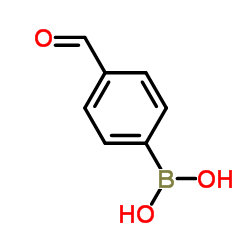
4-Formylphenylboronic Acid
- CAS No.87199-17-5
- GradeIndustrial / Pharmaceutical
- Availability● In Stock
High-purity 4-Formylphenylboronic acid (CAS 87199-17-5), a key boronic acid derivative used as an intermediate in the synthesis of advanced pharmaceutical APIs.
Request Bulk PricingProduct Technical Details
Product Overview
4-Formylphenylboronic acid is a high-value aromatic boronic acid derivative widely employed in modern organic synthesis, particularly in cross-coupling reactions such as Suzuki-Miyaura transformations. With its dual functional groups—a formyl moiety and a boronic acid—this compound serves as a versatile building block for constructing complex molecular architectures in medicinal chemistry and drug development.
Specifications
| Molecular Formula | C₇H₇BO₃ |
|---|---|
| Molecular Weight | 149.94 g/mol |
| CAS Number | 87199-17-5 |
| Appearance | White to light yellow crystal powder |
| Assay | ≥98.0% |
| Water Content | ≤0.50% |
| Melting Point | 237–242 °C (lit.) |
| Density | 1.244 g/cm³ |
| Boiling Point | 347.584 °C at 760 mmHg |
| Flash Point | 164.013 °C |
| UN Number | UN1759 |
| Transport Hazard Class | Class 8 (Corrosive) |
| Packing Group | III |
Industrial Applications
This compound is primarily utilized as a critical synthetic intermediate in the production of high-complexity active pharmaceutical ingredients (APIs). Notably, it plays a pivotal role in the multi-step synthesis of antiviral and oncology therapeutics, including intermediates for Atazanavir (an HIV protease inhibitor) and Rucaparib (a PARP inhibitor used in cancer treatment). Its aldehyde functionality enables further derivatization through reductive amination, Wittig reactions, or condensation pathways, while the boronic acid group facilitates palladium-catalyzed C–C bond formation under mild conditions.
- Enables efficient construction of biaryl and heterobiaryl scaffolds
- Compatible with diverse protecting group strategies in multi-step syntheses
- Supplied in industrial-grade purity suitable for GMP-compliant processes
Handling and Storage
Store in a cool, dry, and well-ventilated area. Keep container tightly closed to prevent moisture absorption and degradation. Due to its classification as a corrosive solid (UN1759, Class 8), appropriate personal protective equipment (PPE) and handling protocols must be observed during industrial use. Standard packaging is 25 kg per drum, with custom configurations available upon request.