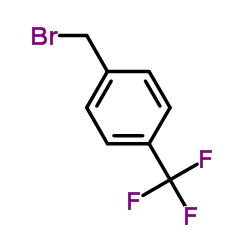
4-(Trifluoromethyl)benzyl Bromide
- CAS No.402-49-3
- GradeIndustrial / Pharmaceutical
- Availability● In Stock
High-purity 4-(Trifluoromethyl)benzyl bromide (CAS 402-49-3), a versatile fluorinated building block for advanced organic synthesis and pharmaceutical intermediates.
Request Bulk PricingProduct Technical Details
Product Overview
4-(Trifluoromethyl)benzyl bromide is a high-value fluorinated aromatic halide widely employed as a key intermediate in modern organic synthesis. With its reactive benzylic bromide functionality and electron-withdrawing trifluoromethyl group, this compound serves as an essential reagent in the construction of complex molecular architectures, particularly in agrochemical, pharmaceutical, and specialty materials research.
Specifications
| Molecular Formula | C8H6BrF3 |
|---|---|
| Molecular Weight | 239.03 g/mol |
| CAS Number | 402-49-3 |
| Appearance | White to light yellow low melting solid |
| Purity (GC) | ≥99.0% |
| Density | 1.546 g/cm³ |
| Melting Point | 29–33 °C |
| Boiling Point | 65–69 °C |
| Refractive Index | 1.484 |
| Flash Point | 192 °F (89 °C) |
Industrial Applications
This fluorinated benzyl halide is primarily utilized as a synthetic intermediate in multi-step organic transformations. Its applications include:
- Serving as an alkylating agent in nucleophilic substitution reactions to introduce the 4-(trifluoromethyl)benzyl moiety into target molecules.
- Participating in cross-coupling reactions (e.g., Suzuki, Negishi) after conversion to organometallic reagents.
- Facilitating the synthesis of active pharmaceutical ingredients (APIs) and bioactive compounds where metabolic stability and lipophilicity are enhanced by the CF3 group.
- Acting as a precursor in the development of liquid crystals, electronic materials, and high-performance polymers.
Stored in a cool, well-ventilated area away from moisture and strong bases, 4-(trifluoromethyl)benzyl bromide is typically supplied in 25 kg drums or customized packaging to meet industrial-scale requirements. As a non-terminal, non-formulation chemical, it is classified strictly as a synthesis intermediate under global regulatory frameworks.