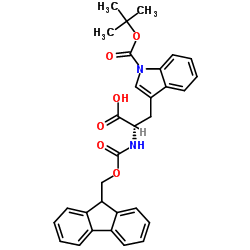
Fmoc-L-Trp(Boc)-OH
- CAS No.143824-78-6
- GradeIndustrial / Pharmaceutical
- Availability● In Stock
High-purity Fmoc-L-Trp(Boc)-OH (CAS 143824-78-6) is a critical protected tryptophan derivative for solid-phase peptide synthesis, ensuring regioselective protection and excellent coupling efficiency.
Request Bulk PricingProduct Technical Details
Product Overview
Fmoc-L-Trp(Boc)-OH, chemically designated as (2S)-2-(9H-fluoren-9-ylmethoxycarbonylamino)-3-[1-[(2-methylpropan-2-yl)oxycarbonyl]indol-3-yl]propanoic acid, is a dual-protected L-tryptophan derivative widely employed in advanced peptide synthesis. This building block features orthogonal protection: the α-amino group is safeguarded by the base-labile 9-fluorenylmethoxycarbonyl (Fmoc) moiety, while the indole nitrogen is protected with an acid-labile tert-butoxycarbonyl (Boc) group. This strategic design enables precise, stepwise elongation in solid-phase peptide synthesis (SPPS) without side reactions at the sensitive indole ring.
Specifications
| Molecular Formula | C31H30N2O6 |
|---|---|
| Molecular Weight | 526.58 g/mol |
| CAS Number | 143824-78-6 |
| Appearance | White to Off-white crystalline powder |
| Purity (HPLC) | ≥99.0% |
| Optical Rotation | -19.0° ± 2.0° (c=1, DMF) |
| Moisture Content | ≤0.50% |
| Melting Point | 86–90°C |
| Solubility | Freely soluble in DMF, DMSO; sparingly soluble in water |
Industrial Applications
As a specialized amino acid building block, Fmoc-L-Trp(Boc)-OH is indispensable in the synthesis of complex therapeutic peptides containing tryptophan residues. Its primary use lies in research and GMP-compliant manufacturing of peptide-based pharmaceuticals, where indole protection prevents alkylation or oxidation during chain assembly. Key application areas include:
- Solid-phase synthesis of bioactive peptides for oncology and endocrinology research
- Production of peptide APIs requiring high enantiomeric fidelity
- Development of peptide libraries for drug discovery screening
- Custom synthesis of modified tryptophan-containing sequences
Stored at 2–8°C in a tightly sealed container under dry, inert conditions, this reagent maintains stability and performance over extended periods. Rigorous quality control ensures compliance with international pharmacopeial standards for residual solvents, impurities, and enantiomeric excess.